


138. Culinary Crops
Description
This section is from the book "The Villa Gardener", by J. C. Loudon. Also available from Amazon: The Villa Gardener.
138. Culinary Crops
The space left for these, in a back garden of the size shown in figs. 34. and 35., and laid out in the manner we have described, with flagstone walks, will be but small; being merely a bed about 12 ft. wide by 76 ft. long. To mate the most of this plot, it must be divided into smaller . beds, say fifteen, each 4 ft. wide, with 1 ft. alleys between, as shown in the figure; and that, at the lower end, as nearest the entrance through the trellis, may contain the perennial potherbs, such as chives, garlic, sage, marjoram, winter savory, thyme, fennel, tarragon, burnet, and mint, the last three being the most useful (tarragon for vinegar, and for flavouring salads and steaks; burnet, at all seasons, for salads; and mint for boiling with peas, and for sauce to lamb, etc.) Annual and biennial herbs, as parsley, chervil, and pot marjoram, may occupy an adjoining bed, double space being required for them; because, while one crop is in use, another must be sown to succeed it For a very small family, not particular in their cookery, one bed, 12 ft. in length and 4 ft. in breadth, will be quite sufficient for the whole of these herbs, perennial, annual, and biennial.
The remaining part of the plot allotted to kitchen crops may be occupied by those vegetables which it is always convenient to have at hand; and by such as never can be so well procured at market, or from the greengrocer, as direct from the garden. Among these lettuce may be included, as always convenient for making a salad, and we would therefore devote the beds 2 and 3 to a succession of this vegetable; bed 4 is for small and other salading, such as mustard and cress, radishes, lamb's lettuce, American cress, etc.; in beds 5 and 6 we would sow winter spinach, which, if the Flanders kind be chosen, will afford a dish now and then throughout the winter, and in spring twice or thrice a week, from April to August; beds 7 and 8 may be planted with scarlet runners, two rows lengthwise in a bed, and these will afford a small dish of kidneybeans every other day, from June till they are destroyed by frost; and beds 9 to 15 may be devoted to peas, that being a vegetable never to be obtained good, except direct from the garden; because, in a few hours after peas are gathered and put in baskets or sacks, they begin to heat and ferment, and when dressed they will be found to have become tough and vapid.
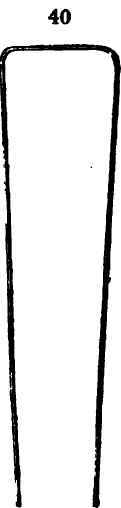
The most suitable sorts of peas for a very small garden are the blue Prussian, Knight's marrow, and the dwarf marrow; because these have the seeds, or peas, large. The frame and the Charlton are early varieties, but both the seeds and the pods are small, and the peas are neither so succulent nor so sweet when cooked as the kinds before mentioned. Whatever kind of pea is sown ought to be staked as soon as the tendrils appear; because, in this way, the plants occupy less room. The kind of staking or supports proper for peas in a small garden is, a line of rods on each side of each line of peas, and at about 3 in. distant from them, with pieces of string stretched horizontally from rod to rod, so as to leave a clear space between the line of rods 6 in. wide, in which the peas will grow up, and support themselves by clasping the strings and rods. The rods may be from 3 ft. to 5 ft. apart, and from 3 ft. to 4 ft. in height; the first string may be 18 in. from the ground, and the others 9 in. apart. The rods, if Kyanised before being used, will last several years; or light iron rods, formed by bending quarter-inch iron rods in the form of a hair pin, as shown in fig. 40., and which will not cost above 2s. a dozen, may be used.
There ate wire hurdles sold for the same purpose, and also iron stakes, but both are much more expensive, though not more efficient, than the light iron rod we have mentioned.
Continue to:


My Books

