


195. The Italian Terrace And The Green-House
Description
This section is from the book "The Villa Gardener", by J. C. Loudon. Also available from Amazon: The Villa Gardener.
195. The Italian Terrace And The Green-House
For ornamenting these in summer, we would cultivate, in a green-house or orangery in the reserve garden, some orange trees, oleanders, pomegranates, olives, myrtles, and jasmines, in large pots or boxes, to place on the terrace and in the greenhouse about the middle of May. For training against the walls of the terrace in the autumn, we would recommend a collection of chrysanthemums to be kept in pots in the reserve ground till the beginning or middle of August, when they may be brought out, and the more delicate and late-flowering kinds placed against the walls of the house within the terrace, and the other kinds placed against the walls all round the house; some of the moat select being arranged in the plant lobby. The kinds may either be chosen from the old Chinese varieties, of which there are above thirty in cultivation in the nurseries, or from the new British varieties, which have been raised from seed in Jersey and other places.
196. The back garden may either be wholly or in part under turf, and varied by trees and shrubs planted for picturesque effect, as in the front garden; or, it may be in part laid out in beds for culinary vegetables, as in fig. 34., p. 71. The walls should, we think, either be covered with ivy, or with evergreen and deciduous shrubs, and especially the flowering and odoriferous kinds. Among these, and also among the trees and shrubs planted in the front garden, may be some dwarf and standard fruit trees, of the more hardy free-bearing kinds; such as the Hawthornden apple, the glout morceau pear, the Orleans and magnum bonum plums, the morello cherry, the green gage and Warrington gooseberries, Wihnot's red currant, the champagne or striped currant, the Dutch white currant, the Naples black currant, and the cane and Antwerp raspberries. Even if there are no beds for culinary crops, there may still be a few circular beds, distributed in open places, for a few strawberries of different kinds; or the strawberries may be grown on a cone of earth faced on every side with bricks, flints, or atones, the strawberries being placed in the joints between them.
By such an arrangement, the strawberries are obtained a week or a fortnight earlier than they would be on flat beds, particularly on the south side of the cone. The advantages of this mode of growing strawberries are, that the fruit may be gathered without stooping; it is certain of being always clean; and, if water be supplied liberally during the flowering and swelling seasons, it will attain a large size. The alpine, or common wood strawberry, treated in this manner, and supplied with water (which can be done by pouring it into an opening made on purpose in the apex of the cone), will continue in bearing all the summer.
197. The reserve garden should contain a house 10 or 12 feet high, to preserve the myrtle, olive, and orange trees from frost during the winter. This house, provided that no plants are kept in it hut evergreens, which, like those above-mentioned, make their young wood during the summer, need not have a glass roof, but only a glass front; in consequence of which the frost will he very easily excluded by a very little fire heat. The chrysanthemums and other plants may be kept in a pit without flues.
198. Remarks
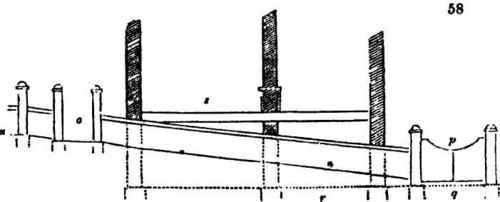
Should it be wished to have a coach-house and stables, they might be formed near the kitchen entrance at c, the stable being on a level with the sunk area and the coach-house over it. The' idea of having the stable under the coach-house is not one likely to be familiar to the general reader; nevertheless, there is a detached house in Porchester Terrace, where, from the declivity of the surface being in the direction of the road, the line of frontage is several feet lower at one end than it is at the other; and at this lower end an entrance is made to the stable and coach-house, which, by excavating the ground a little, are obtained under the principal floor of the house. To render this arrangement more clear to the reader, we refer to the longitudinal section (fig. 58.), in which the line n n shows the declivity of the street; o, the principal entrance which is at one end; p, the entrance to the stables and the garden, which is at the opposite end; q, lines showing the depth to which the ground is excavated opposite the doors of the stable and coachhouse, and to which there is a gradual slope from the street entrance; r, dotted lines, showing the level of the floor of the coach-house and stables; and s, the level of the principal floor of the house.
Continue to:


My Books

