


460. Gatee
Description
This section is from the book "The Villa Gardener", by J. C. Loudon. Also available from Amazon: The Villa Gardener.
460. Gatee
Whether a gate ought to be of open work that may be seen through, or of close boards so as to obstruct the view, is a question that has reference chiefly to places in the immediate vicinity of towns. In all country residences, there can be no objection to the gates being of open work; and there is an advantage to the public in their being so, as it enables the passing stranger to form some idea of the place, and also tends to ornament the country. On the other hand, it seems equally clear that the gates of most small places near towns ought to be close; because one great object of every country residence is privacy, and, in a small place, without close gates, privacy is impossible. At the same time, in residences near towns, where the house forms part of a street or row, and where the entrance door is only a few yards from the road, an open gate allows the servants to see any person who may-ring, either from the entrance door or the kitchen window; and thus enables them to avoid losing their time by going to open the gate for beggars and other intruders.
In similar situations, it is often convenient, when there are close gates, to have a small grating, with a slide within, in order to permit the servant to speak to any person calling at the gate before opening it A door is also sometimes made in the carriage gate, to facilitate the ingress and egress of persons without opening the entire gate. Close gates may, also, be sometimes desirable in point of effect, even where they are not required to insure privacy. Wherever there is any very striking object within the grounds, which can be seen from the entrance gate to better advantage than it can be from any other situation, then we should say that a close gate was desirable; in order that the effect of the object alluded to might not be marred to a stranger, by his seeing it imperfectly before he entered the grounds, and tints getting his first impression of it disfigured by the bars of the open gate. At Blenheim, a more striking view of the lake and bridge than is to be obtained in any other part of the grounds, bursts upon the eye of the stranger, when the close gates at Woodstock are thrown open; but if open bars were substituted for these heavy doors, the spectator would see the lake and bridge first through them, and the striking effect, which now produces a strong emotion of admiration and astonishment, would be frittered away.
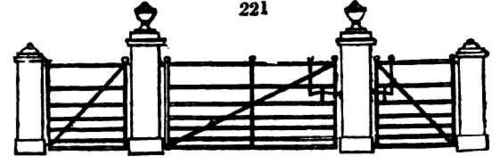
461. The style of the entrance gates ought to be as much attended to as that of the lodge. They ought neither to be so plain as to resemble common field gates (see fig, 221), nor so covered with ornament as to be disproportionate to the style of the house (see fig, 222). Whatever style is employed in the house and lodge, the lines, forms, and ornaments of that style ought alone to be employed in the gates. In the case of houses in the Elizabethan, or in the Gothic style, this would give rise to many rich and beautiful designs; very different, indeed, from those cast and wrought iron pattens manufactured by wholesale, and set up without the slightest regard to the style of the lodge or house to which they belong; but which, from their cheapness, are now so very generally adopted by country gentlemen. The sight of these gates, at the entrance to a place, forbids all idea of taste pervading the interior of the grounds. The great point for an artist or an amateur to bear in mind is, the difference between a gate which is merely to serve as the moveable part of a fence, for the purpose of allowing persons and things to pass from one side of the fence to the other, and a gate which is to serve as a portal to a human residence.
The humblest cottage, if this idea were borne in mind, would be approached through a gate superior in style of design to the gate or door into the adjoining field; while, at the same time, it would be inferior to the gate of a farm-house. We shall now give two or three designs for entrance lodges and gates, referring those of our readers who may wish to know more on the subject to our Encyclopaedia of Cottage, Farm, and Villa Architecture, p. 997, to p. 1006. 462. Parker's setf-acting gate, fig. 223, opens apparently by its own volition, and closes again after the carriage has passed through, without any apparent cause. The effect is produced by small plates let into the ground at short distances from the gate, which when the carriage wheels roll over them descend like a weighing-machine, and act upon certain levers concealed in a trench underground. By means of these levers, a toothed wheel is made to revolve, and to turn a toothed pinion affixed to the swinging post or axle of the gate, and thus to throw it open or close it.
Saul's Gate, fig. 224, is contrived to enable the gate-keeper to open it without going out; and the use of it is partly to enable old and infirm people to be appointed gate-keepers, as an easy manner of providing for them; and partly to avoid the risk often incurred by children who are sent to open gates,, being knocked down or injured by the horses, or the wheels of the carriages, In fig. 224, g represents a horizontal shaft placed in a tunnel made across the road directly under the gate, working at one end on the heel of the hanging post by a pinion at h, and the other by a bevelled pinion at i, on the upright shaft k. This shaft has a pinion which works into another at l, on the axle of which is the winch m, which is placed in a convenient situation inside the entrance lodge.


Entrance Lodge, at Chequers, Buckinghamshtre.
Continue to:


My Books

