


463. Entrance Lodges
Description
This section is from the book "The Villa Gardener", by J. C. Loudon. Also available from Amazon: The Villa Gardener.
463. Entrance Lodges
Fig. 225, is a lodge in the old Engisth manner, designed by £. B. Lamb, Esq., and executed at Chequers, in Buckingham-shire, the seat of Sir Robert Frankland Russell, Bart The watts are composed of stone and flints, both found on the spot, the materials being placed alternately, so as to form a chequered surface, in allusion to the ansae of the place. The roof is thatched with Kyanised straw.
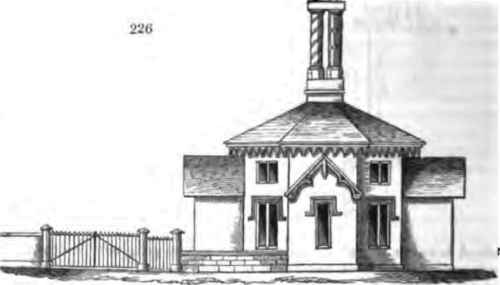
Fig. 226. is the deration, and fig. 228. the plan, (both to a scale of l-l4th of an inch to a foot,) of a Gothic entrance lodge of the smallest size, by
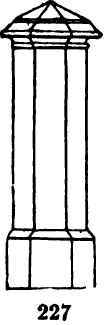
Edward Brigden, Esq., Architect, Bristol. The ground-plan consists of a living-room (fig. 228. a), with a large recess (ft) next the road. The entrance is through the porch c, and d is intended for a scullery; e shows a staircase leading to an octagonal bedroom over the whole. "The most appropriate material," says Mr. Brigden, "for the walls of this cottage, would be flint or ragstone; the latter laid in random courses, and neatly tuck-pointed, has a very good effect. The dressings might be of Yorkshire stone, or any other which would harmonise with the colour of the wall The same stone might be used for the gate piers; or, if magnesian limestone could be obtained in sufficiently large blocks, it would answer the purpose well (it being properly polished). The form of these piers may be as shown in fig, 227. The roof of the lodge may be covered with slate, or with stone tiles. The flues should be conveyed to the centre of the building; and the chimney stacks, which are ornamental, may be of Austin's artificial stone."
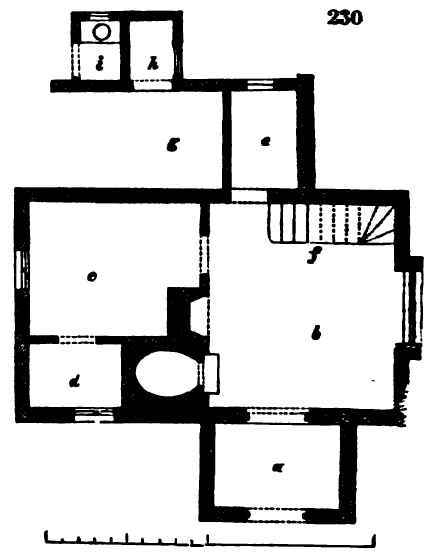
Fig. 229. is the elevation, and fig. 230. the ground plan, of an old English cottage, formed of wooden framing, raised on a cyclopian substructure. This cottage was designed by William Wells, Esq., and is erected on his estate at Redleaf, in Kent The cyclopian walls are " formed of irregular blocks of sandstone, without the slightest indication of horizontal or vertical courses.
The effect, as contrasted with the numerous straight perpendicular lines formed by the atudwork in the upper part of the walls, and with the horizontal lines of the roof, is exceedingly good. The studwork is filled in with brickwork plastered over; the smoothness and finished appearance of which, as contrasted with the rudeness of the cyclopian part, is forcible, and at the same time pleasing. A great beauty in this cottage results from the horizontal division of the upper part of the roof, which projects slightly over the lower part The chimney top is massive and original. The whole was executed by local carpenters and masons, from the sketches of Mr.
Wells, out of the timber and stone produced by the estate. The plan (fig. 230.) shows a porch (a), kitchen (6), parlour (c), light closet (d), pantry (e), and a staircase (f) to two good bed-rooms above, and to a cellar under the parlour below; also an open shed (g) for fuel: i is a water-closet for men, and A one for women and children." The oven in the kitchen is sufficiently large to admit of its being heated with faggots. The roof of the lodge is covered with pantiles; but in America, or any country where wood is cheap, it is, from its high pitch, particularly well adapted for shingles. Where stone is not plentiful, the lower part of the walls may be of brick or mud, on a foundation of masonry.
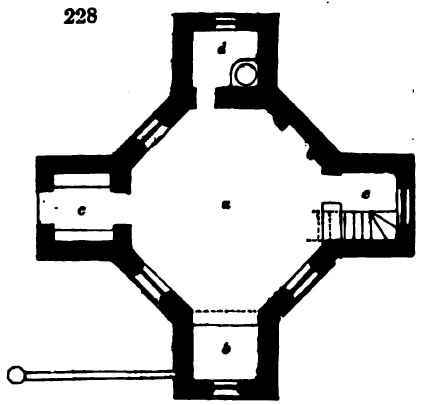

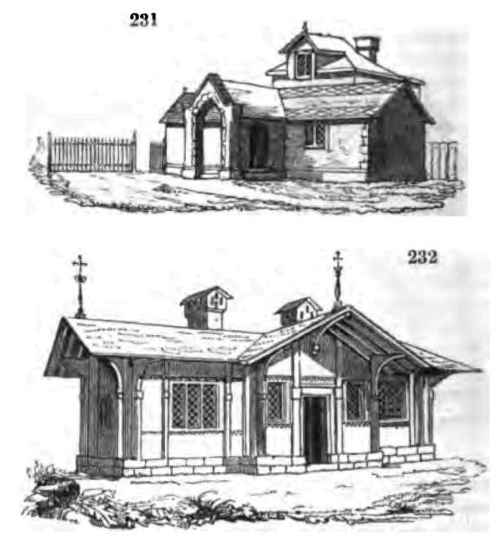
Fig. 231. is a design for a gate lodge in a simpler style, but very well adapted for its purpose.
Fig. 232. is a gate lodge in the Swiss style, which, in a hilly situation, backed by a hanging grove of larch trees, would have a powerful and characteristic effect
The following designs, in the Italian style, are from Hunt's Picturesque
Demotic Architecture; a work which displays great taste in the elevations, but not sufficient attention to comfort and accommodation in the ground plans, These we have altered in the following figures, to supply what we thought was wanting in the originals.
Fig, 233. shows the plan and elevation of what would form a very handsome gate lodge, and serve at the same time as a gardener's house. The porch is seen at b; c and e show an open gallery or veranda, embracing three sides of a schoolroom, which is entered at d, and adjoining which there is the closet f. The kitchen and back kitchen are in the centre of the house, and require no explanation; g and h are the two principal bed-rooms; i is an open gallery; and k a water-closet.
Fig, 234. is a gate lodge, the upper part of which forms a prospect tower. The gate and approach road are supposed to be on the right hand, and the sleeping-rooms to be over the arch (under which there is a seat), and in the lower tower. Such a lodge is perhaps suitable for an entrance gate on an eminence, where it may be seen from a great part of the surrounding country.
Fig, 236., p. 381, shows two entrance lodges, end the gates between, designed by the late Sir J. Wyatvflle for the entrance from Edensor at Chatsworth.
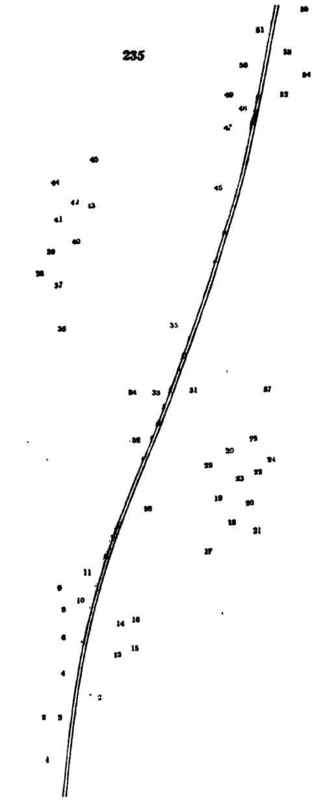
464. The approach from the lodge to the entrance front should display the features of the grounds through which it passes, to the greatest advantage; or, if there be no striking feature worth looking at between the entrance and the house, the road ought to pass through a dense wood or a grove. When it passes through open park-like scenery, trees should be sprinkled along it, in such a manner as to form a kind of running foreground, both to what is before, and to what is on each side; and Mr. Glendinning has shown, in the Gardener's Magazine, a mode of doing this, so as to produce variety, and yet to prevent variety free degenerating into confusion, as is shown in fig. 235, with the list of toes annexed.



465. The first view of the entrance front should, in general, be at an oblique angle, in order that two aides of the building may be seen at once; or, at all events, that so much of two sides may be visible, as to make it evident that the building is a solid mass, and not a mere screen wall. Where the approach is a straight avenue, advancing to the entrance front at right angles with it, a view showing two sides of the house cannot be obtained; and the building must in that case depend, for the effect it produces, on the height or breadth of its elevation, and on the circumstance of its being with or without open porticoes, projecting towers, or wings. There is no fixed distance, at which it is more desirable than at any other, to see the entrance front; but there is one fixed circumstance which especially requires the attention of the artist in laying out and planting the approach. Tins is, that the first view of the entrance front of the house which is obtained within the grounds ought to show it as the leading feature of the landscape, and to be, in fact, the best view of the entrance front that can be anywhere obtained.
Before entering the lodge gates, if the house be seen at all, it has no right to appear otherwise than as a feature among other features of the general scenery of the country; but, within the lodge, the house is the main object of attraction, to which everything else ought to be kept subordinate.
466. In situationt near the sea it is necessary to plant a thick belt, to shelter the gardens from the effects of the sea-breeze; as on the east coast of both England and Scotland the trees are frequently cut in a sloping direction, as shown in fig. 237. The trees that stand best in these situations are the beech, and the pinaster, and the shrubs that bear the sea best are the privet and the tamarisk.

Continue to:


My Books

