


Design XXVII. Plan And Description Of Redleaf, At Penshurst, Near Tonbridge, The Seat Of The Late William Wells, Esq. 384. General Observations
Description
This section is from the book "The Villa Gardener", by J. C. Loudon. Also available from Amazon: The Villa Gardener.
Design XXVII. Plan And Description Of Redleaf, At Penshurst, Near Tonbridge, The Seat Of The Late William Wells, Esq. 384. General Observations
The estate of Redleaf, near Penshurst, lies along the north side and in the bottom of a valley distinguished by the boldness of its undulations, the large proportion of the surface which is under wood and in pasture, the fortunate existence of a fine river, and the cropping out of some rocky strata. The whole surface of this part of the country appears, at no distant period, to have been native forest, or, at all events, under coppice-wood; and hence, in many of the fields, and in all the hedgerows, there are groups of oak trees, aged thorns, maples, and hollies, which give the face of the country the woody appearance of a park. That portion of the estate which Mr. Wells laid out as a residence, occupies a steep undulating bank, facing the south-east, with a deep broad valley at one end, lying in the direction of north and south, and joining the valley of the Eden, a river which afterwards takes the name of the Medway, and joins the Thames at Sheerness.
385. The bold and varied undulations of the grounds at Redleaf, the fortunate disposition of the wood, and especially of the single trees and small groups, left very little for art to do upon a large scale. In some places, a field, or a part of a field, might require to be planted, in order to form, add to, or connect, masses of wood: and, in others, a coppice might require to be thrown into pasture, and added to the park. But nature or accident had everywhere furnished so many trees in groups, that it became altogether unnecessary to plant; and hence there was no necessity for forming those heavy clumps by which so many places in every part of the country are disfigured. Another advantage of Redleaf is, that there is no marked boundary to the property; the mixture of wood, pasture, corn-field, hill, and dale, being so much alike in general feature, in every part of the country, that it is utterly impossible for a stranger to tell where any man's estate begins or ends. Hence, there was no temptation to perpetrate that deformity which so often accompanies the clump, viz. the belt; a most unsocial plantation in a moral point of view, as shutting out all one's neighbours, whether poor or rich,and one which, as it regards pictorial beauty, generally destroys all harmonious connexion of the residence with the surrounding country.
Mr. Wells's operations on the park scenery of Redleaf were therefore comparatively few, and not such as in any degree tended to alter the character of the place. He widened the river in one situation, and altered its direction in another, in order that it might be better seen from the windows of the house (see fig. 185.); he removed hedgerows, and laid down arable lands in pasture, so as to give extent and unity to the park or lawn; he added to or diminished the masses of wood, for the same purpose; and he formed a walk, so as to enable a stranger to make a general circuit of the place. These were the great features of improvement; and they have been executed with so much success, that a stranger, when he arrives at the house, and looks at the views from its windows, is so struck with the beauty and natural appearance of the scenery, that he cannot conceive that anything more is wanting to render the place perfect of its kind. But the most beautiful scenery in the world, whether the work of nature alone, or the result of nature aided by art, will soon cease to please, unless it bears marks of its appropriation to man, or can raise up associations of that kind.
Hence, the tourist, who admires natural scenery in travelling through a beautiful country, endeavours to make it his own, and to let others know that he has done so, either by describing it in words which he can read to his friends, or which he can print, and thus publish to the world (thereby showing that he has as fully enjoyed the beauties of the scenery as if it were his own); or he commits the scenery to paper by a sketch, by which he seems also to appropriate it to himself. The purchaser of a portion of the finest scenery in the world never rests satisfied until he has done something to it; and it is not enough to do something, however great a change that something may have produced, unless it be such as to be recognised by the rest of mankind. It is absolutely necessary that what is done should be discoverable as a work of art and taste. Hence, among purely natural scenery, some work of art must be introduced. Building is the common resource: but even a gravel walk, to show off the natural beauties of the scene, with seats or resting-places formed along it at proper points of view, will suffice.
Admitting this principle to be founded in nature, it was not to be supposed that Mr. Wells, after having improved the general scenery of Redleaf, would rest satisfied with admiring what he had done: on the contrary, having improved the natural beauties of the place, he immediately set about adding to them the beauties of art, by the formation of what may be strictly called garden scenery. Now; the great merit of Mr. Wells as an amateur artist was, that, while he heightened and improved the natural beauties of Redleaf, he had been constantly employed, for nearly thirty years, in creating artificial beauties there, which do not, in the slightest degree, interfere with the great leading natural features of the place. There are very few other proprietors who would not, while improving such a place as Redleaf, have done violence to the natural character of the place, by the evident intrusion of art.
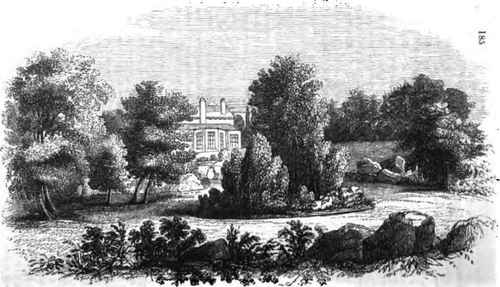
View of the House from a distant part of the Rocky Lawn,
Continue to:


My Books

