


Design XXVI. - Plan And Description Of The 'Grounds At Fairfield Cot, By Mr, Parkins
Description
This section is from the book "The Villa Gardener", by J. C. Loudon. Also available from Amazon: The Villa Gardener.
Design XXVI. - Plan And Description Of The 'Grounds At Fairfield Cot, By Mr, Parkins

a, House.
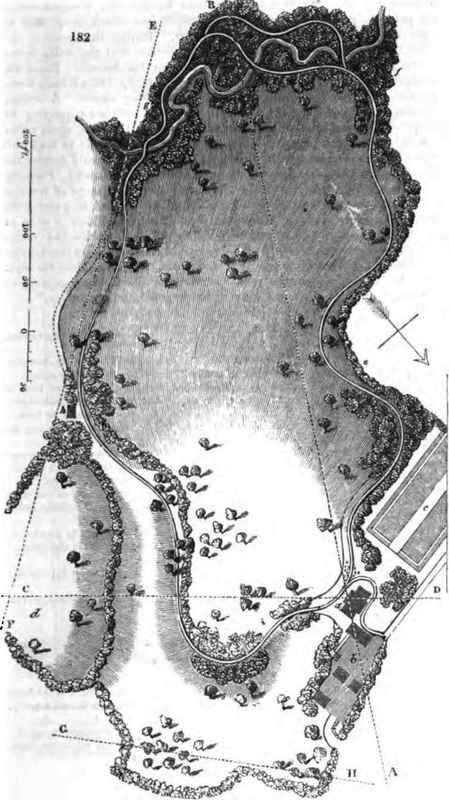
b, Stable, cow-house, piggeries, etc, hidden from the grounds by a plantation, and approached by a road overshadowed with tall trees, c, Kitchen-garden, screened in the same manner. An opening in the shrubbery, however, admits a view down the principal walk, on each side of which the beds are arranged.
d, Orchard. This, from the cottage, has an interesting appearance; it was placed there to hide the extremity, and to confine the eye to a ruined tower, to a river meandering through the vale below, and to distant mountains, seen from the house across the lawn.
e, A seat, composed of rude materials, situated under trees. From this spot is seen an extensive distant country, adorned with water, hanging woods, etc.
f Root-house, built of roots of trees, and thatched; the inside lined with moss. Ivy creeps oyer the door, along with the honeysuckle and Jasmine. A table and two rattle benches constitute its furniture; on the former there is an appropriate inscription. g, A bridge. A few large stones, supporting a plank or two, with a rail on one side, will generally be found sufficient lor such a situation. It accords with simplicity, and is therefore infinitely more attractive than a formal structure, a, Temple of Concord. A small square building, the walls emblematically painted in fresco. From the windows, a most extensive view, particularly of objects in the distance, screened from the house by the orchard. i, A seat in a sequestered situation. On the opposite side of the walk, under cypress and flowering shrubs, an urn, dedicated to Friendship. A B, First sectional line. See fig. 181. C D, Second line. See fig. 163.

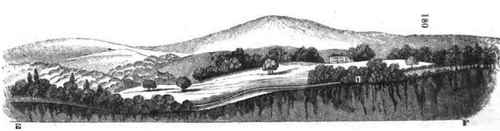
E F, line for first sectional geometrical view, giving the general appearance of the lawn rising to its summit; the woods, the house, Temple of Concord, and distant country.
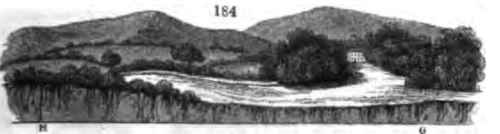
See fig. 180. G H, Line for second sectional geometrical view. In this are shown the cottage surrounded with trees; the lawn; the fence bounding the same; a bend of the serpentine walk, with part of the orchard, and the distant country. See fig, 184.
383. Remarks
The sections and sectional geometrical views in this design would answer exceedingly well for giving a general idea of the effect of improvements; but they would not serve instead of a working plan. Such designs were commonly given, when modern landscape-gardening was in its infancy, by Kent, Brown, Wright, and others, and executed by contract with alterations almost at pleasure, by a contractor under the name of a new ground workman; or sometimes in the ordinary routine, under the direction of the gardener. All the details of execution, and the choice of the trees and shrubs planted, were passed over in the general design of the artist, and left to be supplied according to the taste, knowledge, or means, of the contractor or the gardener. It does not appear that, in the infancy of landscape-gardening, any great value was set upon having a variety of trees and shrubs in plantations; and, accordingly, in the first laid out places in the modern style, with the exception of Pain's Hill, and one or two others, the trees and shrubs are all of the common kind.
At present, however, the taste is decidedly different, and there is a laudable desire on the part of proprietors, and especially on that of the females of their families, to render garden scenery botanically as well as pictorially interesting. The subject of the kinds of trees is scarcely at all mentioned by Mr. Parkins in the description of any one of his designs: he looks on garden scenery entirely with the eye of a painter and a poet, while the modern artist adds to these the eye of the botanist and the cultivator.
Continue to:


My Books

