


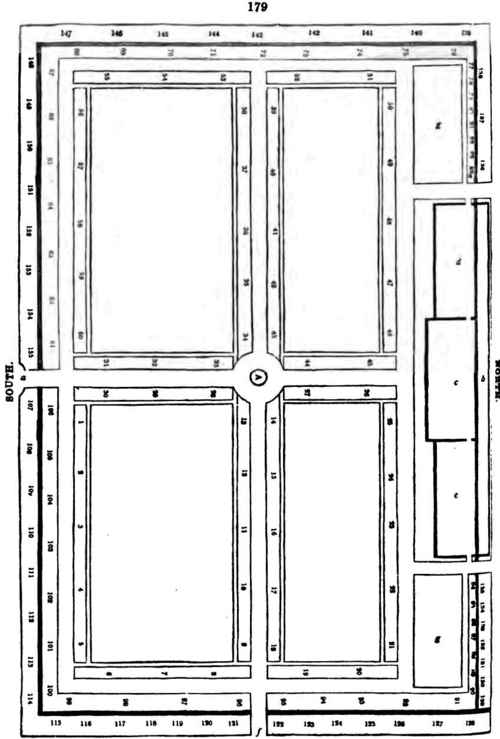
379. The Kitchen-Garden (Fig. 179)
Description
This section is from the book "The Villa Gardener", by J. C. Loudon. Also available from Amazon: The Villa Gardener.
379. The Kitchen-Garden (Fig. 179)
Though the extent of this garden is but small, being only 1 1/2 acres, Mr. Glendinning observes that the accompanying list will show its capacity for containing fruit trees. The borders are proposed to be uncropped, or, at the most, to have only a row of strawberries near the edge of the walk. For the ground lost in this way in the inside of the garden, the space contained in the slip in the outside will be an ample compensation. The apples and pears to be trained on the espalier rails should be worked on quince and paradise stocks.
The following are the references to the plan: a. Tank of pure water.
a. Entrance from the pleasure-ground.
b, Back sheds, fireplaces, coal-bins, working-shed (including a place for making baskets, preparing and painting labels, etc.), potting-shed, mushroom house, and fruit-room, c Fine-stove. d, Vinery. e, Peach-house.
f, Entrance from the frame ground. g g. Departments for early vegetables.
1, Apple, Borovftsky.
2, Dutch mignonne. 3, Ribston pippin.
4, Golden pippin.
5, Summer golden pippin.
6, Pear, Bellisslme d'hiver.
7, Beurre' d'Aremberg.
8, Beurre' d'automne.
9, Beurre de Capiaumont
10, Beurre' Diet
11, Bon Chretien fondant 12, Beurre Easter.
13, Beurre' de Ranz.
14, Beurre' Spence.
15, Catillac
16, Chaptal.
17, Chaumontel.
18, Citron des Cannes.
19, Oolmar, automne. 20, Comte de Lamy. 21, Crassane, Althorp. 22, Crassane, winter.
23, Pear, Delioes d'Hardenpont
24, Doyenne, white.
25, Duchesse d'Angouleme. 26, Famenga.
27, Figue de Naples.
28, Apple, Gloria mundi.
29, Coe's golden drop. 30, Golden Harvey. 31, Hawthornden. 32, Hicks's fancy.
33, Juneating, white. 34, Pear, Flemish beauty.
35, Fondante d'automne.
36, Fondante du bois.
37, Franc real, summer.
38, Gendeseim.
39, Glout morceau.
40, Henri Quatre.
41, Bessel.
42, Incomparable, Hacon's.
43, Sucre vert
44, Marie-Louise.
45, Pear. Monarch, Knight's.
46, Napoleon.
47, Nells, winter.
48, Ne plus meuris.
49, Fasse»Golmar.
50, Rouse Lench.
51, Seckle.
52, St Germain, Uvedale's.
53, Louise bonne (Jersey).
54, Beurre Easter.
55, Beurre de Ranz.
56, Apple, Margaret, early red.
57, Nonpareil, Braddick's.
58, Syke House russet
59, Beinette du Canada.
60, Basset, Boston.
61, 62, 63, Cherry, Morello.
64, Pear, Harie-Looise.
65. Benrre, brown.
66, Gloat morceau.
67, Incomparable. Hacon's.
68, Flam, Morocco.
69, Coe's golden drop.
70, Drap d'or.
71, Cheery, Elton.
72, Downton.
73, Msy duke.
74, Peach, Late admirable.
75, Colonel Ansleys.
76, Nectarine, Murrey.
77, Cherry, Kay duke.
78, Grape-vine, Willmot's muscat.
79, Espexione.
80, Royal muscadine.
81, Faramata cluster.
82, Grove End sweetwater.
83, White cluster.
83 a, Pitmaston white cluster.
84, Fig, Figue blanche.
85, Genoa, large white.
86, Ischia, yellow.
87, Marseilles.
88, Pregussata.
89, Brown Turkey.
90, Apricot, Moor Park.
91, Nectarine, Elruge.
92, Violette hative.
93, Peach, Barrington.
94, Flam, Green gage.
95, Reine Claude violette.
96, Pear, Beurre, Easter.
97, Bearre de Ranz.
98, Gansel's bergamot
99, . Colmar.
100, Plum, Magnum bottom, white.
101, Magnum bonum, red.
102, Apricot, Turkey.
103, Cherry, Griotte de ratafia.
104,105,106, Morello.
107, Peach, Bellegarde.
108, Royal George.
109, Nectarine, Violette native.
110, Apricot, Royal.
111, Hemskirke.
112, Cherry, May duke 113, Elton.
114, Bigarreau Napoleon.
115, Pear, Easter beurre.
116, Beurre de Ranz.
117 to 126, Currants, white and red.
127, Pear, Chaumontel.
128, Passe-Colmer.
129 to 135, Currants, red and white.
136, Plum, Orleans.
137, Washington.
138, Mirabelle.
139,140,141, Green gage.
142,143,144, Apricot, Moor Park.
145,146,147, Cherry, Morello.
148, Plum, Drap d'or.
149, Green gage.
150, Apricot, Bed masculine.
151, Royal.
152, Nectarine, Hunt's Fanny.
153, Elruge.
154, Peach, Noblesse.
155, Grosse mignonne.
380. Remarks
This design is very valuable on account of the list of trees with which it is accompanied, and the indications by figures in the plan of the kitchen-garden (fig. 179.), and in that of the shrubbery (fig. 178.), of the situations in which they are to be planted. All the fruit trees enumerated in the former list have been fruited by Mr. Glendinning, and he can therefore speak confidently of their merits. The arrangements immediately connected with the kitchen-garden, such as the melon-ground, etc, seem also very good; and those for saving all the liquid manure, excellent. Considering that the surface of the ground is nearly flat, or, at all events, that the difference of level between the highest and the lowest points is not more than 30 or 40 feet, and that the whole is surrounded by a belt of Lucombe oaks, which will completely exclude all exterior view, this residence will depend for its interest entirely on its interior beauties; and hence the propriety of introducing as great a variety of trees and shrubs as can be grown in the gardeneaque manner in so limited a spot.
The close plantations near the house, it will be observed, are planted thick in the picturesque style, which will serve by contrast to set off the gardeneaque plantations to advantage. ,
381. General Observations
This design is taken from a work entitled Six Designs for Laying out Grounds, published by Mr. Parkins in 1793. The situation is secluded, and there are only five acres of pasture land. The house is erected on the upper part of a gently rising ascent, commanding the "most luxuriant views of hill, dale, wood, and water" The offices and the kitchen garden are concealed by a shrubbery.
382. Description, Etc
The following description is given in Mr. Perkins's own words: "The orchard, placed at an extremity, gives variety, and hides the bounds, where otherwise they would, by being seen, defeat the deception of extent; and likewise confines the view, which, but for such management, would be considerably too extensive. The remainder of the ground is again subdivided by a hedge, decked with roses, honeysuckles, and other wild shrubs, and irregularly planted, partly to allow the walk to take an easy bend betwixt the two inclosures, and partly to give internal variety; a circumstance which never fails to cheer the imagination, and relieve the eye. Having thus noticed the general disposition, it will be necessary to observe, that the walk, in no> instance, has been suffered to approach too near the bounds. From the shrubbery, after passing a seat under a few trees (e,fig. 182.), it leads down the side of the hill to a copse overhanging a purling stream. A bridge, adjoining to a root-house (f), crosses the rill, the path accompanying its meandering course, till a rustic plank (g), thrown over the same, again unites it with the lawn.
Everything here is simple and unadorned: to load with ornament a scene dedicated to contemplation and repose, would destroy the effect which a sequestered situation ever has upon a congenial mind. Pursuing the walk, a sunk fence on the right admits the country. Clumps of trees in the adjacent pastures unite it with the distance. A little gate, on gaining the summit, leads to the temple of Concord (A). From the window is seen to peculiar advantage the view, purposely hid by the orchard from the house. This circumstance renders the temple much more interesting than it otherwise would be, and increases the variety of the whole. From this place the walk waves to the left. Entering a small shrubbery, with a seat in a sequestered situation (i), it soon opens on the green, and terminates at the cottage."
Continue to:


My Books

