


468. The Lawn
Description
This section is from the book "The Villa Gardener", by J. C. Loudon. Also available from Amazon: The Villa Gardener.
468. The Lawn
As circumstances which seldom fail of producing beauty in the view, we may mention extreme smoothness and high polish in the lawn, the branches of the trees and shrubs being allowed to recline on the ground, which shows that no cattle are introduced there; extent in every direction, but more particularly in the front, which prevents the idea occurring of confinement and limited property; irregularity in the boundary to the lawn, produced by scattered trees and bushes, creating variety and intricacy, which detain the eye and excite the imagination; and an architectural foreground, immediately below the windows of the house, which serves to connect and harmonise it with the grounds. We do not here mention the flower-garden, which is often placed on the lawn front of the house, because it may be sometimes desirable to have one in that situation and sometimes not; but the above requisites can seldom be dispensed with. One of the most common faults in the view from the drawing-room front of the house is, want of breadth in the foreground, (see fig, 238.) This commonly arises from too many objects being placed there; from these being too uniformly distributed over the whole; or from a clump, a walk, a pond, a tree, or some other object being placed exactly in the middle.
A second fault, very commonly met with is, want of proportion between the foreground and the distance. Perhaps the foreground may be covered immediately in front of the windows with beds of flowers or of shrubs, which may occupy too large a space, or which may have grown so high as to shut out great part of the middle distance; or, in contradistinction to this, there may be no effective object in the foreground at all, when of course it will be overwhelmed by the large proportion of the view occupied by the distant scenery.
By effective object we mean the architectural appendages of the house, flower-beds, shrubs, or any other objects which rise up from the surface, and produce shade; which, as every one who has ever drawn a landscape on paper knows, is essentially necessary to a foreground; and hence, when artists have nothing in nature which they can copy into the foreground, they introduce the shadows of supposed clouds, or other objects, or human figures or animals, as in the view shown in fig, 239.: which view, without the horsemen and their dogs, would be nothing; while with them it is an absurdity, as the walk in the foreground, on which the horsemen are, is that on the lawn front of Wimbledon House, and is never used but for foot-passengers.
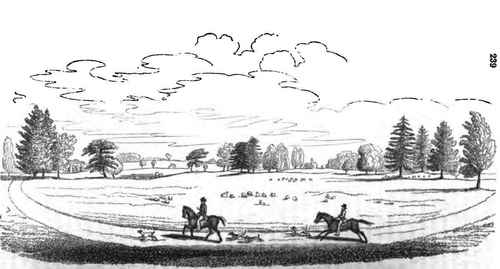
View from the Lawn Front of Wimbisdon House.
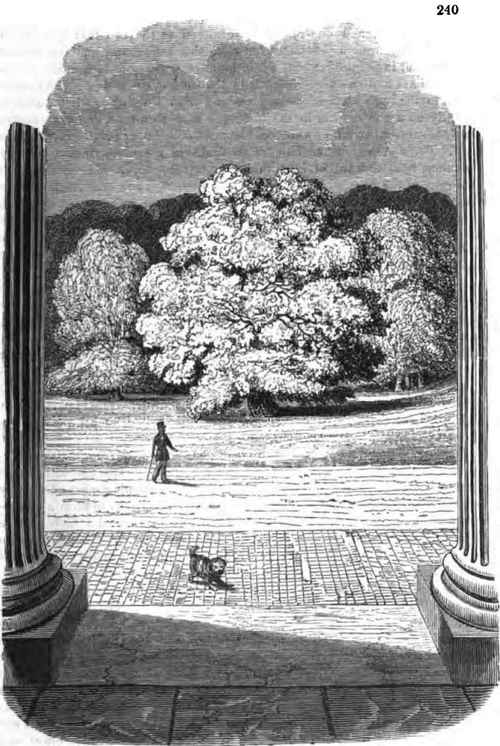
View from the Entrance Portico of Kenwood.
In fig. 240., which is a view from the entrance portico of the mansion at Kenwood, by E. B. Lamb, Esq., the figure is introduced with more propriety; as it is in the proper walk, and does not attract too much attention from the noble oak-trees in the back ground.
A third fault, and one almost as common as the two that hare been mentioned, is, want of harmony between the foreground and the distant scenery; not in point of extent, but in point of style, or of ornament. Thus we sometimes find an extensive lawn in the front of the house, which is continued in the same style of smoothness and high keeping till it terminates abruptly on a common, or in the hedgerow of a corn-field, or an extensive wood, or some other uniform surface or mass of similar or greater extent than itself. Perhaps the most common of all faults in the views from a country residence, next to want of breadth in the foreground, is, the monotony or deformity of the lines and shapes produced by hedgerows and plantations in the middle or third distance. When these faults are in the grounds of an adjoining proprietor, they of course may be considered as beyond the reach of correction; but in this case they are frequently at such a distance from the eye as to be inconspicuous, or to admit of being somewhat disguised by a few trees in the foreground. There are certain faults of this kind peculiar to every style of country. In some parts of Middlesex we have a monotony of hedges and pollard trees, with a total absence of ploughed fields.
In some parts of Kent we have ploughed fields, with a total absence of pasture; and, in many parts of the lowlands of Scotland, we have the beautiful slopes of the hills cut across by stone walls, hedges, or belts of plantation, thus abruptly separating the arable plains from the hill pasture. To overcome or to mitigate difficulties of this kind, is one of the most common purposes for which a landscape-gardener is employed; and, as our friend Mr. Nesfield particularly excels in this department of his profession, we shall, with his permission, give an example which recently occurred in his practice.
Fig. 241. shows the outline of a range of distant scenery, from the drawing-room front of a suburban residence near Stafford. On the hill which forms the distance, there is a long belt or plantation, running most offensively parallel to its ridge; and swelled out in the middle, so as to form a clumplike protuberance there. This clump was made to conceal a high broken bank of rock, which was considered by the planter, or his employer, as an object that ought to be shut out; probably, because it was neither productive of grass or trees: for persons who have no idea of the enjoyments of taste, can see no beauty in anything that is not applicable to common purposes of utility. This plantation is shown surrounded by a thorn hedge, which, having been long left uncut, has attained a great height, and thereby renders the outline of the plantations as conspicuous and hard as possible. The outline at p indicates the slope of the hill descending from the back of the belt; and the line at w shows a portion of a more distant ridge, which, it is proposed, partially to plant; in order, by the contrast of the trees with the line of the implanted ground at p, to render the ridge more conspicuous to the eye.
By planting this distant ridge, a mass will be produced, which will appear to retire behind the belt, and thus increase the perspective effect, and raise in the imagination the idea of this plantation extending beyond the other, and even down the other side of the ridge. At y are high and very conspicuous thorn hedges. At z z are single thorn trees, which were part of some hedge-row lines that marked the outlines of former fields; which, by taking out some, and adding others, may be thrown into ornamental groups.
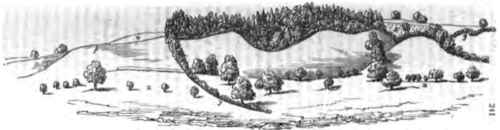
Distant Scenery near Stafford, p, Slope of hill, descending from the back of the bolt w, Portion of a more distant ridge. y y, Thorn hedgea. z z, Single thorn trees.
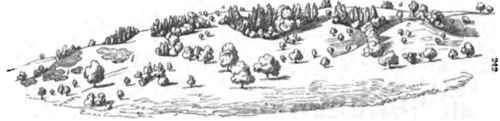
Same View as proposed to be altered. a Steep rooky bank. b Patches of furze, c, Conical hill, riling in front of the more distant ridge d.
Fig. 242. shows the same view as proposed to be altered. In this view, a shows the steep rocky bank as it will appear when the trees are cut away; b, patches of furze, left for the encouragement of game, at the request of the proprietor; c, a conical hill rising in front of the more distant ridge d. As in this scene, as it actually exists, there are numerous trees of transplantable size, of thorns, horsechestnuts, limes, elms, and sycamores, all very favourably circumstanced for removal, most of the additional outstanding trees in groups, shown in. 241., may be transplanted from one part of the grounds to another, so as to produce immediate effect at comparatively little expense.
Continue to:


My Books

