


387. Flower-Garden
Description
This section is from the book "The Villa Gardener", by J. C. Loudon. Also available from Amazon: The Villa Gardener.
387. Flower-Garden
We must confess that it is sometimes a matter of difficulty to determine when a flower-garden should be laid out immediately in front of a house, so as to form a foreground to the distant scenery, and when it ought to be concealed or disguised. In general, this must be determined from the natural expression of the situation, and the views. When these are of a decidedly marked character, and make a strong and elevatmg impression on the mind, the introduction of a flower-garden in the foreground will interfere with this impression, and ought therefore to be avoided, or introduced in such a manner as to be altogether subordinate to the natural features; but, on the other hand, when these features are bad or tame, and comparatively uninteresting, a flower-garden judiciously introduced will create an interest which was naturally wanting. For example, when the foreground is a flat or even surface, with little to vary it except trees and shrubs, and when there is no strongly marked feature in the middle distance, then beds of flowers, and flowering shrubs, form a valuable resource, and may render a naturally dull place gay and interesting.
This is very well exemplified at Chevening near Sevenoaks, the seat of Earl Stanhope, where the foreground on the lawn front it an extensive flower-garden on an even surface, with a considerable piece of water bordered by lawn and trees in the middle distance; and where the background is scenery of the same description, without the appearance of hills, or any marked feature, natural or artificial. At East-well Park in Kent, the seat of the Earl of Winchelsea, where the whole of the surface seen from the lawn front is flat and uninteresting, an extensive flower-garden is very properly introduced; without which the views from the windows of that side of the house would have very little beauty. On the other hand, the lawn front at Linton Place in Kent, the seat of Earl Cornwallis, looking down on a steep descent, at the foot of which is a stream winding through a fertile valley, beyond which is an extensive and somewhat varied distance, flowers in the foreground would here escape notice; or, if extensively displayed, would interfere with the strongly marked natural character of the scene.
These may be considered as rules generally applicable, because they are founded on the fundamental law of the necessity of unity of expression to complete enjoyment; and this fundamental principle evidently influenced the decision of Mr. Wells at Redleaf; but, as taste should be free, allowance must be made for that of individuals who may prefer having a peculiar and conspicuous feature in a scene, to its picturesque beauty and unity of expression as a whole. In analysing the beauties or defects of every place, it is always instructive to be able to separate what is peculiar.to the situation, or the taste of the individual, from what is general, or founded on universal principles.
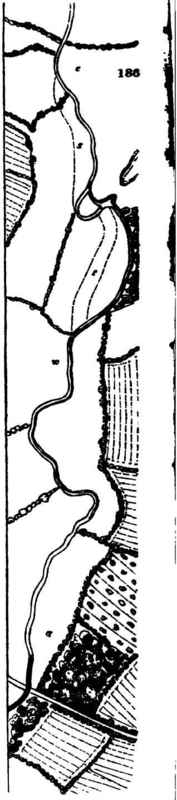
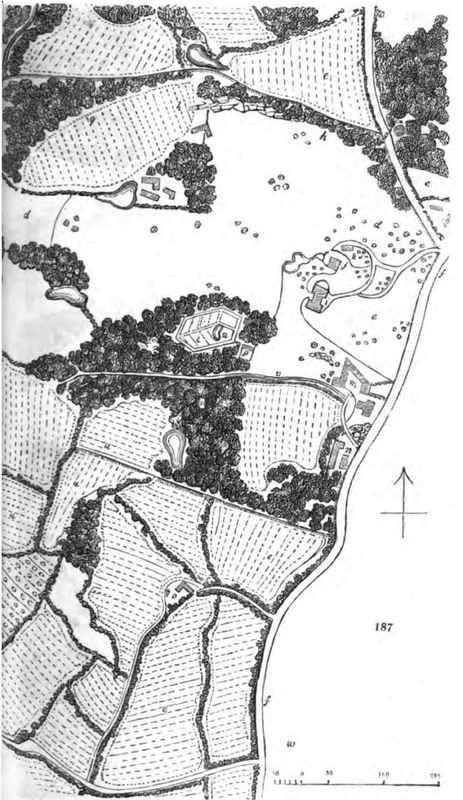
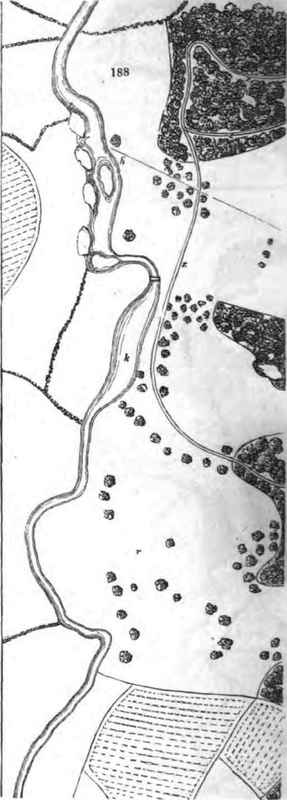
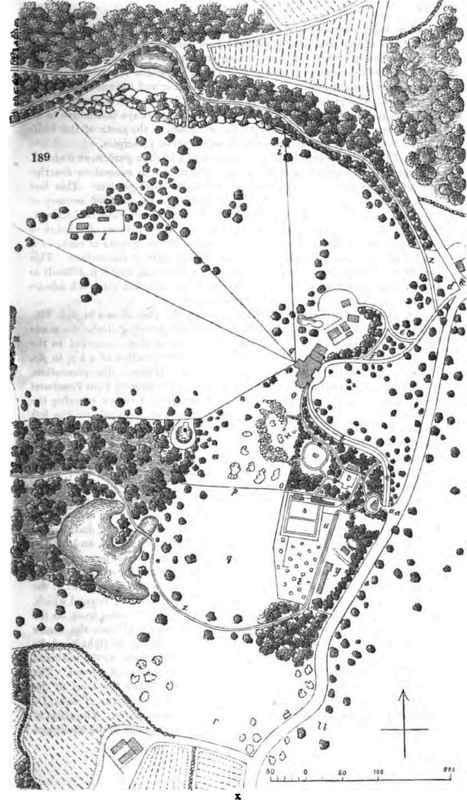
388. The garden scenery at Redleaf consists of a kitchen-garden, an orchard, an English flower-garden, a Dutch flower-garden, and an anomalous description of flower-garden, which may be called the rock-garden. This last garden constitutes by far the most singular feature of the artificial scenery of the place, and is totally different from anything else of the kind in England. The idea of forming it seems to have arisen from the existence of a ledge of rocks in another part of the grounds, and from the abundance of rock, of a kind easily quarried (red sandstone), under most parts of the surface. This part of the grounds at Redleaf is so original in character, that it is difficult to convey a correct idea of it without larger engravings than this work admits of; but we shall nevertheless make the attempt
389. General Description, Etc
On comparing the plan shown in figs. 186. and 187., with that shown in figs, 188. and 189., the principal alterations made by Mr. Wells appear obvious at first sight. One of these, essential to the beauty of the place, is the plantation made in the direction of a b c, in fig. 189., parallel to the approach from Penshurst. Without this plantation, which is chiefly of evergreens, the eye of the stranger arriving from Penshurst would have seen all the natural beauties of the ground before entering the house; because the ground slopes from that line of approach on the left towards the valley, and rises on the right towards the public road. The same thing would happen to a stranger arriving by the London approach, were not the trees disposed along it in the direction d, e, f, which shuts out the great north-western valley, except near the entrance approach; where the eye may detect between the trunks of some large trees just as much of the commencement of the valley as to set the imagination at work to guess its extent.
As the wood is now disposed, the stranger, whether he arrives from London by Seven Oaks, or from Tonbridge Wells by Penshurst, drives up to the house, admiring the finely scattered groups of oaks, thorns, and hollies, on the rising grounds on one side of the approach, without being aware of what is concealed by the plantation on the other side. Entering the house, from the bay of the drawing-room at g, he is struck with astonishment at the extent of the prospect, and at the fine reach of the river at h; beyond which, up the valley, he can see nearly as far as Godstone, where some trees on the summit of a hill above that town mark its situation. If, from the centre window, he turns his head to look through the window on his right hand, he sees the whole range of the Redleaf rocks; and if he turns to the left-hand window, he sees another reach of the river appearing beyond a wood. The surface of the water of the river is probably 200 ft. below the level of the drawing-room floor from which it is seen; the chain or causeway of rocks, i i, 100 ft. below it, and the cottage l, and wood m, rather lower.
Continue to:


My Books

