


Flower-Garden. Part 2
Description
This section is from the book "The Villa Gardener", by J. C. Loudon. Also available from Amazon: The Villa Gardener.
Flower-Garden. Part 2
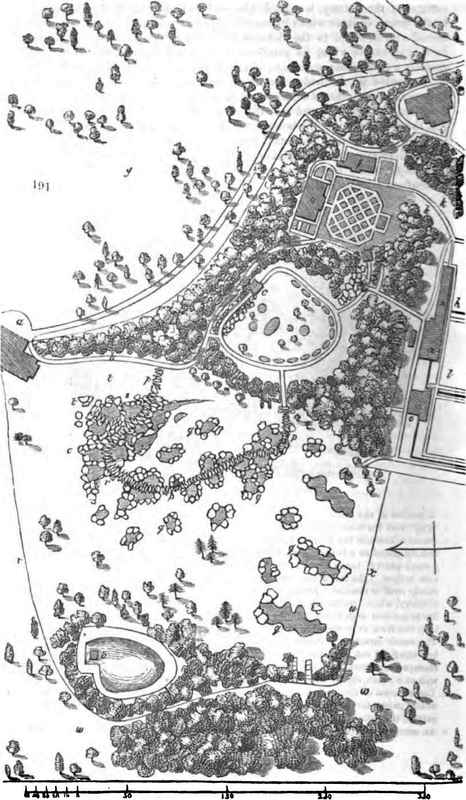
The effect of the woodman's cottage at l, which may be described as one of the aboriginal cottages of the country, is exceedingly good, as seen from the drawing-room, by the strong contrast which its humble appearance and the associations connected with it, afford to the richness and high art displayed in the house. In this extensive view, no gentleman's house is to be seen, no church, and scarcely a farm-house or cottage, so completely are almost all the objects of art concealed by the hedge-row trees. In winter, after the leaves drop, are to be seen some human dwellings, and two or three churches. From the plan figs. 188., 189., as compared with that shown in figs. 186., 187., it will be seen that the corn field q, in the latter figure, is planted, and the coppice-wood at r removed; but the most important features of improvement are, the widening of the river at s, and the altering of its bed at t, as indicated by the dotted lines in fig. 186. Fig. 191. shows a plan of the lawn and flower-gardens at Redleaf, on a larger scale.
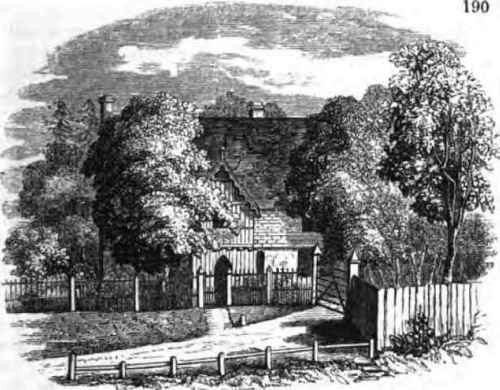
Penshurst Entrance Lodge and Gate.
a, A portion of the house.
b, Walk from the house to the garden scenery.
c, Summer-house in the English garden. This structure, of which a view is shown in fig. 193., is placed on a ledge of rock, which, before the garden was made, formed one side of a stone quarry; hence, immediately beneath this summer-house there is a very considerable hollow. The rest of the flower-garden has an undulating surface, and the beds are chiefly oval or circular. Among the single low trees are two specimens of the common berberry, which, trained to single stems, form very handsome objects. They are profusely covered with bloom in spring, and, in autumn, so completely clothed with their long red fruit, as to resemble, at a short distance, gigantic specimens of scarlet fuchsia. The rustic structure is curiously and exquisitely executed of different kinds of wood, but chiefly of oak with the bark removed, and of hasel. The floor is paved with oak champs; and there is a table inlaid with different kinds of native woods; and chairs, as well as a bench, chiefly formed of hasel rods.
d Continuation of the walk 6, on the top of a ledge of rock still higher than the walk which passes through the summer house (c). The walk d conducts us to the Dutch garden, the buildings in which are an orangery and a rustic billiard-room.
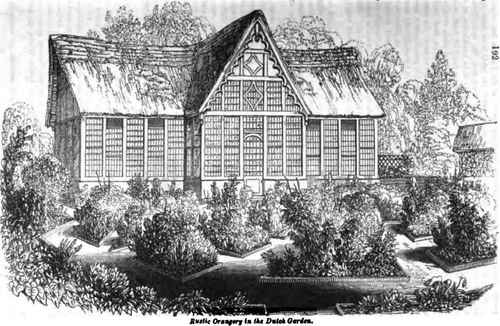
e, An orangery constructed of oak, placed on a basement of rustic masonry, and thatched with reeds, of which fig. 193. is a view. It is placed in the north side of the Dutch garden, some of the rhomboidal beds of which may be seen in the engraving. In this orangery there is a space in the centre, which is occupied as a sitting-room, and is furnished with chains, tables, etc., for eating fruit or taking tea. From this scene there is a door to a Chinese dairy, richly fitted up with Chinese porcelain, many of the specimens of great size, and exquisitely painted. Amongst the flowers, we observed the blue tree posony, which was long supposed to be an imaginary variety of the Chinesa, but which to now said really to exist; like the yellow Camellia, which hoc lately been seen by Mr. Fortune. Corresponding with the dairy to a small room over the stoke-hole with a fire-place. The' dairy to not used as soon, but to merely to be onwsfcleTod as a collection of Chinese dairy porcelain. This conservatory, having; a thatched root, and being in a situation sheltered from high winds, requires very little artificial heat, even in the most severe winters. It to used to protect orange-trees, large myrtles, and anon green-bonse plants as are in a comparatively dormant state daring our winters.
In summer, most of the plants are turned oat, and others brought from the green-booses and forcing-houses, as they come into flower; it being found that in this comparatively cool and shaded boose the bloom is retained much longer in perfection than it otherwise would be. We remarked here some orange-trees, lemon-leaved myrtles, and camellias, which had not been turned out into the open air for several years; and, though the young shoots were etiolated to a considerable extent, yet the intensely dark groan of their leaves appeared to show that shade was more favourable to them than sunshine The thatch, being of reeds, has a handsome appearance. An old cottage or barn might easily be turned into an orangery of this description. f, A billiard-room, with a rustic veranda, also placed in the Dutch garden. It to raised on a rustic stone basement; and the veranda, which to returned at the angles, to paved with oak chumps, and forms a most convenient place for taking exercise in during rainy weather; an use which harmonises well with that of the billiard-table, which, to an amatear gardener, to chiefly valuable as affording him salutary exercise when he cannot be at work out of doors.
The walks in the Dutch garden are paved with white brick, and edged with stone; and, as they have all a gentle inclination so as to throw off the rain rapidly, they are better adapted than any other description of path for walking on after rain; thus permitting a lover of plants to examine them in one of the most interesting states in which they can be seen in spring and summer, that is, when just revived by a shower, and while yet covered with drops of rain. The beds are planted with a very choice selection of herbaceous plants, perhaps unequalled in the country for combining compactness and neatness of growth with beauty and rarity. The walks are 2 1/2 ft wide, and the beds 6 ft wide; so that any person can reach from the margin of the bed to the middle without putting a foot on it. The space beyond the circumferential walk to planted with a collection of all the best azaleas; not crowded together in one mass, as collections of this shrub and rhododendrons commonly are, but in distinct bushes, so that each is covered with flowers from the ground to the summit an every side.
Continue to:


My Books

