


Flower-Garden. Part 3
Description
This section is from the book "The Villa Gardener", by J. C. Loudon. Also available from Amazon: The Villa Gardener.
Flower-Garden. Part 3
To insure this gardenesque appearance, the plants are taken up, reduced, and replanted in fresh peat soil, as soon as ever they begin to grow out of bounds.
An aquarium, on the margin of a bank of rockwork, of which fig. 97. in p. 187. is a view, which extends from the English garden nearly to the Dutch garden. The walk connecting these two gardens, and also a branch from it to the conservatory and kitchen-garden, are covered with an arcade of creeping shrubs, sufficiently open on the sides to admit a view of the bordering plants, which are all of the more rare and beautiful kinds. There are here, also, various sanctums, and minor compartments for small plants, not Shown in the plan; and also a large space for setting out the green-house plants during summer.
h, Experimental garden. Here seedlings of various ornamental plants, such as dahlias, heartseases, herbaceous calceolarias, picotees, polyanthuses, etc., are reared till they come into flower; when»the more beautiful sorts are selected, and the rest thrown away. It was in this garden that the first dwarf dahlias were raised by Mr. Joseph Wells, the late Mr. Wells's gardener, in the year 1826.
i. Gardener's house, which serves, also, as a lodge to the Penshurst entrance, of which fig 190 , p. 307., is a view.
k k, Borders of azaleas, rhododendrons, and other American flowering shrubs.
l, Kitchen-garden.
m n Conservatories and green-houses. In one of the conservatories, there are some remarkably large and luxuriant specimens, particularly of Wistaria sinensis, the Madras citron, Cilanthus puniceus, and Enkianthus quinqueflorus. In an adjoining conservatory, the back wall to covered with camellias, which are not trained in close to the wall, like fruit.
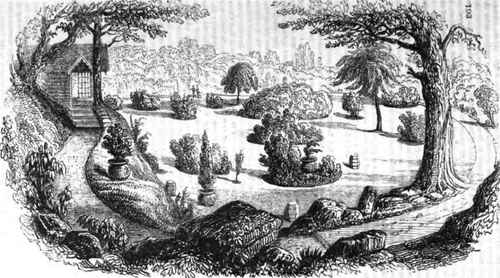
English Garden and Summer-house.
Trees, but hare their young shoots prelecting out like a camellia hedge; and the intensely dark green of their leaves, and the profusion of flowers which they produce under this treatment, show how well it is adapted to them. In general, it may be observed that these conservatories exhibit the true kind of beauty which a conservatory ought to produce; via. free, luxuriant, and seemingly uncontrolled growth; presenting everywhere a picturesque appearance, and directly opposed to the beauty of the green-house, in which the plants are kept in pots on stages, and in which trimness, nearness, and the close training of climbers (in a word, the gardenesque), ought everywhere to prevail. It may be useful, both to amateurs and to gardeners, to bear in mind these distinctive characters of the conservatory and the green-house. The orangery presents an aspect somewhat different; because the plants, instead of being in small pots on stages, are in large pots, boxes, or tubs, and. for the most part, placed on the floor: but still the arrangement of the interior is every where guided by the principles of the gardenesque.
o, Vinery and plant stove.
pp p, Rock-walk, giving a general view of the rockwork garden.
q q etc., Beds of prepared earth, raised above the surface, and supported by large blocks of stone, forming an irregular rocky margin to each bed.
r, A well, or basin, supplied by a spring, and furnishing abundance of water for watering the plants.
r s Direction of an excavation of 8 or 10 feet, forming an irregular precipice on the side next the house, with a bottom sloping in the opposite direction, from which all the rock was obtained for paving the rocky walk, and enclosing the raised beds. In the views from the windows of the house, none of this rockwork appears; the ground at t t t being sufficiently high to carry the eye over it to u. The plants in the rocky beds are partly half-hardy; such as fuchsias, myrtles, and other throbs generally planted against conser-vative walls; magnolias; a fine collection of azaleas and rhododendrons, particularly on the rocky precipices; Berberit, Mahonia, Garrya, and, in short, all the finer shrubs that are rather tender, and some of the more rare trees. There are also some fine specimens of perfectly hardy shrubs; such as of Cotoneaster Uva-ursi and Juniperus Sabina repens; the latter covers an entire bed. Among the more rare trees in the rocky lawn, fig, 194., was one of Pinus sinensis, raised by Mr. Wells from seeds imported from China in 1899, and which had attained the height of 16 ft, and produced cones, before it was killed by the severe winter of 1887-8. Arancarla imbricate is here quite hardy; and Picea Webbiana has attained a considerable else, though much injured by the same winter.
There are also remarkably fine specimens of Abies Douglasti, and of various other species of pines and and firs. There are some remarkably line young cedars, which, in 1887, when measured for the Arboretum Britannicum, were from 36 ft to 52 ft. in height. One of these, which had been raised from seed exactly twenty years before, the cone having been purchased in a London seed-shop in 1816, was, in 1636, 36 ft high, and the girth of the trunk, at 8ft. from the ground, was 4ft. 6 in. Another, 27 years planted, was 52 ft high, with a trunk of 5 ft 6 in. in circumference at 3 ft from the ground. Among the herbaceous plants were most of the Californian annuals and heartseases, and all the finer half-hardy plants, such as petunias, lobelias, etc., and a great variety of pelargoniums. In short, if the reader imagine all the plants introduced into this country that it is desirable to cultivate in a flower-garden, or against a conservative wall, and in a select shrubbery, be will form a good general idea of what were planted on the rocky lawn at Redleaf.
v, Engine-house, fixed over a pond, for throwing up water to the house.
w w, Wood, in which many species of exotic trees and shrubs are introduced among the native kinds.
x x, Wire fence, which separates the mown lawn from the pasture lawn.
y, Pasture lawn; the surface of which is beautifully undulated, and finely varied by groups of oaks, thorns, and other trees. The thorns are, in some instances, of great age, and are often covered with a profusion of mistletoe, which in the winter season gives them the appearance of evergreen trees, and in spring interferes with that general covering of blossom, which, from its uniformity and whiteness, sometimes gives a large hawthorn the appearance of an immense cauliflower, or gives a spotty appearance to the landscape. We may observe, here, that there are various scarlet thorns distributed through these grounds; that two of them, in front of the Penshunt Lodge, are of an intensely dark red; and that others, which are seedlings of these, present different shades of colour, sons being only a pale pink.
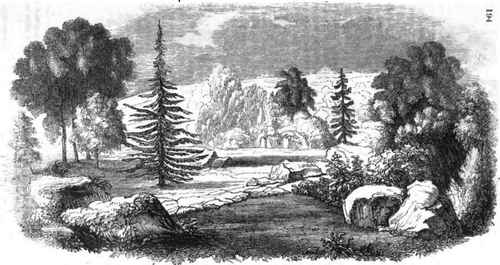
Entrance to the Rocky Lann from the English Flower Garden. The tacky precipice is sltghtly indicated in the middle distance, and the rocky walk in the foreground. The tree on the left is a cedar, in 1837 upwards of SO ft. high.
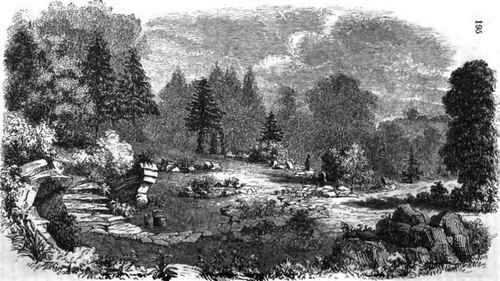
View acrss the Rocky Lawn, showing the Descent of the Rock Walk to the Rocky Hollow.
390. Remarks
The moat original feature at Redleaf, as we have already observed, is the rocky lawn; and respecting it there are several points which require to be noticed. In the first place, a slight scar, or protruding rock, which appeared above the surface before any of the improvements were commenced, indicated that the same rock was abundant beneath the surface; secondly, the general slope of the grounds admitted of making a large excavation at this scar, and yet preserving the surface perfectly dry; thirdly, this excavation enabled Mr. Wells to get an extensive flower-garden near the house, which, at the same time, should not be seen from it; and, fourthly, this lawn was in harmony with the rocky bank in the English garden, and with the ledge or causeway in the rocky valley (fig. 195.); which ledge may be said to form, as it were, the key-note to the place. The suitableness of the stone walk to this rocky garden is worthy of notice; not only does the material harmonise with the margins of the beds, and the rocky bank, better than gravel would have done, but, being on a steep slope, it is not liable to be washed away, as that material would have been, by every shower of rain.
The walk is formed by flat laminae of the sandstone, from six inches to a foot in thickness, not very even on the surface, and joined together in the most irregular forms, like the lava pavement! in Portici, and other towns in Italy. The stones rise from 3 in. to 9 in. above the surface of the grass; the width averages from 4 ft. to 5 ft.; but sometimes, where very large stones occur, the walk is double that height We are, however, inclined to think that, if this rocky walk only rose an inch or two above the surface, instead of 6 or 8 inches, the effect would be better, and the walk would have the appearance of being more solid and secure, and it would also be less conspicuous at a distance. One practice which is adopted at Redleaf is, that, in every part of the garden scenery where the slope is considerable, the walks are paved with brick, and have brick or stone edgings. Some great advantages result from this practice. The walks are never injured by rain, bur rather improved by being washed clean; and, as no weeds can grow in them, nor can they get soft with rain, nor powdery with dry weather, they never require rolling.
Gravel walks must be turned or partially renewed every two or three years; and the box, which is annually clipped, should also be taken up and replanted, sometimes every six or seven years. Brick or flagstone walks, or walks of asphalte, however, with brick or stone edgings, if properly laid at first on a solid foundation, and with such drainage as will admit of no water stagnating beneath the bricks, will last ten or twelve years, without any repairs whatever.
Continue to:


My Books

