


Design XXVIII. Plan And Description Of The Grounds At Hoole House, Near Chester, Occupied By Lady Broughton. 391. General Observations
Description
This section is from the book "The Villa Gardener", by J. C. Loudon. Also available from Amazon: The Villa Gardener.
Design XXVIII. Plan And Description Of The Grounds At Hoole House, Near Chester, Occupied By Lady Broughton. 391. General Observations
Hoole is situated about two miles from the city of Chester, on the road to Liverpool. The extent of the place is between twenty and thirty acres; and it is arranged as a farm, a lawn, a kitchen-garden, and a flower and rock-garden, the latter being one of the most remarkable specimens of the kind in England.
392. Description, Etc
The surface of the ground at Hoole is flat, and the soil a rich loam. In the extreme distance, in one direction, are seen the Welsh mountains; in another, the Peckforton Hills and Beeston Castle. The general plan of that part of the ground which lies round the house is shown in fig. 196., to which the following letters refer: a, The home, of which the elevation is given in fig. 197.
b, A conservatory forming the front entrance, as shown on a larger scale in fig. 197.
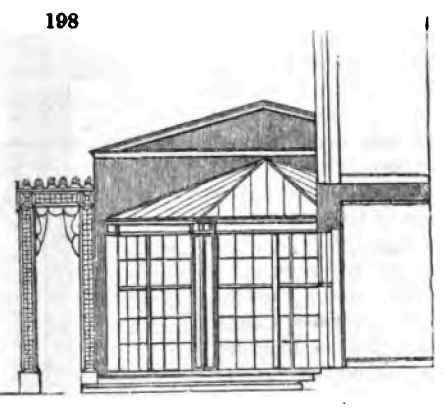
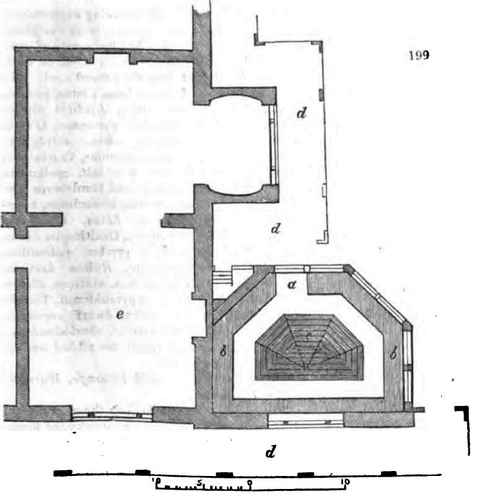
c, Camellia-house, of which a ground plan is shown in fig. 199., an deration in fig. 198.
and a plan of the roof in fig 300. In the ground plan (fig. 199.) a is the entrance from the veranda; b b, shelf for plants; c, stage for plants; d d d, veranda; and e, the drawing-room, d (in fig. 196.), Drawing-room window, which looks on the flower-garden.
e, Geranium-house; the communication between which and the camellia-house is by the veranda d, in fig. 199. f, Flower-garden, the view of which, from the drawing-room window. is shown in fig. 201. gg, The rockwork surrounding the flower-garden. h, Walk midway up the rockwork, but concealed from the eye below by the rocks between it and the flower-beds. i, Stable. j, Stable-yard. k, Kitchen-garden. l, Beserve-garden.
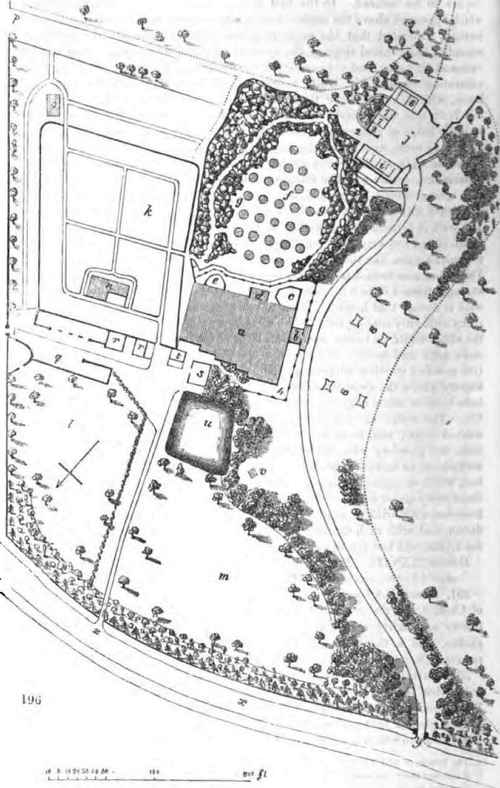
m, Grass field. n Gardener's office and green-house.
o, Under gardener's room. p. Back entrance to the stable-yard.
q, Soil yard. r r, Back shed and other conveniences. s, Coal-house.
t, Iee-hcuee. u, Pond. v, Bee-house.
w w, Flower-baskets on the lawn. x, Road to Chester, y , Entrance-gate to the approach-road. z. Back approach.
1, Back approach to the garden.
2, Archway between the rock and the stables.
3. Back entrance to the flower-garden. 4, Pavement under the veranda.
5, Back door to the rockwork and flower-garden. 6, Cow-house.
7 7, Coach houses. 8, Harness-room. 9, Shrubbery.
Fig. 202. is a view of the highest part of the rockwork, from the centre of the flower-garden. The highest point is in the south-east angle, where it is 34 ft. above the level of the lawn.
Fig. 203. is a view of the rockwork, the lawn, and the camellia-house, from the rock-walk in the north-east angle.
393. Remarks
The striking effect produced by the flower-garden at Hoole depends on the contrast between the smooth flat surface of the lawn, with the uniformity of the circular beds, and the great irregularity of the surrounding rockwork. The length of the flower-garden, within the rocky boundary, is 60 yards, and the breadth 34 yards. The baskets, twenty-seven in number, are in five straight rows, and each basket is a circle of 9 ft. 5 in. in diameter. They are made of wire, worked on an iron rod, the rod being placed upon small pegs, to keep the basket to the level of the grass; and they are painted a yellow stone colour, to harmonise with the rocks and the veranda.' They stand 8 in. above the ground, the grass coming close to the iron rod. The distance between each, across the garden, is 4 ft., and down the garden, 8 ft 10 in. They are planted with spring, summer, and autumn flowers mingled together; and the spaces left, when those are over, are filled with green-house plants, viz. geraniums, verbenas, etc, German stocks, and tender annuals, which keep up the colour until the frosts destroy them: the hardy perennials remain for the next season.
394. The design of the rockwork was taken from a small model representing the mountains of Savoy, with the valley of Chamouni: it has been the work of many years to complete it, the difficulty being to make it stand against the weather. Rain washed away the soil, and frost swelled the stones: several times the main wall failed from the weight put upon it. The walls and the foundation are built of the red sandstone of the country; and the other materials have been collected from various quarters, chiefly from Wales; but it is now so generally covered with creeping and alpine plants, that it all mingles together in one mass. The outline, however, is carefully preserved; and the part of the model that represents "La Mer de Glace" it worked with grey limestone, quartz, and spar. It has no cells for plants: the spaces are filled up with broken fragments of white marble, to look like snow; and the spar is intended for the glacier. On the small scale of our engravings, and without the aid of colour, it is altogether impossible to give an adequate idea of the singularity and beauty of this rocky boundary; and we may add that it is equally impossible to create anything like it by mere mechanical means.
There must be the eye of the artist presiding over every step; and that artist must not only have formed an idea of the previous effect of the whole in his own mind, but must be capable of judging of every part of the work as it advances, with reference to that whole. In the case of this rockwork, Lady Brough-ton was her own artist; and the work which she has produced evinces the most exquisite taste for this description of scenery. It is true it must have occupied great part of her time for six or eight years; hut the occupation must have been interesting, and the result, as it now stands, must give her Ladyship the highest satisfaction.

Conservatory at HeeleHouse forming the Front Entrance.
395. The rockwork is planted with a selection of the most rare and beautiful alpines, particularly with all the close-growing kinds; each placed in a nidus of suitable soil, and the surface protected from the weather by broken fragments of stone, clean-washed river gravel, the debris of decaying rock, moss, or other suitable substances, according as the object was to retain moisture; to evaporate moisture, in order to prevent the plants from damping off; to increase the heat, in which case dark fragments of stone are used; or to diminish it, which is effected by the employment of white pebbles, which, by reflecting the light and heat, keep the ground cool. The following is a list of the principal genera: - Saxifrages, sedums, Cistus, panties, rock pinks, anemones, Dryas, Myosotis, heaths, violas, Lychnis alpina, Erinus, Frankenia lae'vis, campanulas, ajugas, alyssums, anemones, O'xalis, hepaticas, antirrhinums, aquilegias, Arabis, aretias, asters, Astragalus, armerias, Anagallis, Cheiranthus alplnus, Cerastium, claytonias, Convallara bifolia, C6ptis trifolia, Cornus canadensis, Cortusa Matthioli, cyclamens, Calceolaria Fothergilli, drabas, erodiums, Galium grae cum, Gaultheria pro-cumbens, globularias, crane's-bills, gypsophilas, gentians, hieraciums, hype-ricums, Hippocrepis, Jeffersonia diphylla, Lathyrus, Lotus, Leontodon aureum, linums, mitellas, Moehringia muscosa, menzieaias, Ornithopus durus, Ononis, Onosma, Orobus, pinguiculas, phyteumas, pyrolas, potentillas, primulas, Pisum maritimum, Polygala Chamaebuxus, Rubus arcticus, Aubrietia purpurea, Saponaria ocymoides, Salvia pyrenaica, stances, silenes, soldanellas, Solidago minuta, Be1lis minuta, Teucrium pyrenaicum, Tiarella cordifolia, Mitella diphylla, Trientalis, Thymus corsica, dwarf veronicas.
The evergreens are chiefly yews, privets, laurels, arbutus, rhododendrons, brooms, cedars, box, daphnes, laurustinus, etc.; to which are added azaleas of every kind, and various other low-growing shrubs. Design XXIX. Plan and Description of Dunchurch Vicarage, Warwickshire, the residence of the Rev. J. Sandford.
Continue to:


My Books

