


187. Planting With Bulble, To Be Succeeded By Half-Hardy Annuals And Green-House Plants
Description
This section is from the book "The Villa Gardener", by J. C. Loudon. Also available from Amazon: The Villa Gardener.
187. Planting With Bulble, To Be Succeeded By Half-Hardy Annuals And Green-House Plants
The third mode is adapted for gardens where there is not only a reserve ground, but pits or hot-beds in which to preserve some of the plants which we shall recommend during winter, and to bring forward others in spring. During winter, the beds are supposed to be filled with bulbs in the manner before-mentioned; or, what would produce a truly brilliant effect, wholly with hyacinths, and the margins of the beds with a line of crocuses. The bed b might be planted with mixed hyacinths, one of a sort; the beds c and d, with white hyacinths; h h and e e, with red; and ffand g g, with blue. The smaller beds might be filled entirely with crocuses. In the course of the month of May, the bulbs should be removed, and the ground dug and planted as follows: - d, with variegated pelargoniums (geraniums); c, with Bath scarlet pelargoniums; d, with Frogmore scarlet pelargoniums; e e, with Verbena chamssdrifolia (Mettndres), scarlet; f f, with Lobelia lutes, yellow; gg, with Petunia nyctagmiflora, white; h h, with Petunia phoenicea, dark purple; i i, with Lobelia gracilis, blue; k k, with Nierembe'rgta gracilis, white; i, with Nemophila aurlta, blue; and m, with Senecio elegans fl. pi. ruber, red.
All these plants are easily procured; and they may be preserved in pits or frames, with a very alight assistance, during cold and damp weather, from fire or dung heat. All of them, ought to be planted so close together, as to cover the beds by the middle of July; and any shoots that rise above 6 in, from the bed should be cut off or pegged down, and any naked space that may occur on its surface should be covered by pegging down shouts from the adjoining plants.
188. Planting a front garden with Florists' flowers - Fig, 52, is a fa garden of the same size as fig. 51. in p. 122., laid out with a view to culture of florists' flowers. The side walls should be planted with ivy; and in front, next the street wall and railing, the ivy may be trained to wires, one wire being introduced between each rail. The plants trained against the house should he select climbing rosea, The borders a and b should be devoted entirely to dahlias in summer, and bulbs In winter and spring; the bed C, to chrysanthemums; d, to pinks and carnations; e and f, to tulips; and a and h, to hyacinths; the other bulbs, such as ranunculuses, anemones, etc, being grown in the dahlia borders before the latter are planted; or, if the symmetrica) effect .is dispensed with, tulips, hyacinths, ranunculuses, and anemones, may be grown in the beds e f g h. These beds, after the bulbs are removed, may be planted with showy annuals or other plants brought forward in the reserve ground- As the foliage of the carnations and pinks, which occupy the centre bed, is evergreen, it will look well throughout the year.
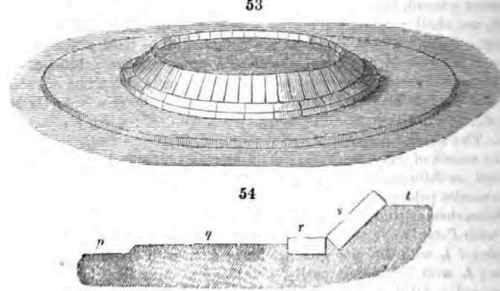
189. A mode of planting a front garden with ornmental green-house plants, is to have a raised bed of brickwork, as shown in fig. 53.; and of which fig 54. is a section. In this section, p is the surface of the lawn; q, a raised bank of turf, to serve as a preparation for a base to the brickwork; r, a circk of bricks laid flat, and half sunk in the turf; #, a circle of bricks laid all to one elope, and touching with their lower edges the circle of flat bricks; and the surface of the bed. The perspective view of this bed is shown in fig, 53 Such a bed ought to be planted in the centre with the most choice summer-flowering green-house plants; and round the margin, with migno-Vstte, Verbena chamsedrifolia (Melindres), or some other fragrant or brilliant-coloured cleeper which will hang down over the bricks. A large fuchsia in the centre, surrounded by variegated pelargoniums, with a border of mignonette inter-mixed with blue anagallis, will have a good effect; as will a large Brugmansta suaveolens (Datura arborea) in the centre, with the surface of the bed entirely covered with the Ver-bena chamaedrifolia, which would hang down with its brilliant scarlet flowers over tike brick frame. The brug-nfcansia (fig. 55.), when well-grown, is a particularly suitable plant for this purpose.
It may be kept in the frame in the reserve ground during the winter; and, if turned out into rich soil, and kept well supplied with water during summer, it will produce a profusion of its fine trumpet-shaped, pure white, fragrant flowers, from June till the beginning of October; when the plant ought to be taken up, repotted, and re-turned to the pit, to prevent it from being injured by frost.

Continue to:


My Books

