


59. Gardenesque Imitation
Description
This section is from the book "The Villa Gardener", by J. C. Loudon. Also available from Amazon: The Villa Gardener.
59. Gardenesque Imitation
Where the gardenesque style of imitating nature is to be employed, the trees, shrubs, and herbaceous plants must be separated; and, instead of being grouped together as in forest scenery (where two trees, or a tree and a shrub, often appear to spring from the same root, and this root is accompanied by large rampant herbs), every gardenesque group must consist of trees which do not touch each other, and which only become groups by being as near together as is practicable without touching, and by being apart from larger masses, or from single trees or rows of trees. It in not meant by this, that in the gardenesque style the trees composing a group should all be equally distant from one another; for in that case they would not form a whole, which the word group always implies. On the contrary, though all the trees in a gardenesque group ought to be so far separated from each other as not to touch, yet the degrees of separation may be as different as the designer chooses, provided the idea of a group is not lost sight of. In fig. 10. the trees are arranged in the gardenesque manner; and in fig. 20., in the picturesque style.
The same character is also communicated to the walks; that in the gardenesque style having the margins definite and smooth, while the picturesque walk has the edge indefinite and rough. Utility requires that the gravel, in both styles of walk, should be smooth, firm, and dry; for it must always be borne in mind, that, as landscape-gardening is an useful as well as an agreeable art, no beauty must ever he allowed to interfere with the former quality.

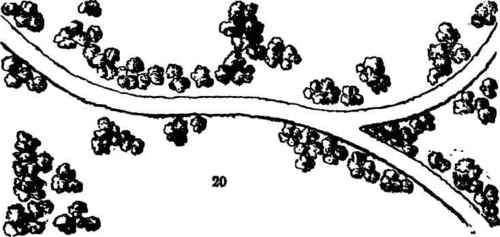
60. In laying out and planting grounds, or in criticising such as are already formed by eminent artists, it is necessary always to bear in mind the difference between the gardenesque and the picturesque; that is, between a plantation made merely for picturesque effect, and another made for gardenesque effect. Gardenesque effect in plantations is far too little attended to for the beauty of the trees and shrubs, whether individually or collectively; and picturesque effect is not generally understood by gardeners; so that the scenery of suburban residences is often neutralised in character by the ignorance of professional landscape-gardeners of the gardenesque, and of professional horticulturists and nurserymen of the picturesque. To make the moat of any place however small, all the styles of art ought to be familiar to the artist; because there are few places in which, though one style prevails, some traits of other styles may not be advantageously introduced. In planting, thinning, and pruning, in order to produce gardenesque effect, the beauty of every individual tree and shrub, as a single object, is to be taken into consideration, as well as the beauty of the mass: while in planting, thinning, and pruning for picturesque effect, the beauty of individual trees and shrubs is of little consequence; because no tree or shrub, in a picturesque plantation or scene, should stand isolated, and each should be considered as merely forming part of a group or mass.
In a picturesque imitation of nature, the trees and shrubs, when planted, should be scattered over the ground in the most irregular manner; both in their disposition with reference to their immediate effect as plants, and with reference to their future effect as trees and shrubs. In some places trees should prevail, in others shrubs; in some parts the plantation should be thick, in others it should be thin; two or three trees, or a tree and a shrub, ought often to be planted in one hole, and this more especially on lawns. Where, on the contrary, trees and shrubs are to be scattered in the gardenesque manner, every one should stand singly; as in the geometrical manner they should stand in regular lines, or in some regular figure. In the gardenesque, there may be single trees and single shrubs; but there can be no such thing as a single tree in the picturesque. Every tree, in the picturesque style of laying out grounds, must always be grouped with something else, if it should be merely a shrub, a twiner, or a tuft of grass or other plants at its root In the gardenesque, the beauty of the tree consists in its own individual perfections, which are fully developed in consequence of the isolated manner in which it has been grown; in the picturesque, the beauty of a tree or shrub, as of every other object in the landscape, consists in its fitness to group with other objects.
Now, the fitness of one object to group with another evidently does not consist in the perfection of the form of that object, but rather in that imperfection which requires another object to render it complete.
61. In rustic, indigenous, or facsimile imitations of natural scenery, the object, as we have already observed, is to deceive the spectator, and make him believe that the scene produced is of a fortuitous origin; or produced by the humble exertion of a country labourer. Such scenes differ from those of the geometric style, and also from those of artistical imitation, in this, that the same person who contrives them must also execute them. They can have no merit in design, and only mechanical merit in the execution. They scarcely require the aid of either a professional landscape-gardener, or a professional horticulturist; but, at the same time, they could not be executed by every common labourer. The imitation of such scenes must he made by a sort of self-taught artist, or a regularly-instructed artist who will condescend to accept of this kind of employment Those villas in which it might be desirable to produce a fac-simile imitation of fortuitous scenery ought to be situated near a large town, in order that the scene created may contrast the more advantageously with everything around it.
In many spots in the neighbourhood of London, and other towns which are built of brick, and where gravel is found for forming the roads, there are often clay pits or gravel pits on the ground which is to be let for building on; as in other situations there are old chalk pits or stone quarries. Suppose a pit of either kind to be in some part of a piece of ground of an acre or two in extent, which is to be laid out as a country house; and that it were thought advisable, as an episode to the general scenery of the place, that a fac-simile imitation of nature should be created in this pit.
As a first example, we shall suppose that the pit is a clay pu\ and not fit for a human habitation at the bottom. In this case, let the bottom of the pit be covered with turf, smooth in some places, and in others mixed with nettles, thistles, and other weeds, and varied by thorns, briars, brambles, elder bushes, and other trees and shrubs that generally spring up on waste ground. In one or two parts of the bottom of the pit let there be pools of water, with rushes and other aquatic plants, and some alders and willows of the commonest kind for shade. These and other details being executed in the bottom of the pit, surround it on the outside by a thick plantation of one or two kinds of trees and shrubs, such as are generally found in copse-wood; and let there be a winding straggling path through this copse-wood, of such a length as to obliterate for the moment the impression of the artificial scenery of the other parts of ,the pleasure-grounds on the mind of the spectator while he is pursuing the winding slightly-marked path among the bushes to the bottom of the pit.
If the plantation were surrounded by a hedge or other fence, and the entrance to the path were through a gap in this fence, the deception would be the more complete.
The second example we shall suppose to be a dry gravel pit, and that in the bottom of it a dwelling-place might be formed for a workman and his wife, with a hovel to serve as a cow-shed, in which cows might be kept for the family, and in which alto an ass might be kept for the use of the gardener, in rolling hit walks, carting manure and weeds, and for other pur-poses. Instead of a crooked footpath entering through a gap in a hedge, as in the first example, a rough winding road might he formed, by which it might be supposed that the gravel had been carted out of the pit, hut which, owing to the lapse of time, had become principally covered with grass; and this might be entered through an old rickety gate; while in the bottom of the pit there might be the cottage dwelling, and the hovels, which, though comfortable within, ought to appear in a half-ruined state without; and a hayrick rudely fenced round, with a small stack of fagots for fuel, etc. The reader can easily supply the rest.
Both these examples would be fac-simile imitations, which might easily be mistaken for nature itself, or what we call rustic scenery; and, though they might, and doubtless would, afford pleasure in themselves, and as contrasted with the scenery around them, yet that pleasure could in no respect be considered as resulting from them as works of art, unless we were told that they were artificial creations.
Continue to:


My Books

