


Appearance Of Art. Continued
Description
This section is from the book "The Villa Gardener", by J. C. Loudon. Also available from Amazon: The Villa Gardener.
Appearance Of Art. Continued
Water, bounded by the formal lines of the ancient style is easily recognisable as artificial: but how is this end to be attained in a style which professes to be an imitation of nature? There are two kinds of water, in imitations of natural scenery. One is, where there already exists a brook, or a lake, or a river, which is to be appropriated, and rendered a work of art; and the other is, where there is no visible water naturally, but where excavations are to be made, and to be filled with water, which is to assume the character of a lake or river. In the first case, the brook, lake, or river, is readily appropriated as a work of art, by planting exotic, woody, and herbaceous plants along the margins, in a natural-looking manner; carefully removing all that are indigenous, with the exception, perhaps, of such as are not conspicuous, as the usual grasses which compose turf. Thus, the cut-leaved alder might be substituted for the common species; the weeping poplar, or the weeping willow (if not too common in the neighbourhood), and the paper birch, for the common willow and birch; and that truly elegant exotic aquatic tree, the deciduous cypress, might be made the prevailing species.
31. The application of the principle of the recognition of art to rocky scenery may, at first sight, appear to present some difficulties. By rocky scenery is here meant scenes of nature in which rocks are predominant features. By what means, for example, are the terrace walk and the perpendicular rocks on the banks of the river Wye, at Piercefield in Monmouthshire, to be rendered a work of art? By substituting another kind of rock for the indigenous one? No; for not only is the scale too large to render this practicable, but, if it were accomplished, the very largeness of the scale would make it to be still considered as the work of nature; unless, indeed, rocks, which every one knew did not exist in the country at all, were substituted for the natural ones; and even in this case, though the character of art would be maintained, yet the associations connected with solid natural rocks would be so effectually obliterated, that, on the whole, the interest of the scene would be destroyed. Neither in landscape-gardening, nor in any other art, ought every thing to be made to give way to one view of a subject.
The most complete mode of appropriating the rocky bank at Piercefield, as a work of art, would be, by the artificial manner of conducting a walk through it, and by the manner in which this walk is constructed. Such a walk should be carried along on a level, or on a regular slope or slopes; and the contrast of such a line, and the rough and ever-varying natural surface, would alone indicate the employment of art Another mode would be to remove all the indigenous vegetation above and below it, and to supply its place by foreign vegetation of a similar character. Instead of the common oak, which is the prevailing tree at present, substitute the evergreen and the Turkey oaks; and, instead of the common brambles, sloes, and thorns, which protrude from the rocks, substitute the thorns of Greece and America, and the laurustinus, the arbutus, and the cistus of Italy.
32. In the ease of buildings in the artificial landscapes created by landscape-gardening, art is always recognised in the building itself, that being indisputably an artificial object: but the principle of the recognition of art is not always perceived in the placing of the building: on the contrary, nothing is more common, in arranging the grounds round an edifice, than a violation of this principle. Wherever a building, whether a house, an obelisk, a column, or a statue, is set down among trees and plants, and appears to rise up among them as if it were itself a tree or a plant, there will be found a want of the artificial principle. This want is produced by the vegetation being placed too near the artificial object, and by the trees and ground not having been treated according to art. An artificial object ought, surely, not to appear to grow out of the ground, like a natural one: it ought to grow out according to art. - which indicates that it ought to rise from an artificial basement; and that the ordinary vegetation of the spot ought to be kept at some distance from it May not creepers be planted against it? Yes; because the planting and training of these indicate design and intention, and enable the spectator to recognise art.
We do not say that it is always advisable to plant creepers against a building; because there are a variety of circumstances to be taken into view before any one point can be determined: we merely say that there is nothing in the principle of the recognition of art at variance with the use of creepers, where their use is not at variance with any other principle.
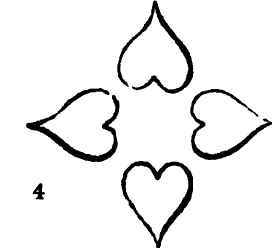
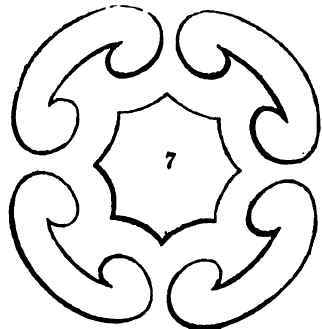
33. Art is easily recognised in all walks and roads; but not always artist-like art The uniformity of the breadth, and the evenness of the surface, of a walk may secure it the character of art, while this character may be counteracted by the footpath-like junction of one walk with another, as in fig. 2., while the artist-like junction is shown in fig. 3. The tune remark will apply to the forms of flower-beds on grovel or turf: they are always easily recognised as belonging to art, but not always to high art; that is, the shapes of the beds are not always artist-like. In fig. 5., the forms of the beds resemble those of common cordate leaves, thrown down in a natural manner, some in one direction and some in another, as if they had dropped off from a dried specimen in a herbarium. In fig. 4., the same leaves are disposed of, as a whole, in an artist-like manner. In fig 6., the shapes, considered separately, are artist-like; but they are thrown down without the slightest regard to symmetry. In fig 7., they are disposed of symmetrically, that is, according to art.


Even a straight line, in gardening and in architecture, may be laid out or formed in an unartist-like manner; for example, a line of box, or a brick edging, to a walk, or to a bed or border, which, instead of being perfectly straight, is bent to one side, will be much more offensive to the eye of an artist, than a line perfectly straight in the direction of all its parts, but some parts of which are wanting. It is not that either line could have been formed by nature, but that the evidence of art is more decided in the one case than in the other. The imagination easily supplies the parts which are wanting; but it will not so easily set that part of the line straight which is bent to one side. If, indeed, the line were bent equally to both sides, the absence of rigid art would be less offensive, because the imsgin-ation would form a middle line for itself.


Continue to:


My Books

