


39. Regularity And Symmetry
Description
This section is from the book "The Villa Gardener", by J. C. Loudon. Also available from Amazon: The Villa Gardener.
39. Regularity And Symmetry
In the modern, or irregular, style of landscape-gardening, as well as in the irregular style of architecture, which, whether under the name of Gothic or Italian, is the style of country houses now most prevalent, the production of a whole requires a much greater knowledge of art than in the ancient style, either of landscape gardening, or of Greek or Roman domestic architecture: in both of these styles an attempt was seldom made to produce a whole, except by means of regularity and symmetry. It is almost unnecessary to state, that, in the ancient style, whether in ground, in wood, in water, or in buildings of every description, and in roads, regularity or symmetry were the governing principles. The place, as a whole, was generally symmetrical, one half reflecting the other; and the details were always regular. In an age when the beauties of irregularity, and the variety produced by wild scenery, prevailed throughout the country, those of regularity and symmetry would be found to be characteristic of art and civilisation; and they were preferred by our ancestors, with a taste as just and correct relatively to them, and to the circumstances in which they were placed, as our widely differing taste is to us, and our circumstances.
40. Though symmetry may appear to be a beauty exclusively employed in architecture, and in the ancient style of laying out grounds, yet this only applies to symmetry when it is joined with regularity. In every irregular whole, that is satisfactory to the eye, there will always be found a certain balance or proportion, which one side of the centre of the picture bears to the other, and which balance is nothing more than symmetry. It will be recollected, that the essential principle of symmetry is the union of two parts as a whole, which do not form wholes separately; in opposition to uniformity, where, the parts being regular, each taken separately forms a whole. Now, in every pleasing landscape it will be found, that, if it were bisected perpendicularly by an imaginary line, something like an equal body of scenery would be found on each side. The same may be said with reference to any irregular building which is pleasing as a picture, and also to any irregular flower-garden, or the planting of an irregular park. A pleasure-ground, which, viewed from the drawing-room windows, appeared to have all the shrubs on one side, and only flowers and lawn on the other, would not be so satisfactory as one where they were more equally balanced.
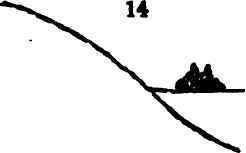
Neither would the views from the house, over a lawn the surface of which formed a hill on one side and a hollow on the other, be agreeable. Hence, a view across a slope, as in fig. 14,, is never so satisfactory as one either up or down the declivity; but a view across two slopes intersecting each other, as in fig. 15., is satisfactory; because in this last case, the one balances the other. Single objects, that are not regular, such as a tree, are never satisfactory, unless they are symmetrical; that is, unless the quantity of branches on one side appears to balance the quantity on the other. Thus, those trees which, being the most irregular by nature, are symmetrical at the same time, are more pleasing than those which are comparatively regular and symmetrical; because they show a greater amount of variety, combined with symmetry. In this point of view, an oak, an elm, and a sweet chestnut are more pleasing trees, and higher in the scale of beauty, than a silver fir, a spruce fir, or a larch. The same observation will apply to shrubs, and even to herbaceous plants.
One of the most interesting results of symmetry, as applied to trees, is, where the trunk is thrown, by nature or accident, into a position where it requires extraordinary forme of growth in its branches to adjust them to the natural symmetry belonging to its species: for example, when a tree, planted on the banks of a river or lake, has its trunk inclined oyer the water, and its head in an erect position, and balanced by branches on each side, in the usual manner.

41. Variety is the next beauty common to architecture and to landscape-gardening; and it must be acknowledged to be a great addition to symmetry, or to any whole in which there is a complete unity of expression, whether that whole be irregular or symmetrical. In architecture, variety is produced in symmetrical and regular buildings, by a difference in the details; and, in irregular buildings, by a difference even in the smaller parts of the composition, as well as in the details. In regular and symmetrical buildings, variety is chiefly confined to what may be considered the ornamental parts of the edifice; such as architraves, mouldings, cornices, etc. The component parts which are essential to the symmetry, or the regularity, of the whole must remain the same; whereas, in irregular buildings, not only may there be a variety in the mouldings and ornaments, but in the component parts; such as projections, recesses, towers, etc.
42. In the ancient style of landscape-gardening, variety was very seldom attempted, except in flower-gardens; because, as we have already observed, it was a beauty so common in the surrounding scenery, as not to be in demand. The reverse is the case in the modern style of laying out grounds; for, the country being now under regular cultivation, in right-lined enclosures, variety is, in a great measure, banished from general scenery; and, hence, it is sought for as a rarity in artificial scenery, in the same manner as uniformity was in ancient times.
43. In planting, variety is produced in several ways; by varying the dispositions and distances of trees of the same kind relatively to one another; by varying the disposition and the distances of trees of the same kind with shrubs principally of one kind; and by the use of trees and shrubs of many different kinds. The latter is the most difficult; as, to produce a proper effect, some knowledge of botany and of plant culture is required, as well as a knowledge of art The reason is, that this variety of trees and shrubs is known to comparatively few; and, many of them having been but a few years in the country, it is only in consequence of botanical knowledge, and a knowledge of the art of cultivation, that an estimate can be formed of what, in point of bulk and character, they will afterwards arrive at. Hence, an artist may have a knowledge of architecture and of the principles of picturesque beauty, in the general disposition of landscape scenery, without being at all adequate to produce the higher beauties of which landscape-gardening is susceptible; and hence, also, it will almost always be more easy to form a perfect landscape-gardener out of a gardener and botanist, than out of a landscape-painter or an architect.
The cause is, the science of botany; and that practical application of it which constitutes a knowledge of plants and their culture, consisting of numerous details, and requiring considerable time, are best attained in youth.
Continue to:


My Books

