


Renovating Suburban Gardens. Part 3
Description
This section is from the book "The Villa Gardener", by J. C. Loudon. Also available from Amazon: The Villa Gardener.
Renovating Suburban Gardens. Part 3
232. The most important consideration, however, with reference to renovating suburban gardens, is the state of the trees and shrubs. In almost all suburban gardens of twenty years' standing, this will be found to be most wretched. The ornamental shrubs will commonly be found to consist only of the coarser-growing kinds, which bare remained and become vigorous, after having choked up and destroyed the weaker and more delicate kinds; and the ornamental trees will be found too large, ovarshading everything, and rendering the ground damp and unproductive, and the atmosphere unhealthy. The fruit trees will generally be cankered, and producing little or no fruit; and the little which they do produce will have a had flavour. The fruit shrubs, such as the gooseberry, the currant, and the raspberry, will be found overgrown, and crowded together for want of pruning and thinning. The only effectual remedy for these evils is, to root out the whole of the ligneous plants, and to introduce young healthy plants in their stead. There need be the less regret at doing this, because the kinds of fruit trees and shrubs, and of ornamental trees and shrubs, that were planted in suburban gardens twenty years ago, were very inferior to those which may now be purchased in the nurseries.
There is another reason why it will almost always become necessary to root out the fruit trees in an old garden; which it, that their roots will, in most cases, be found too deeply buried in the soil The main cause of this is, that they have been planted too deep at first; that is, the soil having been trenched perhaps 2 or 3 feet deep, previously to planting, the trees have been planted just as deep as they would have been on solid ground; in consequence of which, and of the watering and treading down the soil to the roots at the time of planting, the collar of the tree is, the very first year, 2 or 3 inches below the surface; and every year afterwards, from the additions made to the soil by manure, and from its swelling up in consequence of the pulverisation it receives by culture, the root of the tree becomes still more and more deeply buried, till, at the end of 20 years, the collar is perhaps 6 or 8 inches deeper in the soil than it ought to be. This burying of the collar is the grand cause of the unfruitnilness of fruit trees in small gardens; and, indeed, it is not too much to say in all gardens whatever; and this deep burying of the roots is just as hurtful to a gooseberry, a currant, or a raspberry, as it is to an apple, a pear, or a plum.
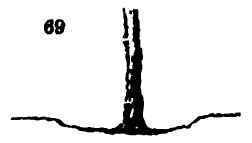
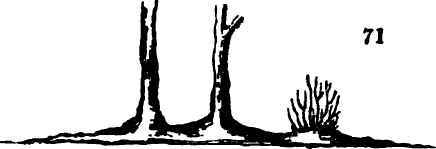
In the case of flowering trees and shruhs it is equally injurious, by preventing them from flowering. If, therefore, old trees and shrubs of any kind are to be retained in renovating the garden, they will require to be taken up, and replanted with their collars rather above the surface than under it, so as to allow for the sinking of the ground, and to cause the tree, even when the ground is thoroughly settled, to have the appearance of growing out of a small mound. If we examine thriving trees in a state of nature, we shall always find that the collar (that is, the point of junction between the stem and the root) rises above the general surface, as shown in fig, 67. On the other hand, if we examine trees that have been planted by man in deeply trenched soils, we shall generally find that, though planted at first as shown in fig. 68., they will, after a certain number of years, have sunk, as shown in fig. 60.; or, if care has been taken to keep the ground about them level by adding fresh soil as it sinks, they will appear, as in fig. 70., with their collars completely buried, and their trunks rising out of the soil like a post driven into it by art, instead of springing from a woody base formed by the roots, like trees and shrubs in an indigenous state, as shown in fig. 71. In replanting, either with trees already in the garden, and taken up in order to have their roots raised higher, or with young trees, they ought always to be planted on little hills, more or less in the manner shown in fig. 72.; so as ultimately to settle down into flattened protuberances, as in fig. 67. It may be asked how the ground is to be cropped close to the roots of trees so treated; to which we answer, that we have already shown in pp. 76., 77. the utter impossibility of fruit trees planted in dug ground bearing well, unless an undug space be kept all around them.
There is not a single point in the whole culture of trees and shrubs that is of equal importance to that of keeping the collar of the trunk above the surface; and there is not one which is more generally either neglected, or by some means or other counteracted, not only in small, but in large gardens.



233. Where it it proposed to retain the ornamental shrubs or trees already existing in an old suburban garden, they will very generally require to be taken up and replanted, no less than the fruit trees, unless they should be so large as to be of a timber-like size; in which case, as in a very small suburban garden they will be disproportionate to every thing about them, they ought to be rooted up entirely. The only remedy for trees which have been too deeply planted, besides taking them up and replanting them, is removing the earth which covers their roots, as deep as the lower part of the collar; but, as this would very much disfigure any garden, whether large or small, it is a remedy which we cannot recommend any one to resort to. In the case of the smaller shrubs, whether fruit-bearing or ornamental, such as gooseberries, currants, roses, etc, there need never be the slightest hesitation in rooting up such as have been too deeply planted, throwing them away, and replacing them with young plants from the nurseries.
234. It mag sometimes happen, where the soil is poor and shallow, and the subsoil gravel, rock, or chalk, that fruit or ornamental trees or shrubs may be suffering for want of nourishment, and may, from this cause, exhibit canker or mossiness on their branches. In this case, the obvious remedy is to supply nourishment, which should be done, not by digging dung into the soil, but by top-dressing it with thoroughly rotten horse or cow dung, or with a composition of soil and some other animal or mixed manure. Where such trees stand in dug ground, the manure may be slightly forked in; but where they stand on turf, spreading it on the surface in autumn, and allowing it to remain there during winter, will be sufficient. Renovating fruit trees by top-dressing the surface has the double advantage of rendering them more productive of fruit, and of making that fruit of higher flavour. Even when trees have been too deeply planted, if their collars are laid bare, and the surface soil removed for 2 or 3 feet all round, to within 2 or 3 inches of the main roots, and afterwards the surface top-dressed, from the trunk as far as the roots are supposed to extend, the evils of deep planting will be mitigated, it being understood that the surface is never to be afterwards dug.
The fibrous roots are, by this treatment, tempted to come up to the surface in search of the nourishment afforded by the manure; and, whenever the greater number of the roots of a tree are near the surface, from the greater warmth in summer, and the influence of the air, it is certain to blossom and bear well, and, without being over-luxuriant, to be in a thriving state.

Continue to:


My Books

