


Water. Continued
Description
This section is from the book "The Villa Gardener", by J. C. Loudon. Also available from Amazon: The Villa Gardener.
Water. Continued
286. With a view to beauty, the distinctive properties of water, as contrasted with those of ground are, clearness and brilliancy, the power of multiplying objects, coolness, and motion. These are the principal properties which concern the landscape-gardener; and it is difficult to imagine a situation in which one or other of them may not be exhibited, and turned to excellent account. The following rules refer to this principle:
1. Clearness in pieces of water is displayed by allowing them chiefly to reflect the sky; and brilliancy, by having the situation somewhat derated, or otherwise so prominent that the water may catch the rays of the son, and reflect them directly in the eye of the spectator. This is a kind of beauty not often desirable in landscape; but it may occasionally be wanted to contrast with others; and it has this advantage, that it may be introduced in a very limited space, to which it adds great cheerfulness.
3. The power of multiplying objects by reflection is by far the most valuable property of water, relatively to landscape-gardening. Forms, shades, and colours may thus be doubled; and the most forcible contrasts may be produced between water surrounded by trees; build-tags, or other objects, and open lawn or pleasure-ground. Hence, it is seldom desirable to form pieces of water without planting trees or shrubs, or both, along its banks. Water, without wood, may display clearness, and convey the idea of coolness; but it cannot have that intricacy, variety, richness, and force of effect, which are produced in greater perfection by the shade, colouring, and forms of trees and shrubs, with the occasional aid of buildings and animated nature, than by any other means at the command of the gardener.
3. Coolness, as a property of water, is actually produced by evaporation; but its cooling effect in landscape may be considered as depending on the idea of coolness which we associate with water, and which has been originally derived from experience. This property in water renders it a desirable material for contrasting with gravel, buildings, rocks, or other objects, which, with reference to their effect in landscape, are considered warm.
4. The motion of water, in the imitation of its more common forms m nature, is displayed in artificial brooks, rills, springs, etc.; and in the imitation of more extraordinary natural appearances, in artificial cascades, fountains, and Jets. As the motion of water may thus be displayed on a very small scale; the property of motion, and, as already mentioned, that of clearness, are, perhaps, of the most universal use in gardening; there being scarcely any ground-plot, however small, that will not admit of a fragment of rock, with a drooping fountain, or of a marble basin, or stone vase, of dear water, to reflect the rays of the sun. and tints of the sky.
287. With a view to picturesque effect, water may be introduced into the grounds of every residence, however limited it may be in extent; and the effect will depend, not on the magnitude of the piece of water, but on the character or expression which it is made to assume. Hence the following rules:
1. That, in very small places of even a few perches in extent, a surface of water, of not more than a few square feet, sunk in the ground, and with a gravelly, rooky, or stony margin, by reflecting the objects near it, and the sky, may give an extraordinary interest to the landscape; the water being kept clear, and perfectly free from mud and decaying objects. - (See fig. 100.)
2. That a brook or streamlet, however small, can never be successfully imitated, unless there be a current of water equal to that which is found in brooks of the same magnitude in a state of nature.
8. That the character of a brook being briskness, it should never be imitated by art, except where there is not only an abundance of water, but a surface having a considerable slope, in order that the water may run rapidly.
4. That, where a natural brook passes through a park or pleasure-ground, It may be improved in effect by expanding some parts of it into pools; and by the distribution of gravel, stones, and other rocky materials, along its banks.
5. That a river, which, to bo natural, ought to indicate on its banks the progress and action of water, can never be imitated in a park or pleasure-pound, except where there exists naturally a considerable stream.

9. That a lake may be imitated wherever there is a sufficient extent of nearly level sur-face to excavate; or where the water may be made to cover an extensive surface, principally by throwing a dam across a shallow valley.
7. That a prolonged lake, tame river, or even a canal of traffic, is occasionally admissible in artificial scenery, under particular circumstances; and more especially when it is at such a distance from the eye, and so far below it, as to render it impossible to detect whether the water is in motion or stagnant; the water, in this supposed case, being perfectly clear. Thus a pleasure-ground or park, which occupies the upper part and the sides of a hill, may have a tone of canal, or tame river, intermediate between the upper part of the bill and the valley at its bottom; by which means this canal will form an interesting foreground from the park above it to the country beyond. This is beautifully exemplified in many places bordering canals; for example, at Offchurch Rectory, near Leamington, in Warwickshire; and at Wentworth Castle, in Yorkshire.
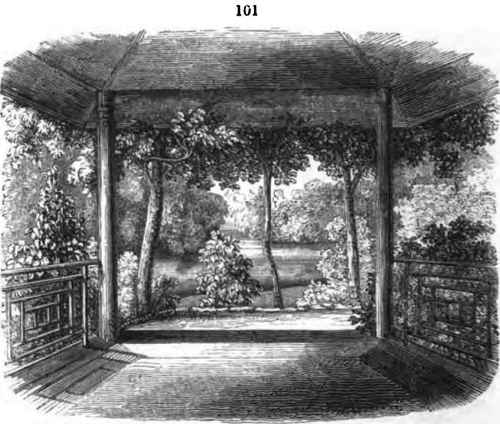
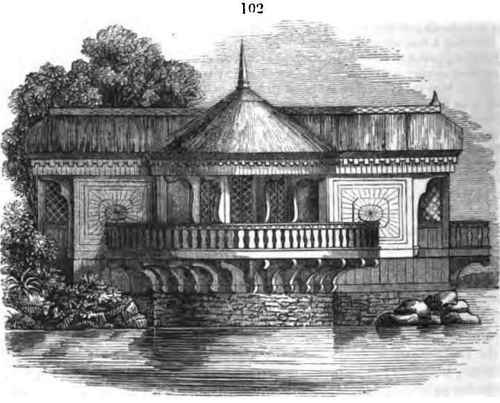
288. Fishing-houses, and other garden buildings, have often a very pleasing effect when erected near water, not only from the variety they introduce in the landscape, but from the pleasing effect of the views which may be obtained from them, particularly during the heat of summer, when the appearance of water seen from an ornamental building, like the Chinese temple (fig. 101.), has a very striking and beautiful effect. A fishing-house (fig. 102.) is a kind of summer-house, from the windows or balcony of which persons can fish, or sit to enjoy the cool breeze at their pleasure. The style of the house shown in fig, 102. is Swiss, and it consists of a circular porch, a in fig. 103.; a room, 11 ft. in diameter (b), with windows opening, like doors, into a circular gallery or balcony (c), partly projecting over the water, and supported on brackets. More than half the balcony is sheltered by the large projecting roof of the circular room, which is also supported by brackets, as posts might obstruct the view, and be otherwise inconvenient. On each side of the circular room are rooms (d and e), each 18 ft. by 11ft., for refreshments, etc, the one marked d having a balcony hanging over the water. A boat-house is another architectural appendage to water, of which there are many various kinds.
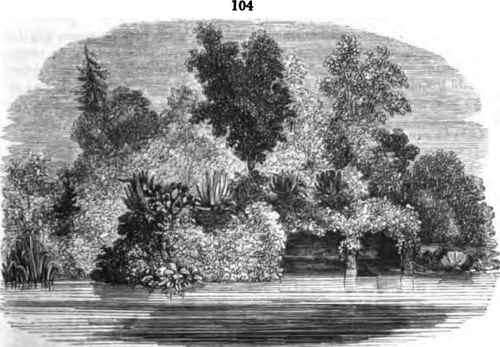
Fig. 104. is one of the most simple of these, and it is merely formed in a bank, overgrown with shrubs and flowering plants. In other cases, the boat-house is formed under the fishing-house, or built separately, according to the taste of the proprietor.

Continue to:


My Books

