


February. Forestry. Editorial Notes
Description
This section is from the book "The Gardener's Monthly And Horticulturist V28", by Thomas Meehan. See also: Four-Season Harvest: Organic Vegetables from Your Home Garden All Year Long.
February. Forestry. Editorial Notes
The Great Council Tree of the Senecas at Kanadesaga (Geneva), N. Y„ Nearly two miles northwesterly from the foot of Seneca lake. - On the Old Castle farm of Jerome Loomis, now owned and occupied by his children, is a large elm tree, known as the Great Council Tree of the Senecas. This elm is in fact a double tree, the two bodies branching just above the ground. Its measurement, August 21st, 1879, was as follows: Trunk, just above the ground, but near the crown of the roots, 25 feet; two feet above the last measurement, or about three feet from the ground, 21 feet 3 inches; trunk of west branch, 13 feet 6 inches; east branch, 15 feet 2 inches; the last two measurements being five feet from the ground. Spread of the whole tree 120 feet.
This noble elm is situated just east of the ridge on the farm on the east side of the old Preemption road, nearly half a mile distant and a little east of north from the Old Castle, and was situated in the midst of the corn-fields of the Seneca Indians at Kanadesaga. A little to the north of the tree was a large peach orchard, which was destroyed by Sullivan's army, September 8th, 1779. This peach orchard in a few years was again in a flourishing condition, and in 1797 one hundred bushels of peaches were sold from it to a neighboring distillery. The same year a farmer on one of the Old Castle farms sold cider to the amount of one thousand two hundred dollars, which was made from apples grown in the old Indian orchard, the trees of which had likewise been girdled by Sullivan's army, but had sprouted from the roots and were again in full bearing.
The large apple orchards were around and near the Old Castle, which was on the Crittenden farm, and also on the farm opposite the Old Castle, on the east side of the old Pre-emption road, then in the possession of Major Sanford Williams, but afterwards owned by Mr. Swales. Crittenden and Williams each had a cider mill and were at that time quite extensively engaged in the manufacture of cider, which found a ready market, as there were none but Indian apple trees in existence, and of them but few scattering trees, except what were on their farms.
Trees of wild plums, black mulberries, butternuts, walnuts and hickory nuts were in abundance in the immediate vicinity.
Under the eastern edge of the tree is a large stone deeply imbedded in the ground, about four feet long and twenty inches wide. This stone had a hollow scooped out towards one end, and was used by the Indians for pounding corn in, and it is in the same place where it was used and left by them.
An Indian orator once said: "We shall not long occupy much room in living; we shall occupy still less when we are gone; a single tree of the thousands which sheltered our forefathers, one old elm under which the tribes used to meet, will cover us all; but we would have our bodies twined in death among its roots on the very soil where it grew. Perhaps it will last the longer from being fertilized with their decay." - From Conover's Early History of Geneva, 1880, p. 41. [The above cut is from an engraving printed in Frank Leslie's Popular Monthly, October, 1885, made from a photograph taken by Jas. G. Vail for Geo. S. Conover, in August, 1879, and which has been kindly loaned us by the publisher. During a gale of wind on the 14th of September, 1882, one of the large branches, comprising about one-half of the tree, was blown off and it has lost its pristine beauty and grandeur].
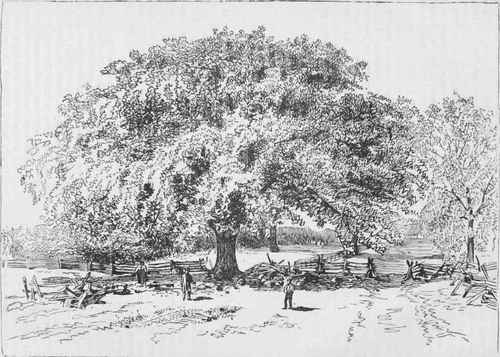
The Great Council Tree of the Senecas at Kanadesaga (Geneva), N. Y.
Continue to:


My Books

