


May. Number 329. Flower Garden And Pleasure Ground. Seasonable Hints
Description
This section is from the book "The Gardener's Monthly And Horticulturist V28", by Thomas Meehan. See also: Four-Season Harvest: Organic Vegetables from Your Home Garden All Year Long.
May. Number 329. Flower Garden And Pleasure Ground. Seasonable Hints
Mosaic beds, so much derided when the style was introduced, seem to have touched a popular chord, and instead of being laughed down are more in vogue than ever. We have from time to time given some sketches of beds, and designs for filling them; but so many continue to inquire, and there is so much variety to choose from, that we have been wishing that some one would get up a book of plans in cheap style, so that we could refer all inquirers to them. As if "a little bird" had whispered the thought to them, Messrs. George A. Solly & Son of Springfield, Mass., have gone and done this excellent work, and we have before us their "Book of Plans" that meets the want exactly. There are twenty-five folio sheets, with several designs on each sheet, which can easily be worked out by any intelligent person; and be-sides the designs themselves, the sections of each design are numbered in such a way that any person can tell by the corresponding numbers how to plant the bed; each number of course signifying that the same plant is to be used.
We give herewith a view of a bed which has been laid off after a design of Messrs. Solly, which will show how pretty a mosaic bed may be, and how well they work in among the various elements in artificial gardening.
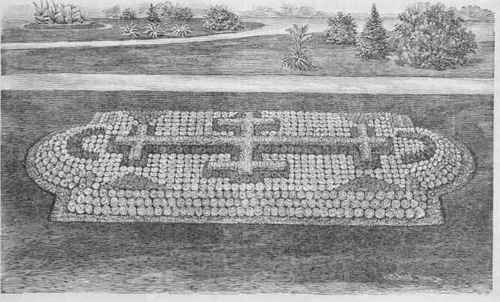
A key is furnished with the book, which gives a list of plants suited to colors to go with the numbers.
This is not the period of the year to thin out trees when they have become too thick on the grounds; but the autumn will soon be here, and in view of the importance of the question, it seems a seasonable hint to be given now. It is surprising, in view of how much has been written about it, so little thinning is done. In our own city of Philadelphia, where, if anywhere, one would think the influence of the Gardeners' Monthly would be felt, thousands of trees are annually destroyed by the struggle with one another, simply because of a sentiment that it is not wise to destroy in an hour what it has taken a quarter of a century to grow. Let any one note a tree standing by itself - note it at this season when covered with foliage, note the branches extending, perhaps, fifty feet from the trunk, and admitting a glorious current of cool air under it; and then note the score or two of trees crowded together in a hundred feet lot, the branches struggling upwards to get a glimpse of the sky - forming an impenetrable mass through which not a breath of air can stir, and he will see the difference. The owner often sees it; and instead of thinning the trees, calls in the aid of the tree-butcher who lops off the heads.
The result is, these large scars never heal, the wood rots, and in a few years the trees have to be taken out at any rate - the whole tree is gone. And then, what do lopped trees look like? They are outrageous in the sight of every person with even the germ of taste. Street trees especially suffer from this unseemly crowding. It is very well to put trees about 20 feet apart at first, because we get some shade and some ornament sooner than we should do. It looks naked for too long a time, to have small trees so set with the view to what they will be in a quarter of a century hence. It is best to set double the number of trees finally required, with the firm determination to take out the half ten or twelve years after; or that some one else may do it, if we should ourselves be in another land.
Continue to:


My Books

