


Small Fruits
Description
This section is from the book "The Gardener's Monthly And Horticulturist V28", by Thomas Meehan. See also: Four-Season Harvest: Organic Vegetables from Your Home Garden All Year Long.
Small Fruits
By Wm. H. Hills. Boston: Cup-pies, Upham & Co., Agricultural publishers. 1886.
This is a large octavo of 137 pages, and, though we have seemingly enough works on this subject, this is really one of the most original and interesting books of the class that has come before us for some time. The author is of the combative kind, and strikes out right and left in a manner truly refreshing. The reader becomes imbued with the same spirit, and, as there are innumerable "chinks" in the author's armor, the combative reader can enjoy the rare opportunity of thrusting in his lance as he goes along, feeling that the author ought to enjoy the fun of the thing as well as himself. Sometimes the free lance of the author does not do injustice to himself. In his preface he states that he does not attempt more than to aid those " who may wish to cultivate fruits for their own tables, with their own hands;" but it is really a work by which the market grower may profit quite as well. He tells us that it is no importance to us in this year, Anno Domini 1886, to know whether Pliny, Virgil or Ovid knew anything about strawberries - a common protest with those who decry classical history - but surely the same argument might be used against the information as to what Michael Keen did in 1806, of which he tells us.
He has a sharp thrust at some one who recommends to those who want to get something very extra in the strawberry line, to put on manure "three inches deep and then fork in," protesting that it would cost between two or three thousand dollars per acre. But if we are writing for the amateur gardener we have nothing to do with the broad acres, and surely some splendid results have been had by just such a dressing of manure. He insists that on all wet lands underdraining of some kind "must be," while it is certain sure that throwing the earth up into ridges and making surface conduits will do just as well, and cost very much less. Some nurserymen advertise that when customers send orders for special varieties, they should at the same time send word whether the nurseryman is at liberty to substitute others in case the stock has run out of some kinds particularly desired. Every nurseryman knows that in a great majority of cases the purchaser would much prefer to have this done, than to send to a number of places to get separate parts of one order.
What possible harm can there be in asking beforehand whether such substitution is desired by the customer or not? The author thinks that figures giving the size of a fruit are of no use to the reader; but surely there are some kinds that are smaller than others, and figures giving the largest size that any variety has been known to reach are surely some guide. Quite as much so as drawings. We have in this book an illustration of Albany seedling an inch and a quarter wide, and of Prouty two inches wide. Why not say "1 1/4 inches" and " 2 inches " as give cuts of these varieties?
Aside from the criticism that the author invites, there is a great deal wholly new to the literature of small fruits that will make the work welcome everywhere.
We give the following chapter on winter protection of the raspberry as illustrative of the practical character of the book :
"Many of the red raspberries, and some of the Black-Caps, are killed back to the ground when no winter protection is given. The foreign varieties are all tender, and their hybrid seedlings are not usually hardy. There are not more than two or three varieties of marked excellence that can be safely exposed to our Northern winters. The Turner and Cuthbert are seldom injured, but even these will yield larger and finer fruit when protected.
"The covering of the raspberry need not be heavy - only just enough to keep the plants in place. Many are frightened when told that the plants require protection; but the labor is not half as great as might be supposed. Soil affords the best covering, and is always at hand. The method is as follows :
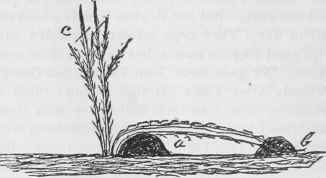
" First, run a furrow between the rows, to loosen the ground, and let a shovelful of dirt be thrown by the side of each plant, near its crown, so as to raise a small mound over which to bend the canes. This will prevent breaking by too short a curve. Let a boy bend the canes over the mound, all in one direction, and in line with the row, and hold them while the shovellers, one on each side, throw on dirt enough to keep them down, as represented in the accompanying cut. In this way pass along the rows rapidly, and complete the covering more at leisure. The illustration shows at a glance the method of bending down the canes, a representing the mound, and b a shovelful of dirt thrown on the tips as a weight. The mark of cancellation at c indicates the point at which the canes should be pruned to give the plant a bushy form. In the way here described a large " patch" may be gone over in a day, and no labor will be better rewarded, whether the variety be tender or half-hardy. Slight protection will bring the plants through the winter uninjured, and ensure larger and better fruit.
Some recommend turning a furrow up to the plants on either side, but this cuts and exposes the roots too much.
" As soon as the frost leaves the ground in spring the plants should be uncovered and tied up to stakes. For removing the dirt from the bushes a fork is preferable to a hoe or shovel. The treatment of the raspberry should be such as to secure mature wood before winter. For this reason the application of manure in mid-summer, and cultivation early in autumn, thereby causing a late growth, should never occur. Top-dressing after the leaves have fallen will do no harm, and the whole ground should be thoroughly cleaned before winter sets in".
Report of Forestry Division of the United States Department of Agriculture. Vol 4. Edited by Nathaniel H. Egleston.
The government reports on forestry contain an immense amount of facts in connection with American forests and forest planting, that give them a great value as works of reference, and make them almost essential in every forester's library. The present volume is at least equal in this respect to any of its predecessors. The facts collected this time relate chiefly to the Southern States, the prairie and desert States, and the States bordering on the Pacific. A distinctive feature is a mass of correspondence digested, showing what has been done in the way of planting, and what kinds have been found the most successful in different places. This is the class of facts that will be of the most benefit to American forestry. After reading this report we are more than ever convinced of the utter hopelessness of trying to preserve the old forests, and the utter worthlessness of preserving them even if the task were within human power.
Continue to:


My Books

