


April. Greenhouse And House Gardening. Seasonable Hints
Description
This section is from the book "The Gardener's Monthly And Horticulturist V29", by Thomas Meehan. See also: Four-Season Harvest: Organic Vegetables from Your Home Garden All Year Long.
April. Greenhouse And House Gardening. Seasonable Hints
Very much more attention is being given to the culture of Amaryllis as pot plants, than formerly. We know a friend who has a fair collection, and he is rarely without some one in flower the whole year round. Though they well repay a close study of their peculiar wants, they are fortunately so constituted as to do fairly well under even shabby treatment, and are therefore nice things for novices who have little practical experience in plant growing. The friend to whom we have reference, moves all his plants out of doors to a partially shaded place for the summer. It is customary with some of the best growers to give the plants certain seasons of rest, when the pots are set on their sides, and the soil and bulb allowed to become dry; others insist that this is not necessary but that the plants may be kept on just as other plants are, and that they will do equally well. There is evidently much to learn about these plants in connection with American treatment. We have had from time to time the experiences of some correspondents, and more would be desirable. In the Old World the culture is advancing as fast as in ours, and some nurserymen make growing Amaryllis an especial branch of their trade.
A large house full of flowering plants is a particularly brilliant object and draws crowds to admire them. We give on p. 104 an illustration of the house of Mr. Williams, who is well known in America by his advertisements in the Gardeners' Monthly. It may help those who love to look on things critically, to say that in these modern times, botanists have removed nearly all the kinds we know as Amaryllis to other genera, and these illustrated in particular to Hippeastrum. The old Amaryllis Belladonna is nearly all that is left to Amaryllis proper. But the term, Amaryllis, as signifying the whole family, without any regard to any special genus in the family, is very convenient, being so widely known, and will be long retained by plant growers.
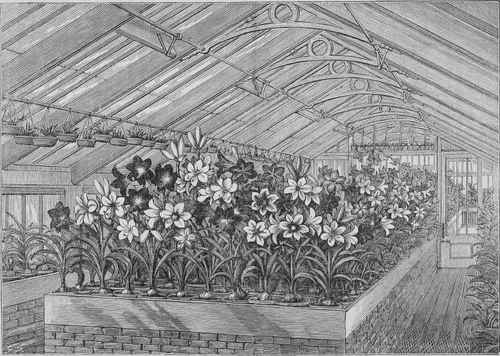
Amaryllis House of B. S. Williams, London N., England. (See page 103).
Continue to:


My Books

