


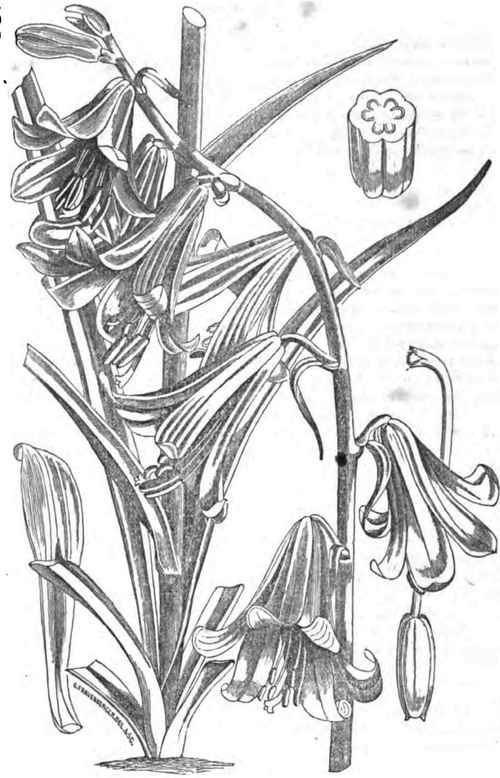
The Lilium Thompsonianum, (Da. Thompson's Lily)
Description
This section is from "The Horticulturist, And Journal Of Rural Art And Rural Taste", by P. Barry, A. J. Downing, J. Jay Smith, Peter B. Mead, F. W. Woodward, Henry T. Williams. Also available from Amazon: Horticulturist and Journal of Rural Art and Rural Taste.
The Lilium Thompsonianum, (Da. Thompson's Lily)
We find a colored drawing and a description of this Lily in the Flore des Serres. It was discovered more than thirty years ago, by the celebrated Dr. Wallich, or by collectors in his service, in the mountains of Gossain-Than, and Kamaon, and rediscovered a long time afterwards by Dr. Royle, at Mussoree. It bloomed for the first time in Europe in the greenhouses of Messrs. Loddiges, in London, in 1844, and the specimen from which this drawing was made, in the kew Gardens, in April, 1853. It was produced from seeds collected at Almora, 8000 feet above the sea level, by Messrs. Thompson & Setrachey. Dr. Royle placed it among Fritillaria, but.
* It ls some evidence of oar advance that expensive books like Michaux at twenty-four dollars, and NuTTall's throe additional volumes at twenty-one, are taken off to remote States with the rapidity they are. Even at those seemingly high prices they could not be manufactured, and so snperbly colored, but that the plates were obtained from Paris gratuitously by the liberality of the late William Maclure, for the benefit of his countrymen. By this he has done moch for America; we will not stop to contrast his counductt with the much bepuffed speculations of a * • * * and a Planchon asserts that it is neither more nor lees than a Lily. It appears to hare been found under two forms, one of which has rose-colored and the other violet-colored flowers; but Dr. Wallich's notes on the two forms in a living state leave no doubt as to their specific identity. The culture is described as in a cold frame, or in pots in a cold greenhouse or orangery during winter. There is a strong probability of its resisting the climate of a great part of this country in the open air.
Its distinct color and graceful habit claim attention.
* * * but we are proud to believe that there la a Utile aristocracy of readers of the Horticulturist, who cellmate.
Continue to:


My Books

