


The Monitor Strawberry
Description
This section is from "The Horticulturist, And Journal Of Rural Art And Rural Taste", by P. Barry, A. J. Downing, J. Jay Smith, Peter B. Mead, F. W. Woodward, Henry T. Williams. Also available from Amazon: Horticulturist and Journal of Rural Art and Rural Taste.
The Monitor Strawberry
WE present this month a portrait of the Monitor Strawberry, one of Mr. Fuller's seedlings, recently alluded to as No. 42. For a number of months we have been directing a series of experiments, having in view the improvement of , our frontispieces. The result of these experiments have not, in some respects, been as favorable as we could wish. The photograph is altogether unexceptionable, but it is difficult to get it properly colored, and is attended with most vexatious delays. The next best process for some objects is the one presented this month. It was executed by Mr. J. W. Orr, of New York, and while it is satisfactory to us, it is very creditable to him. Artistically, it is one of the very best things that we have yet presented to our readers, and as such we give all a colored plate of it. We hope they will accept this as an evidence of our fixed determination to keep the Horticulturist up to the mark, in spite of the war. These experi- ments have been attended with no little expense, but have been rich in experience, of which our readers will receive the benefit.
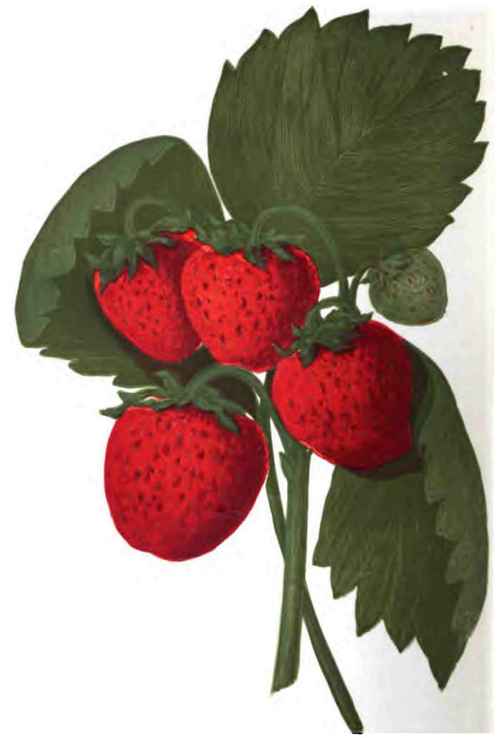
THE MONITOR STRAWBERRY.
Engraved on Wood and Printed in Colon, by J. W. Orr, for the Horticulturist.
Mr. Fuller, as we have already stated, has devoted a considerable portion of his time for several years to the raising of seedling strawberries. At first he simply planted the seed from a fine berry, depending upon chance for a good fruit; the result proved to be unsatisfactory. He next resorted to hybridising, and, as was to have been expected, obtained fruit of a better class; but even with this careful direction of means, the per centage of really good fruit was not large, and comparatively few reached the standard of excellence he had proposed to himself. His object was to obtain a berry that should unite in itself the chief points of excellence of a strawberry, such as earliness, size, firmness, good flavor, productiveness, vigor, etc. Mr. Fuller's beds consisted of several hundred seedlings, which we carefully examined during two years. During the first year we selected a dozen or so as the best The next year three were selected as possessing the above points of excellence, viz., 42, 7, and 53, the Monitor, our present frontispiece, being one of them, and also the earliest.
They have all been purchased by the Tribune Association for distribution among their subscribers, the price paid being $3,000. Mr. Fuller, therefore, will not be benefited by any notice of his seedlings, for he has none to sell, and none will be able to get them for some time, except subscribers to the New York Tribune. This is a somewhat novel mode of disposing of strawberries, but one upon which the parties interested should be congratulated. The Monitor is the firmest and most juicy of Mr. Fuller's seedlings, and we think will bear carriage well. The fruit is large, and of a good scarlet color. The form is conical, some berries, however, being a little flattened. The flesh is white, firm, and moderately juicy, and the flavor very good. The flower is hermaphrodite or perfect, and needs no other kind to fertilize it. The calyx is large, and parts from the fruit much easier than many other kinds. The foliage is large, and has substance in it. Last, but not least, it is very productive. A strawberry thus early, productive, firm, and good, is by no means common. The Wilson possesses some of these points, but the Monitor is far better.
A pomological description of all three will be found in our July number.
Of the other two, Nos. 7 and 52, wo will simply say here, that No. 7 (Ridge-wood) is nearly as good in all respects as the Monitor, while No. 53 (Brooklyn Scarlet) is even better, though a little later. It is a very handsome berry. The Tribune Association may consider themselves fortunate in having secured these berries.
Continue to:


My Books

