


Pears - Felix De Leim And Cadette De Vaux
Description
This section is from "The Horticulturist, And Journal Of Rural Art And Rural Taste", by P. Barry, A. J. Downing, J. Jay Smith, Peter B. Mead, F. W. Woodward, Henry T. Williams. Also available from Amazon: Horticulturist and Journal of Rural Art and Rural Taste.
Pears - Felix De Leim And Cadette De Vaux
The outlines and descriptions of these pears we now give more to draw attention of pear-growers to them, than to advise their planting. It has been said they might possibly prove identical with varieties known under other names, but if so, we have yet to learn. They are both foreigners.
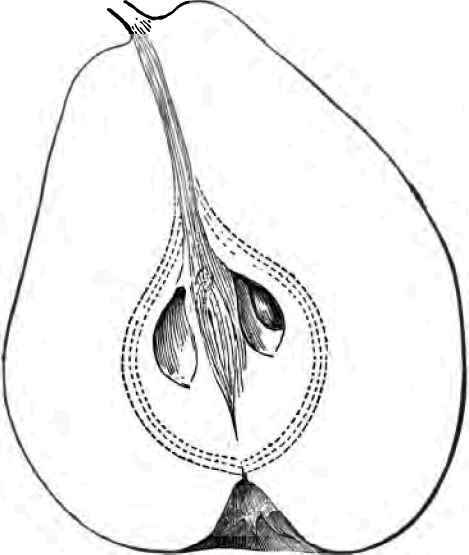
Fig. 95. - Felix de Leim.
Fruit, medium size; oblong pyriform; pale greenish yellow with faint marblings and shades of russet, and scattered dots at calyx end, surface having a rough feel; stem, slender, planted on one side with a slight depression; calyx, with narrow long segments, completely reflexed; basin, round, small, shallow; core, small, with a granulous outer line; seeds, plump, obo-vate pyriform, blackish; flesh, white, buttery, juicy, melting, vinous, sweet. Season, late autumn.
The fruit of Cadette de Vaux is large or above medium, of irregular obovate obtuse pyriform shape, greenish yellow, with suffused green dots; stem, rather stout and fleshy at base; calyx, large and open, With long, completely reflexed, segments; basin, shallow; core, small, - center, hollow, and the capsules partially hollow; seeds, light brown, long pyramidal and pointed at both ends; flesh, breaking, almost melting, - sweet, juicy, aromatic. Season, winter.
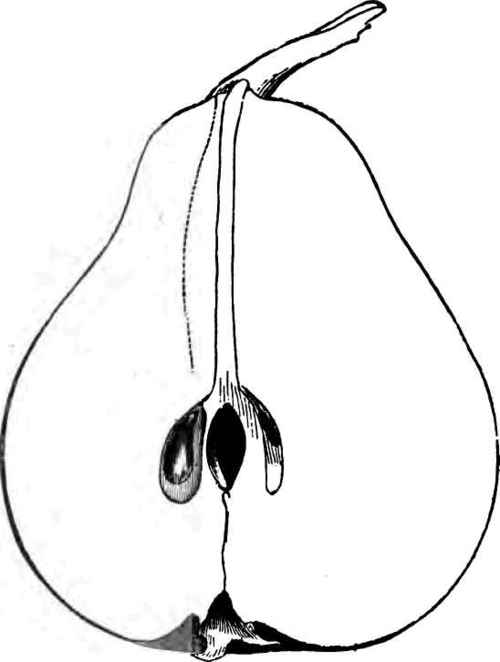
Fig. 96. - Cadette de Vaux.
Continue to:


My Books

