


Propagating Plants By Budding
Description
This section is from "The Horticulturist, And Journal Of Rural Art And Rural Taste", by P. Barry, A. J. Downing, J. Jay Smith, Peter B. Mead, F. W. Woodward, Henry T. Williams. Also available from Amazon: Horticulturist and Journal of Rural Art and Rural Taste.
Propagating Plants By Budding
Budding is the art of taking a bad with a small portion of the bark adjoining from one plant and inserting it in that of another, or into some other part of the same plant from which it was taken.
The physiological principles which govern the operation are, that there must exist an affinity between the plant from which the bud is taken and the one upon which it is to be placed, and the nearer the relationship the more readily will it unite and permanent the union.
The science of botany assists us in determining this relationship, but it is only by observation and practical experience that the affinity between the various plants has been fully determined.
For instance, it is doubtful whether by the aid of the science of botany alone, we could determine the reason why the pear, which so closely resembles the apple in all its parts, and botanically so nearly related, should in its wood have so little affinity.
In budding, it is very important that the bark of the stock should part readily from the wood; and to secure this, it is necessary that the operation should be performed when the flow of sap is abundant, because if the bud is inserted at this time it immediately finds the nourishment which it requires for its support.
The sap which has been assimilated by the leaves descends mainly through the inner bark, and on the external surface of the wood of the stock; it therefore comes in contact with the inside of the bark adhering to the bud, and is transmitted to the bud itself, which thus becomes attached to the plant upon which it is placed; or, in other words, a union is formed between the two.
For budding are necessary a small knife for preparing the buds for insertion, and opening the bark of the stock to admit them, and a quantity of some material to tie around the stock, so as to hold the bud in its place. Budding-knives are made after various patterns, those commonly used are represented in the accompanying figures. Fig. 175 has an ivory handle, made very thin at the end, and is used to raise the bark of the stock. Fig. 176 is a small pocket-knife with a thin blade, round at the end. The cutting portion extends about one third around the end of the blade, and about two thirds of its length, leaving the lower part dull. I consider this form of knife far preferable to the first, as in using it there is no loss of time in reversing it whenever a bud is inserted, as is necessary when using one in the form of fig. 175.
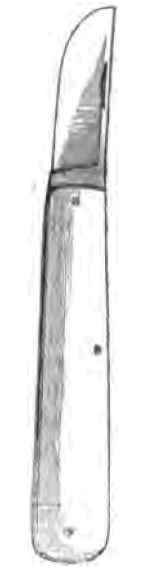
Fig. 175.
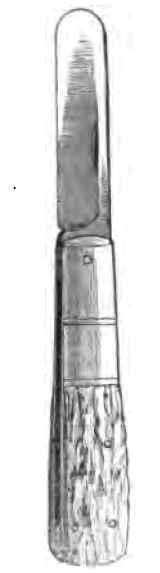
Fig. 176.
But it is immaterial what form of knife is used, provided it has a keen edge, and is dexterously used.
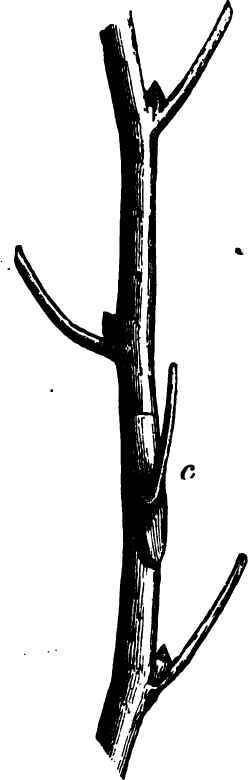
Fig. 177.
The material commonly used for tying in the bud is called bass, and is procured at almost any seed store, or it can be obtained in the form of bass-mats; but when it can not be had in either of these forms, and basswood trees, also called Linden (Tilia of botanists), are at hand, the bark may be stripped from them in the spring as soon as it will part freely from the wood. Immerse it in water from two to four weeks (varying according to the temperature of the water), and the bark will part with its mucilaginous matter, after which it may be divided into thin layers resembling fine silk, being very soft and pliable. The inner bark of other trees is sometimes used, also woolen yarn, strips of thin cotton cloth, cotton wicking, etc.; but the bass is more extensively used than any other material for this purpose.
In selecting buds, the young shoots of the present season's growth are usually preferred, and these should be taken from the most healthy and thriving branches. The leaves should be immediately removed, leaving a portion of the leaf-stalk attached, as seen in fig. 177. If the leaves have fallen from the branch, it is usually thought to be too ripe for use, but in some instances such buds may be used with success. If there are any soft, immature buds on the upper portion of the shoot, or any undeveloped ones on the lower end, they should be rejected.
To become an expert in budding, the following formula may be observed: Take the branch in the left hand, with the small end toward your body or partly under the left arm; insert the knife-blade a half inch below the bud, cutting through the bark and a little into the wood, passing it under the bud, and bring it out above it, taking off the bud with the bark and a thin slice of wood attached, as at c, fig. 177. Then first, and from this an incision down the stock about an inch long, being careful not to cut too deep; lift up the edge of the bark by passing the back of the blade up to the horizontal incision without removing it. Lift the bark on the other side in the same manner - the two incisions making a wound on the stock resembling the letter T, or as shown in fig. 178.
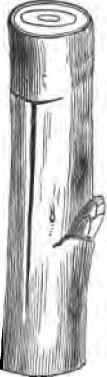
Fig. 178.
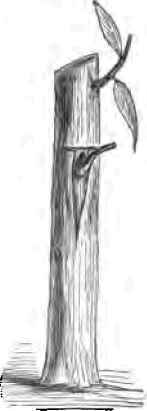
Fig. 179.
(if using budding knife fig. 176) let the forefinger clasp the lower part of the blade; make the horizontal incision in the stock
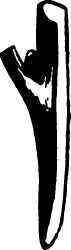
Fig. 180.
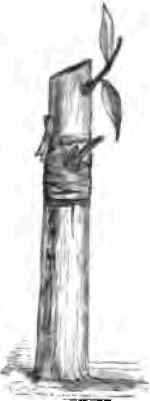
Fig. 181.
If the bark parts freely from the wood, it is not necessary to pass the knife-blade under the bark the entire length of the incision, but only enough to allow the point of the bud to enter the incision; a slight pressure forces it down to its place - see fig. 179.
Continue to:


My Books

