


Propagating Plants By Budding. Continued
Description
This section is from "The Horticulturist, And Journal Of Rural Art And Rural Taste", by P. Barry, A. J. Downing, J. Jay Smith, Peter B. Mead, F. W. Woodward, Henry T. Williams. Also available from Amazon: Horticulturist and Journal of Rural Art and Rural Taste.
Propagating Plants By Budding. Continued
The expert budder holds the bud between the thumb and forefinger of his left hand while making the incision in the stock; and as the knife leaves it, he catches the lower joint of the bark attached to the bud under the bark of the stock before it falls back into place, and thrusts it down into position. If the upper end of the bark of the bud does not pass completely under the bark of the stock, it must be cut across so as to join the incision in the stock. If the bud was removed after being fitted as described above, it would appear as in fig. 180.
When the bud is fitted to the stock, wind the bass (or other aterial used) around the stock, and tie it, covering the entire incision, leaving only the eye uncovered, as shown in fig. 181. The ligatures should be removed or loosened as soon as the bud has firmly united with the stock, which will usually be in ten to fifteen days, if at all. The horizontal incision in the stock is sometimes made below the perpendicular one, as at fig. 182. This allows more of the downward flow of sap to reach the bud than when cut across above it; but as it often proves detrimental, and not so convenient, this mode is rarely practiced, except upon plants in which the peculiar condition of the sap at the time of budding seems to require it
When a bud is taken from the shoot, as represented in fig. 177, c, there is a small piece of wood remaining under the eye, which, in budding some kinds of plants, it may be desirable to remove, although it is an almost universal practice in this country to let this wood remain, and doubtless in a majority of cases, and with most kinds of plants, it is best to do so; but there are instances when a more permanent union would be secured if it was removed. When the wood is to be taken out, branches must be used from which the bark will readily peel from the wood without tearing or breaking the fibers. Hold the branch in the left hand with the smaller end toward you; insert the knife-blade about one inch below the bud; cut a little deeper than you would if the wood was to be left in; pass the knife above the bud about an inch, then cut across through the bark only, about half an inch above the bud - see fig. 183; then, with your finger and thumb, lift up the bark, at the same time press it gently forward, and you will take off the bark and bud (a), usually without injuring it in the least, and leaving the piece of wood (b) adhering to the branch.
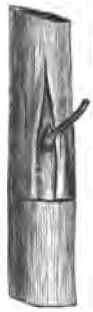
Fig. 182.

Fig. 183.
Examine the bud after it has been removed, for the purpose of ascertaining whether the chit, as it is called, has been broken off even with 'the inside surface of the bark, or whether it has broken within the bud, leaving a cavity; if the latter, there is danger that although the bark around the bud will unite with the stock, the bud itself will fail to grow unless the flow of sap on the stock is sufficiently abundant to fill the cavity soon after the bud is inserted.
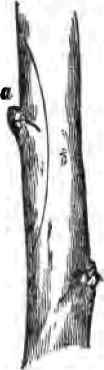
Fig. 184.
Another method of taking out the wood from the bud is to cut around it, as shown in fig. 184, then, with the thumb, press it sideways, and slip it off. This mode is used when the branch is large and the bark too thick to work readily in the former method. A thin piece of ivory, bone, or a goose-quill is sometimes used for separating the wood from the bud; but the method I have illustrated is the safest, and may be used in almost every instance where it is necessary to remove the wood.
Propagating Plants By Budding #1
The particular manner in which buds are taken from the branch or inserted in the stock will make but little difference in the final result, provided the operation is carefully performed and at the proper time.
One operator will insist that the best way to make the horizontal incision in the stock is by giving the edge of the knife a sloping inclination downward, as shown in fig. 194. This form has its advantages as well as its disadvantages. The point of the bark to which the bud is attached is more readily inserted under the bark of the stock than when the incision is made at right angles, but it also permits the water which falls upon the stock to enter the wound, often to the great injury of the inserted bud. This method is given in "Warder's American Pomology," and is there called Mr. Jackson's method.

Fig. 194,
The sloping incision would naturally suggest itself to any one who wished to perform the operation of budding very rapidly, because if the stock was in a proper condition, the bud could be thrust home without resorting to the knife for the purpose of lifting the bark; although, it must be admitted that, as a general rule, to lift the bark with the knife is far better than to do it with the bud. The bark and wood to which the bud is attached are not usually firm enough to resist, without injury, the pressure required to lift the bark of the stock.
The time for budding most kinds of hardy plants is usually during their growth in summer, varying the time to suit the different species, varieties, localities, and soils.
The experienced propagator who has become acquainted with the habits of the various species usually delays the operation until the stock has passed the time of its most rapid growth, for he has learned that if the bud is inserted too early in the season the stock will overgrow and smother it. Again, buds which are inserted too early will often push into growth, and not having sufficient time to mature their wood before winter, consequently perish.
Pinching off the end of the new shoot when a few inches long will often hasten its maturity, but buds which make no growth in fall are the safest. Removing the ligature with which the bud is tied, as soon as a union has been formed between bud and stock, will usually prevent a late growth.
Although summer is the best time for budding most kinds of plants, still the operation may often be performed successfully in the spring when vegetation is just starting into growth or when the sap has commenced to flow freely. The branches from which the buds are to be taken are usually cut from the parent plant early in winter and put away in damp moss, earth, or some similar material, where the buds will remain dormant, yet alive and uninjured, until wanted for use. Budding in the spring is performed precisely as in the summer, except that there should he no attempt at removing the wood. Buds may be removed from one tree and inserted into another in the spring, if both stock and cion are in the same condition, but the operation is not generally as successful as summer budding.
With trees and shrubs which have a very thick bark, such as the hickory, chestnut, and mulberry, the annular or ring budding will be found a very convenient and safe method of propagation. It differs from the other methods in several particulars, but the main one is that the bud is not inserted under the bark of the stock, but is fitted to it. A ring of bark passing nearly or quite around the stem upon which there is a bud, is taken from the branch, and a similar ring is cut from the stock, and the bud and bark are fitted into this and then carefully tied in its place. The branch from which the bud is taken, and the stock to which it is affixed, should be of nearly the same size, although a piece of bark may be taken off from the bud, or the same added to it, for the purpose of making a close joint. Fig. 105 shows a stock and the ring of bark, with bud ready to clasp around it.
Ring budding is a valuable method where it is desirable to propagate many kinds of trees which require great care and considerable skill to insure success with the ordinary forms of summer budding. Like other methods of propagating plants, budding may be performed in various ways. The exact form or size of the bud or stock is not so very essential, the main thing to be observed is their condition at the time the operation is performed. It should be borne in mind that new plant-cells must be formed before a permanent union can take place, consequently both bud and stock should be in a condition to produce them soon after the junction is artificially made. As the delicate tissues of growing wood or bark are very sensitive to exposure, it is apparent that in performing the operation of budding in any of its forms, it should be done as rapidly as possible, compatible with completeness of execution.
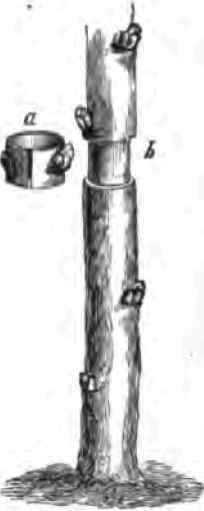
Fig. l95.
Continue to:


My Books

