


Residence Erected For W. Gummere, Germantown, Pa
Description
This section is from "The Horticulturist, And Journal Of Rural Art And Rural Taste", by P. Barry, A. J. Downing, J. Jay Smith, Peter B. Mead, F. W. Woodward, Henry T. Williams. Also available from Amazon: Horticulturist and Journal of Rural Art and Rural Taste.
Residence Erected For W. Gummere, Germantown, Pa
The economy obtained in the plan of this building is remarkable. The contract was taken at $5,700, exclusive of range, heater, and mantels, while an ordinary "double" square house, erected at the same place and time, with the same number of rooms, and about the same average size of rooms, cost $7,000. The difference is much the more remarkable, on account of the neighboring house having been completed in plaster externally, with wooden partitions and ordinary finish inside, while the house forming the subject of our sketch is finished externally with hewn stone, the inside partitions in the first, and partly in the upper stories, being of stone or brick, and the finish throughout unusually good and substantial. The amount of waste room however, in the neighboring house, is, as might have been surmised, great; while I think it will be difficult to point to a single cubic foot of wasted room in the plan now under examination. As regards the degree of picturesque beauty obtained in this arrangement, especially when contrasted with a three-story square house, the architect must leave this question to the taste of the readers of the Horticulturist.
The plan embraces an entrance hall, 10 ft. wide, with a coat closet, a very cosy " library and breakfast room " with closet for books and china, a large square parlor with bay window, a spacious dining-room with two china closers and pantry, and convenient inner and outer kitchens. Above, are chambers, bathroom, closeting, and the observatory. The verandas are ample and shady. The plan of a side entrance was adopted in order to narrow the front to a proper proportion with the width of the lot (80 ft.) and to avoid too much cutting up of the front lawn with the carriage road. I think the plan, however, would strike the eye very pleasantly, if erected on a wider domain, though in the latter case some modification might be advisable. The effect of a two story building, more agreeable to rural simplicity than that of a towering three story, is here produced, notwithstanding the existence of an actual third story, (level-ceiled over three-fourths of its space,) by the depth given to the cornice on the wall, and the high heads of the second story windows, by which the architectural effect of these features is also increased, while the economy in roofing, etc, obtained in a three story over a two story building, is preserved.
Contributed by R. Morris Smith, architect, 146 So. 4th St., above Walnut, Philadelphia.
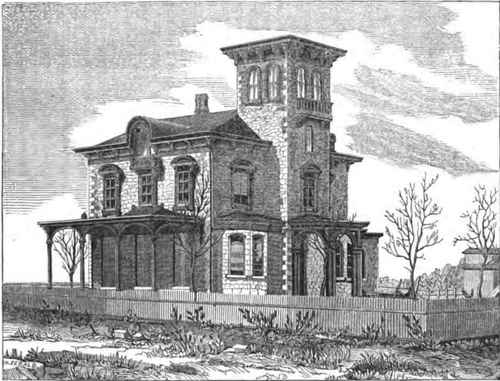
RESIDENCE ERECTED FOR W. GUMMERE.
Continue to:


My Books

