


Zauschnebia Californica. [From The London Horticultural Magazine]
Description
This section is from "The Horticulturist, And Journal Of Rural Art And Rural Taste", by P. Barry, A. J. Downing, J. Jay Smith, Peter B. Mead, F. W. Woodward, Henry T. Williams. Also available from Amazon: Horticulturist and Journal of Rural Art and Rural Taste.
Zauschnebia Californica. [From The London Horticultural Magazine]
Zauschneria California, Presl (Californian Zauschneria) - Onagraceae § Epilobeae.
To the indifferent observer, there is not much resemblance between the Evening Primrose and the Fuchsia; and yet, in fact, their structure so closely corresponds, that they are ranged in the same natural family, - that of Onagraceae. The resemblance, it is true, is not so much in outward aspect as in their internal structure, which, if examined, will be found to present many points of accordance. The Zauschneria, however, to some extent, links them together even in outward aspect; the general habit and appearance of this plant is such as would be readily identified in ge-ral character, by a slightly practiced eye, with some of the forms of (Enothera, and the blossoms are not unlike those of the Fuchsia.
It will be seen that the number four, or some multiple of four, prevails in the floral parts of all these plants; thus, the calyx has four lobes, whether it be the colored calyx of the Fuchsia, or the green calyx of the Evening Primrose; the petals, also, are four in cither case. In some plants the order of the stamens are four, in a few instances half four, and in the Fuchsia, and many others, twice four; the stigma is more often four-lobed, and in one species of Fuchsia these lobes are so apparent, that it has in consequence, been named tetradactyla, or four-fingered. Where this kind of structure is present, the plants are said to be tetramerous, from the Greek tetra, which signifies four. Among exogenous plants, this tetramerous structure is not by any means so common as the pentamerous, in which the number five rules in some or all of the floral organs; while, on the other hand, among endogens, the parts are usually arranged by threes.
This Zauschneria has been for some time known and regarded as a desideratum for our gardens. It has lately been obtained from the California fields, by Mr. Hartweg, the collector for the Horticnltural Society Of London, and proves to be, as was expected, a plant of considerable beauty, and therefore a very interesting and valuable addition to our collections. It is an herbaceous perennial, and quite hardy if planted in a situation where it is not exposed to much damp about the roots in the winter season. Its habit is branching and bushy, and as it grows about three feet high, it forms, from its size, an object of some attraction, especially as the blossoms are of large size, and very numerously produced. The stems are furnished with ovate leaves, which are slightly toothed on the margin, and attached without any intermediate stalk, or, as it called sessile. These stems become much branched, and every one of the branches produces from the axils of the leaves towards its apex, one blossom, which assumes a nearly horizontal position, is about an inch and a half in length, and is of a bright scarlet color.
The calyx is tubular, with a four-cleft apex, the sepals being rather narrow and sharp pointed, and the tube itself marked with four stout ribs; the corolla consists of four petals, which are universally heart-shaped, and spread out nearly or quite flat; the stamens, which are eight in number, and the stigma which is four lobed, are all red, and project considerably beyond the corolla. It will thus be seen, that although in many respects approaching near to a Fuchsia in appearance, it is, in fact, very distinct from that, and all other flowers at present cultivated in our gardens, and will probably become highly prized as an ornamental species.
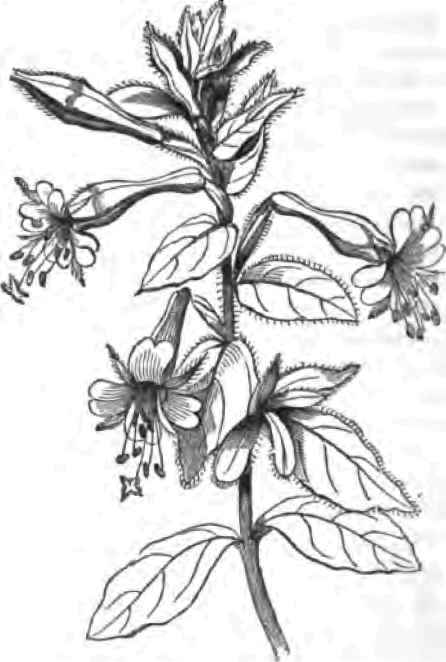
Mr. Hartweg found it "in fields about Santa Cruz, in California," from whence seeds were sent, and received in England, in May, 1847. Sown in May, the seeds produced plants which, though of perennial duration, blossomed by the month of September. Probably when established, it will be found to produce its blossoms throughout the summer season.
The cultivation of this plant is stated in the Journal of the Horticultural Society, to be extremely simple. " The plant grows freely in good garden soil, and is easily increased by cuttings or seeds." A warm dry situation would be the most likely to ensure success in its cultivation.
[This pretty plant is quite hardy in our garden. En. Hort].
Continue to:


My Books

