


Cuttings Of The Leaves
Description
This section is from "The Horticulturist, And Journal Of Rural Art And Rural Taste", by P. Barry, A. J. Downing, J. Jay Smith, Peter B. Mead, F. W. Woodward, Henry T. Williams. Also available from Amazon: Horticulturist and Journal of Rural Art and Rural Taste.
Cuttings Of The Leaves
Cuttings of the leaves are seldom used in propagating hardy plants. They are sometimes employed merely for the purpose of showing what may be done, although there are usually other methods which are attended with less trouble and are far more certain. When it is desirable to propagate from cuttings of the leaves of woody plants, they are usually taken off entire, with the petiole or leaf-stalk-attached, as shown in fig. 108; the petiole in this case representing the stem of a cutting of green wood.
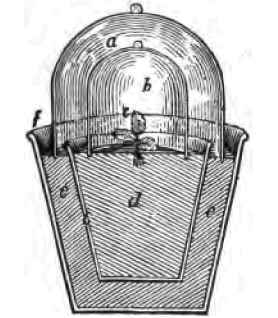
Fig. 110.
The leaf shown in fig. 108 is that of the common lilac If carefully separated from the branch, when fully expanded, but not mature, and placed under proper conditions, roots will be emitted from the lower end of the petiole; afterward a bud will be produced near the junction, showing conclusively that buds, or the power of producing them in woody plants, do not belong exclusively to the stems, branches, or roots, as some vegetable physiologists assert, but that even the leaves are capable of becoming individual plants. The rose has often been propagated from its leaves; in fig. 109 is shown a rooted leaf with the small bud at the base of petiole as it appears when first starting to form a new stem. The usual method employed in making experiments with such delicate subjects is to use two bell-glasses, placing one over the other, as shown in fig. 110, the leaf cutting being planted in pure sand in the center of the pot. Also two pots are sometimes used, as shown; d, the center one, being filled with pure sand, and the space between the two, e, filled with moss or tan; f. the outside pot; a, the large bell-glass; b, the smaller one; c, the leaf cutting.
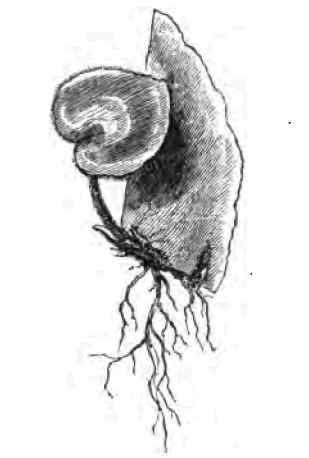
Fig. 111.
As I have previously stated, propagating woody plants in this manner is of no practical use, but it merely shows us that it can be done; besides, it furnishes positive proof that many theories heretofore advanced in regard to the origin of buds and structure of leaves are wholly untenable. In propagating succulent plants, many of which have no true leaves, the stems answering the place of both, we are obliged to use the leaves or stems, whichever we may choose to call them; but there are other plants, like the gloxinias, begonias, portulaccas, lilies, some of the ferns, in fact, a host of exotic plants, as well as a number of indigenous ones, of which it is often quite convenient to use the leaves for the purpose of propagation. With what are usually called herbaceous plants, that can readily be propagated in this manner, it is not necessary to plant the leaf entire, but it may be divided into a number of cuttings, and each will produce one or more plants. Fig. 111 shows a section of a begonia leaf with roots and the new plant as they are first formed.
With these leaf cuttings a warm humid atmosphere is very essential as well as with green wood cuttings and leaves of woody plants. Various materials are sometimes used in which to grow the green as well as ripe wood cuttings - sand, clay, peat, pulverized brick, moss, tan-bark, spent hops, etc., etc., each of which have had their advocates and day of popularity; yet the most skillful propagators of plants at the present time depend mainly upon sand, for in addition to its porous nature, which admits of such perfect drainage, it contains less noxious materials which often combine with the juices of the plants when exposed, and thereby cause their destruction. The amount of plant food required by cuttings while producing roots is so exceedingly small, that the air and water which surround them will generally furnish a full supply.
Continue to:


My Books

