


The Dwarf Convolvulus
Description
This section is from "The Horticulturist, And Journal Of Rural Art And Rural Taste", by P. Barry, A. J. Downing, J. Jay Smith, Peter B. Mead, F. W. Woodward, Henry T. Williams. Also available from Amazon: Horticulturist and Journal of Rural Art and Rural Taste.
The Dwarf Convolvulus
The Dwarf Convolvulus (Convolvulus minor) is a beautiful flower, with three distinct colors, blue, yellow, and white; the blue being of every shade from purple to a delicate azure blue. We have also the white and striped. The species is a native of Spain, Portugal, Sicily, and the north of Africa, and was introduced into England from Portugal early in the seventeenth century. Some botanists suppose this species to have been originally only found in Barbary; but whether introduced or indigenous, it is now a common weed both in Spain and Portugal. The flowers always fold in gloomy weather and at night The French call it Belle-dejour.
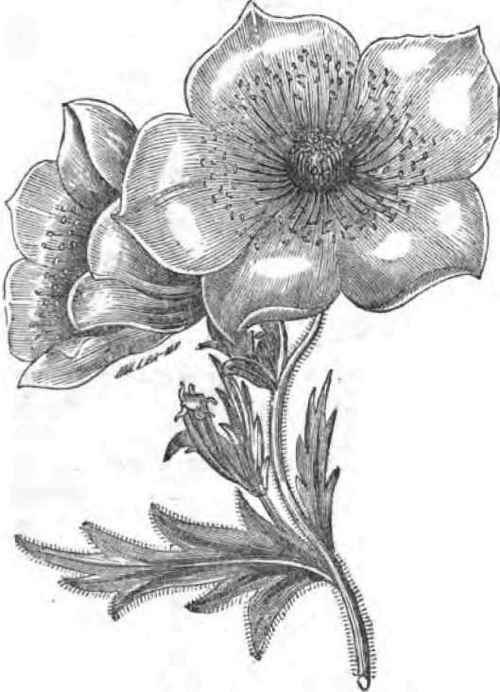
GOLDEN BAETDNIA.
When the seeds are sown, a shallow drill should be made for them, in which the seeds may be dropped and covered lightly. When the plants come up, they should be thinned so as to stand about an inch apart They require a dry situation, and rather a rich, light soil. Sow early in the spring, and they will commence flowering in July, and continue until covered with snow.
We received last year several packages of this seed from France, among which were several varieties new to us, one of which was peculiarly dwarfish in its character. Among our large collection of annuals, last year, none attracted more attention among florists than this Dwarf Convolvulus.
The Convolvulus major, or Morning Glory, is too well known to need a description, it being one of the most common as well as the most beautiful and easily cultivated of our climbing annuals. It requires the same treatment as the Dwarf Convolvulus, but needs strings or poles on which to climb. It makes an excellent covering for arbors, porches, or unsightly fences.
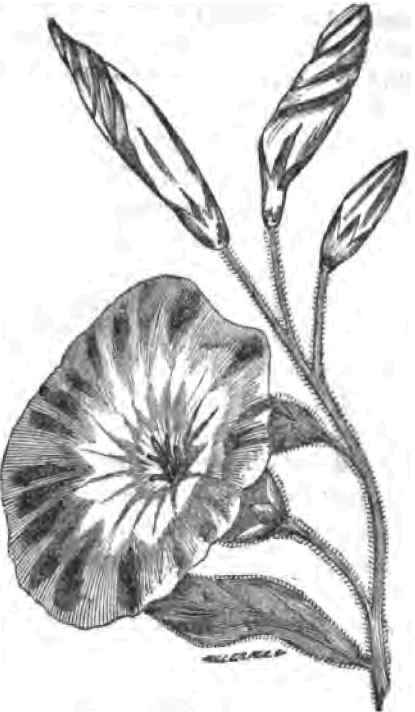
DWARF CONVOLVULUS.
Continue to:


My Books

