


Economy And Simplicity Of Hot Water For Heating Greenhouses
Description
This section is from "The Horticulturist, And Journal Of Rural Art And Rural Taste", by P. Barry, A. J. Downing, J. Jay Smith, Peter B. Mead, F. W. Woodward, Henry T. Williams. Also available from Amazon: Horticulturist and Journal of Rural Art and Rural Taste.
Economy And Simplicity Of Hot Water For Heating Greenhouses
We have used hot water in our establishment the past twenty-three years for heating our greenhouse erections, - at first, with great caution and some small fear; and we consider it economy wherever there is an amount of 2,000 square feet of glass to heat. We have seven of Burbridge and Heally's double cylinder ribbed boilers in operation; they cost (made in Philadelphia) from $35 to $45 each, and with Sylvester register doors, bars, and fixings, about $20 additional. The greatest capacity we have put any of that kind of boilers to is in four houses, each 55 feet long and 18 wide, and kept at a temperature of from 45° to 75o, as required, using 600 feet of four-inch pipe for the purpose, and find it fully sufficient. We find no difficulty in filling circulation, or any arrangement we undertake. We are, however, particular to have an air-pipe at the highest, point, and also fill the boiler and pipes at the extreme end, having found at our early adventure that there was an objection to the arrangement for filling at the boiler, causing frequent eruptions of hot water from the boiler, thereby impeding or entirely defeating circulation.
We prefer having the extreme end of the pipes about 12 to 18 inches higher than the boiler, and all the extremities mus't be on the same level, or the highest end will always have the hottest water. We have more than once heard it said "something wrong with the pipes," but have generally found it "something wrong " with the attendant, which was readily discovered by feeling the pipes on the upper surface backward and forward till we came to heat; then on the under surface, which if warmer than the upper, water was certainly deficient; but if the cold was only in spots, with a cracking noise in the pipes, air had got into them, which is a very rare occurrence, and caused by the pipes being out of an even inclination. The air-pipe must be occasionally examined with a wire or rod to keep it clear of incrustations.
All the boilers should have a tap at their lowest part to empty them when required. We have them, however, that have not been emptied the past five years. We find water perfectly ductile in its adaptation. You may dip the pipes to almost any accommodation, observing the following rules. If you wish to dip the .flow-pipe at any place, the dip must be shorter than the rise, thus:
If in the return-pipe, the dip must be longer than the rise. Wherever these dips occur, however, there must be an air-tube. It is all important for success in every heating operation, that simplicity, cheapness, and durability, with economy of fuel, should be combined. We therefore look for a cheap, efficient boiler and four-inch pipes at 25 to 30 cents per lineal foot. The "one boiler system," as it is called, has been adopted very successfully in some European establishments, while others have failed from deficiency in working-knowledge. We presume, however, that there are none more effective than that of Thos. Winan, Esq., of Baltimore, where ten or twelve greenhouses, and nearly as many graperies, with mansion, carriage-houses, etc., are all completely heated by one tubular boiler, with the greatest simplicity in its manipulations.
[The interest of the "Boiler Question " is by no means confined to this continent; it is at present discussed in the English journals a good deal more than in ours. The "one boiler system," alluded to by Mr. Buist, is said to be most efficient there. The "Polmaise " is being discussed again, and a recent modification of it by Mr. Kidd is said to be a great improvement; but this modification is nothing more than the hot air furnace common in dwelling-houses all over the United States. Mr. Winan's boiler must be a powerful one, and we should have been glad if Mr. Buist had told us who it was made by. Making a "dip " in a pipe, as illustrated by Mr. Buist, is a point that has been warmly discussed, but we know that it can be done without detriment to the circulation of the water.
Rise.
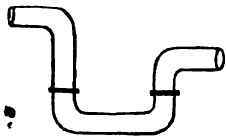
Dip.
We prefer, however, to make the dip and rise at an angle of about 45° instead of a right angle; but it can be done either way. We do not make the statement as a matter of opinion, but as a matter of fact. We hope to have the pleasure of hearing from Mr. Buist again. It is always a gratification to see in the pages of the Horticulturist the names of its old friends. - Ed].
Continue to:


My Books

