


Garden Thermometers
Description
This section is from "The Horticulturist, And Journal Of Rural Art And Rural Taste", by P. Barry, A. J. Downing, J. Jay Smith, Peter B. Mead, F. W. Woodward, Henry T. Williams. Also available from Amazon: Horticulturist and Journal of Rural Art and Rural Taste.
Garden Thermometers
Urwards of a year ago we drew the attention of our subscribers to the important subject of garden thermometers, and pointed out certain improvements therein effected. Since that time, we are happy to be able to note that the attention therein drawn to the subject has been instrumental in effecting still greater improvement, combined with economy. Our friend, Mr. George Cox, the well-known optician (5, Barbican, London), has specially directed his attention to the improvement of that most useful instrument, the garden thermometer, and we are glad to say with the greatest success.
We consider Mr. Cox entitled to the best thanks of the gardening public for his exertions in producing so fine and delicate a thermometer at so reasonable a price (3s. 6d.). This simple and accurate instrument is less expensive than registering thermometers previously in use, and equally correct. It shows the temperature at the time of observation, like any other thermometer; and when hung up horizontally, and the floating index tilted to run to the upper end of the spirit, it is set for determining the coldest point reached during the day or night The spirit collapses over the top end of the index, and draws it down the tube, leaving it at the extremest degree of cold arrived at. The observer will then have the satisfaction of seeing how cold it has been since his last observation, and what is the present temperature.
Our experience warrants us in saying that "Cox's garden thermometers" are decidedly the most inexpensive, durable, and correct of any previously in use; and we hope no gardener will neglect to provide himself with so useful a guide in all his operations. The fact is, and it cannot be disguised, that, as a body, horticulturists are not sufficiently alive to the importance of paying close attention to temperature and other meteorological conditions, although in scarcely any profession is it more necessary and beneficial.
A superior instrument has also been brought out by the same eminent maker, being a self-registering thermometer for both day and night, in which each tube is influenced by the same bulb. The centre bulb is filled with pure spirit, which expands by heat, and causes the mercurial column to descend on the left hand (or night) side, and ascend on the right hand (or day) side, carrying the index with it on the surface until the heat is diminished, when the index will be left at the maximum, or highest degree of temperature. This furnishes the registration for the day. For the night, as the temperature is decreased, the spirit contracts, and is followed by the column of quicksilver, which then ascends on the night side, and carries the index on its surface, until it reaches the minimum or coldest point.
This instrument is eminently adapted for the open air, conservative walls, frames and pits, greenhouses, stoves, and every other erection connected with our "science of horticulture".
A more extraordinary instrument, very valuable, though more costly, is Mr. Gauntlett's new "Patent Chronometrical Thermometer," for horticultural- purposes, for keeping a permanent, written record of atmospheric tem-perature, whether in doors or out. Every proprietor of a greenhouse or stove should possess one of these invaluable articles.

The novelty of this thermometer consists in metallic tubes being used in place of mercury, and in their connection with a clock movement, which puts in motion a drum, to which a strip of paper is attached. The ther-mometric tubes expand and contract as the temperature varies, and the motion thus produced is conveyed to a pencil that inscribes a line upon a strip of paper. This line is a permanent record of the temperature. When the strip of paper is filled up, a fresh strip is attached. These strips are ruled with lines, as shown in the following diagram; the vertical lines represent the thermometric scale. The horizontal lines correspond with the hours of the day and night. This instrument is chiefly valuable for horticultural purposes, where temperature is a matter of the first importance. The strip of paper shows at a glance what the temperature of a propaga-ting-house, greenhouse, conservatory, etc., has been during any moment of the day or night, the precise moment when a change took place, and how long such change continued. The clock movement, which consists of an excellent eight-day timepiece, not only propels the strip exhibiting the temperature, but also shows the time. The action of this thermometer is very quick.
Changes of temperature, however slight, are instantaneously indicated; this arises from the large amount of metallic surface exposed to the heated medium. The mercurial thermometer, on the contrary, is very slow in indicating slight changes of temperature. This is owing partly to the substance of the glass opposing an obstacle to the transmission of heat to a certain extent, and partly to the bulk of the mercury offering so small a surface to be acted upon by heat, which must be diffused throughout the mass before any true indication can be given. This property of instantaneous indication renders the Chronometrical Thermometer peculiarly valuable for scientific purposes; we therefore unhesitatingly recommend it to the gardening public. - Horticultural Cabinet.
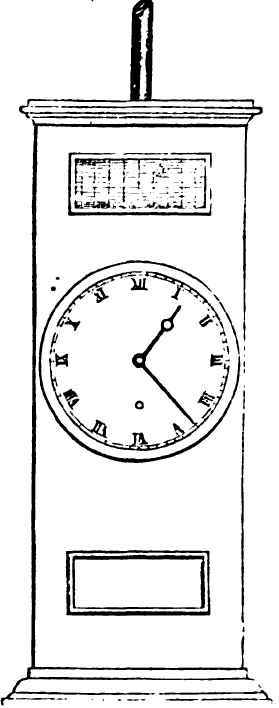
Gauntlett's Chronometrical Thermometer.
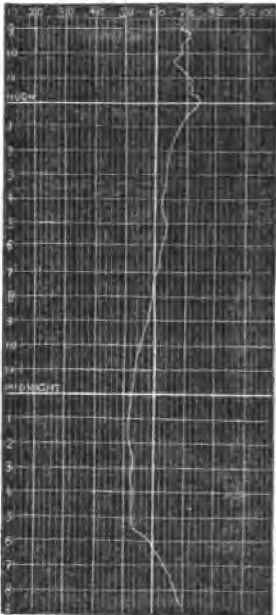
Scale traced by Gauntlett's Instrument.
Continue to:


My Books

