


Part V. Sundry Operations. Forcing, Heating Glass Structures
Description
This section is from the "Kitchen Gardening Made Easy" book, by George M. F. Glenny. Also see Amazon: Kitchen Gardening Made Easy.
Part V. Sundry Operations. Forcing, Heating Glass Structures
Forcing, Fumigating, Labelling, etc.; and the Importance Of attending to the same.
Forcing
There are various ways of accomplishing this operation; it can be done by means of hot-water pipes, flues, and stable-dung. The two former methods are resorted to where expense is no object; but where economy has to be studied, the latter mode will be found very effective for all ordinary purposes. By way of illustrating the subject we give illustrations of three structures (see Figs. 11, 12, 13).
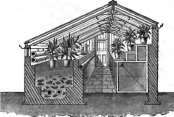
Fig. 11. End section of a useful short back-roof forcing-house, Laving ventilators in lien of front sashes, with top and bottom heat. The front pit is suitable for melons, cucumbers, etc, and the stage at bach for plants requiring similar temperature.
Another cheap and handy method of heating a frame is by means of Mussett's stove, Fig. 14: a, Boiler; b, flow pipe; c, return pipe; d, heating apparatus; e, paraffin lamp; F, hole in the ground to let down lamp.
The next sketch (Fig. 15) represents the apparatus, which is 20 inches high and 44 inches long, including boiler with a paraffin lamp attached: A, boiler; b, flow pipe; c, return pipe; D, heating portion; e, paraffin lamp; the dotted line shows the ground level; and f, hole in ground for removing and returning lamp.
Heating Glass Structures
This is a matter of no small moment to both amateur and professional gardeners, and as it can now be accomplished so easily and cheaply by means of hot-water pipes, there is no reason why the former should not have his cucumber and melon house as well as the latter. The first thing to consider in starting is what sized pipes shall be used.
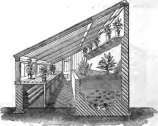
Fig. 12. End section of a forcing-house, with pit for bottom heat at back and stage to front. Such a structure would be found very useful' for the production of chilis, tomatoes, capsicums, etc, and also for melons and cucumbers.
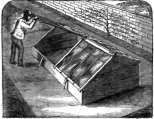
Fig. 13. Flan of a two-light frame, suitable for cucumbers, melons, etc, and, in short, anything that requires heat.
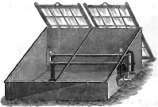
Fig. 14.
Shall we have four one-inch pipes, or one four-inch pipe? The prevailing notion is that one large pipe is preferable to four small ones. We must not, however, lose right of the fact that the circulation of hot water is quicker in email pipes, and that the heating surface presented to the air of the house is greater from four one-inch pipes than from one four-inch pipe. Perhaps the best excuse for using the latter is that the larger volume of hot water in the large pipe would not cool so quick, and consequently would supply" a latent heat which the smaller pipes, having cooled earlier, would fail to do. Another perplexing question with the amateur is, when he has built a new glass-house, How much piping is necessary to heat it, and where shall it be placed? What sized and what shaped boiler is best to maintain a given tem-perature under all conditions of outside weather? To which we answer, that the quantity of cubic feet of air enclosed by the house must be calculated, together with its architectural features - wheather it be a span-roofed louse, with its four sides and roof of glass, or a lean-to. The former is the best for light, but would necessarily require more piping than the latter, that is supposing the temperature in each house has to be kept the same, say fifty degrees.
A lean-to {such as represented at Fig. 16), with a wall forming the back, is a form of house in which plants receive light on one side only, and should face to the warmest points. It is well known that glass radiates heat very freely, and this form of house, presenting as it does less glass surface to the cold air, would require less piping than a span-roofed house of the same dimensions. Again, the wall itself, having absorbed heat when the house was warmest, would gradually give up such heat as the house cooled, and thus contribute towards warming the house when warmth was most needed. As the more "laps" there are, where the panes of glass meet, the more heat is necessary, we hare shown the policy of using large panes, and consequently reducing thenum-ber of laps considerably. It is better to have double the number of pipes kept at a nice mellow warmth, than a small quantity which you will be forced to keep quite hot. The best boilers are those which, when fixed, allow a free access of the flame to its outer as well as its inner surface; but for amateurs who prefer to look after their own fires, provided the work can be done in a cleaner and lets laborious manner, there is nothing to surpass gas, which, if on the premises, can easily be conducted to the inside of the house.
As we have already stated, the gas-fired boiler and its connections may all be inside the house, and thus apply the heat with much economy direct to the air of the house. Mr. Mussett has invented a kind of hood or funnel-shaped cap of sheet-iron (Fig 17), which is to be properly adjusted over the burners, in such a manner as to collect the fumes thrown off by the gas in combustion; and a pipe fitted to this funnel should lead to the outside of the house, for the purpose of conducting the vitiated air to the winds.
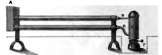
Fig. 16.
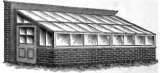
Fig. 16.

Fig. 17.
Since describing the foregoing our attention has been drawn to Tebbs's Universal Heating Stove (see Fig. 18), a very useful invention, and one likely to supersede all previous contrivances for heating greenhouses, conservatories, ferneries, libraries, and, in short, any place where pure air and genial, warmth is required! Anyone inspecting this apparatus will be at once convinced of its utility. The inventor describes it in the following terms: - "In introducing to the notice of the public my new Heating Apparatus, the main object has been to place in the hands of all interested in the cultivation of plants under glass an original, safe, and economical means by which the greatest amount of heat can be obtained with the smallest amount of fuel, requiring little or no attention for twenty-four hours, and giving off nothing but pure heated air. This is obtained by bringing the pipes or tubes together in one body, and allowing the smallest space between each for the circulation of hot water on their outer circumference, retaining the inner circumference for the heating of the atmosphere as it ascends by the natural attraction of the vertical heated tubes or pipes, which will be found much more effective than the old system of having pipes or tubes filled with water extended from the boiler by flow and return, as the heat becomes expended every foot it travels.
By this new system I maintain the whole of the pipes or tubes at the same high temperature, thus heating the air more rapidly as it ascends through the inner circumference. They can be adapted for burning either gas, fuel, or petroleum oil, and can be made any size or shape".
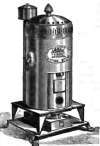
Fig. 18.
Continue to:


My Books

