


Exercise II. Seed-Testing
Description
This section is from the book "Laboratory Manual Of Horticulture", by George W. Hood. Also available from Amazon: Laboratory Manual Of Horticulture.
Exercise II. Seed-Testing
Material. Seeds of clover, celery, onion, cucumber, tomato, wheat, cabbage, oats, eggplant, beet, peas, rye, beans.
Apparatus. Sprouting-chamber, Geneva seed-tester, pane of glass the size of the tester.
Use the Geneva seed-tester to familiarize the student with this method, which can be applied on a large or a small scale. Each seed-tester should be thoroughly sterilized by placing about one inch of water in the pan, allowing the cloth to remain in the folds suspended on the rods, and boiling the water from fifteen minutes to a half hour, or until everything is thoroughly steamed. A piece of glass should be placed over the top of the tester to hold the steam and to give a more thorough sterilization.
1. Count out one hundred seeds of clover, celery, onion, cucumber, tomato, wheat, cabbage, oats, eggplant, beets, rye, and fifty seeds of peas and beans. Place the seeds in the tester, which has previously been thoroughly sterilized with steam. Discuss why we sterilize the tester. The tester should be placed in a sprouting-chamber where the temperature can be maintained around 80° F. Why? Discuss fully what would happen to the seeds if the temperature were to fall as low as 50° F. Why is it important that seeds should not be planted until the soil is thoroughly warmed up? Will any seed germinate in the presence of oxygen and moisture without heat? In testing seeds do all of them germinate at the same time? Discuss the irregularity of seeds in germinating when the same external conditions are given. Is a sprouting-chamber necessary in order to germinate seeds? Discuss the advantages gained by the rapid germination of seeds.
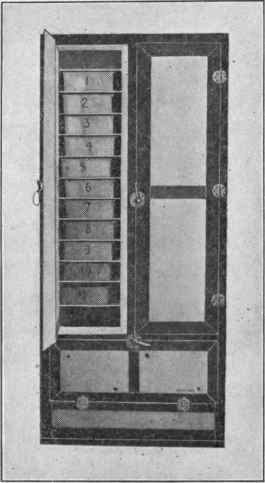
Fig. 3. Sprouting-chamber, or germinating-oven, showing the Geneva seed-testers on the shelves.
Seed-Testing. Student's Notes And Report
Name of Seed | Date GERMINATION | No. OF Seeds | No.of Seeds germinating, by Days | Total No. GERMI-NATING | Per Cent Germination | ||||||
1st | 2d | 3d | 4th | 5th | nth | 7th | |||||
• | |||||||||||
2. Tabulate your results, and figure out the per cent of germination. This test should continue from a week to ten days, but a week is usually sufficient for most seeds. Remove all of the seeds as they germinate after the count has been tabulated. Discuss fully what is gained by seed-testing. Discuss the three essentials necessary for the germination of seeds.
Note. I have found that the most convenient size of the Geneva seed-tester for class use is eight inches wide, fourteen inches long, and three inches deep. No. 12 wire makes a good size to support the cloth, and the length of the cloth most convenient is four feet, containing ten pockets. In making the pockets, enough Canton flannel should be allowed for the making of the seam, so that the pocket may be at least one and one-half inches deep. Two or three such cloths may be placed in each pan if necessary.
References
Bailey, "The Nursery Book," chap. i.
Bulletin No. 35, Rhode Island Agricultural Experiment Station.
Goff, "Principles of Plant Culture," pp. 24-32.
Continue to:


My Books

