


Exercise XV. A Study Of Hardwood, Or Dormant, Cuttings
Description
This section is from the book "Laboratory Manual Of Horticulture", by George W. Hood. Also available from Amazon: Laboratory Manual Of Horticulture.
Exercise XV. A Study Of Hardwood, Or Dormant, Cuttings
Material and apparatus. Currant and gooseberry branches and rooted cuttings of each; sharp knife.
Hardwood cuttings are made from the dormant, or mature, wood of dicotyledonous plants, and should be cut just below a node because they form roots more promptly if cut at this point. They are usually taken in the fall or the early winter and stored in a cool place in sand so that they will callus over before being planted the following spring.
1. Study hardwood cuttings of the currant and the gooseberry. These cuttings should be about six inches in length, and, if the weather permits, the students should be allowed to collect their own cuttings from the parent bush.
Make a natural-size drawing of each of the cuttings. How many buds are usually found on each? How does the cutting of the currant differ from that of the gooseberry? What is the age of the wood from which cuttings are taken? Describe.
2. Study some cuttings of the currant and the gooseberry that have been stored in damp sand for two months. How do they differ from cuttings just taken? Make a drawing of the lower end of the cutting, showing the callus tissue. What is the purpose of this tissue? Label all parts, and discuss.
3. Study some cuttings that have just started into growth. From what position on the cuttings do the roots come? Explain. What indications are there on the cuttings that roots are forming? Discuss.
References
Bailey, "The Nursery Book," chap. iv.
Groff, "Principles of Plant Culture," pp. 207-218.
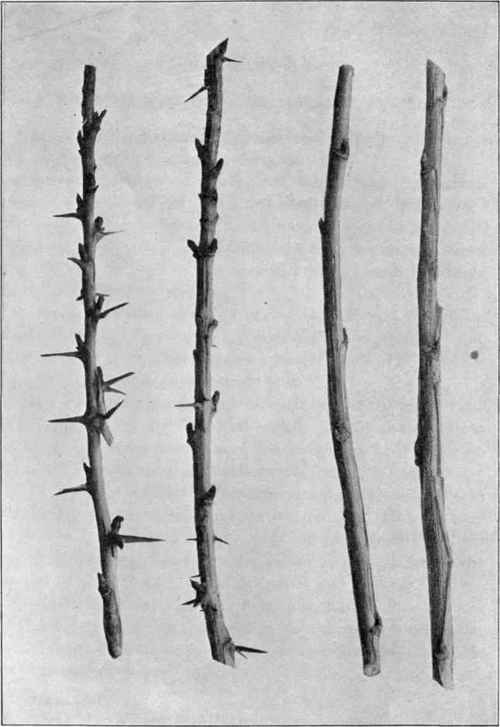
Pig. 9. Hardwood cuttings of the gooseberry and the currant Natural size.
Continue to:


My Books

