


Exercise XXI. Grape. A Study Of Buds-Vine Fruits
Description
This section is from the book "Laboratory Manual Of Horticulture", by George W. Hood. Also available from Amazon: Laboratory Manual Of Horticulture.
Exercise XXI. Grape. A Study Of Buds-Vine Fruits
Material and apparatus. Canes of the grape, showing well-developed buds; razor, lens.
The Grape (Vitis Sp)
The grape is one of our oldest fruits. The history of the Old World grape goes back to prehistoric times. Grape seeds have been found in the remains of the Swiss lake dwellings of the bronze age, and the original habitat of the grape is supposed to have been about the Caspian Sea. Several species of grapes are recognized, but the two of greatest commercial importance are the Vitis vinifera, or the Old World grape, and the Vitis labrusca, or the New World grape. There are many hybrids between these two.
Vitis labrusca. Varieties suggested for study: Black Hawk, Champion, Chautauqua, Colerain, Concord, Cottage, Eaton, Glenfeld, Hosford, Moore Early, Lutie, Lucile, Wyoming, Worden, Vergennes.
1. Secure canes of one or more of the above varieties, and study carefully. Make a drawing of a cane, natural size, including at least two buds. Describe the position and the arrangement of the buds. What is the color of the bark? Describe. Make a drawing, at least one inch in length, of a bud. How does this bud differ from the bud of the cherry and of the "apple? Describe the bud scales. 2. Make a longitudinal and a cross section of a bud. Describe the internal structure. Is this a fruit bud or a leaf bud? Where is the fruit borne on the grape? Describe fully.
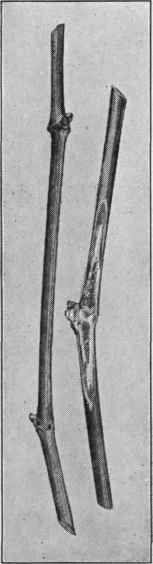
Fig. 17. Grape canes, showing the buds.
3. Make a longitudinal section of a cane, through a node, and show by a drawing the internal structure. Label the pith, bark, and wood. What proportion does the bark bear to the pith? Can you locate the diaphragm which is found at the node, after a longitudinal section of the cane is made? Label. Describe.
Vitis vinifera. Varieties suggested for study: Black Hamburg, Tokay, and Malaga.
1. Secure canes from one of the above varieties, and study them critically. Make a drawing, natural size, of a cane, including at least two buds. Describe the buds and the bark. Make a drawing, at least one inch in length, of a bud. Describe the difference between the labrusca and the vinifera. What differences do you observe in the bud and the cane of each? Where are the vinifera types of grapes grown?
2. Make a longitudinal section of a cane, showing the diaphragm. Does the diaphragm of the vinifera differ from that of the labrusca? Describe.
Vitis labrusca x vinifera. Varieties suggested for study: Brighton, Campbell Early, Catawba, Diamond, Essex, Goethe, Hartford, Herbert, Iona, Isabella, Lady Washington, Jefferson, Woodruff.
This group includes many good varieties of grapes which have originated by the crossing of the vinifera with the labrusca. The characteristics are derived from both of the parents, but some varieties show more characteristics from the male, others more from the female.
1. Secure canes from one or more of the above varieties, and study carefully. Make a drawing of a cane, including at least two buds. How do these buds differ from those of Vitis labrusca and Vitis vinifera? Can you see any resemblance to either parent? Study carefully, and note which parent they seem to resemble the most. Make a drawing, at least one inch in length, of a bud. Describe.
2. Draw a longitudinal section of a cane, showing the diaphragm. Describe. Describe in detail the differences between the Vitis labrusca, the Vitis vinifera. and the cross between the two.
References
Bulletin No. 193, California Agricultural Experiment Station. Circular No. 16, New York Agricultural Experiment Station.
Continue to:


My Books

