


The Question Of Drainage, Curbing, And Gutters
Description
This section is from the book "Manual Of Gardening", by L. H. Bailey. Also available from Amazon: Manual of Gardening.
The Question Of Drainage, Curbing, And Gutters
Thorough drainage, natural or artificial, is essential to hard and permanent walks and drives. This point is too often neglected. On the draining and grading of residence streets a well-known landscape gardener, 0. C. Simonds, writes as follows in "Park and Cemetery":
"The surface drainage is something that interests us whenever it rains or when the snow melts. It has been customary to locate catch-basins for receiving the surface water ab street intersections. This arrangement causes most of the surface water from both streets to run past the crossings, making it necessary to depress the pavement, so that one must step down and up in going from one side of a street to the other, or else a passageway for the water must be made through the crossing. It may be said that a step down to the pavement and up again to the sidewalk at . the street intersections is of no consequence.but it is really more elegant and satisfactory to have the walk practically continuous (Fig. 68). With the catch-basin at the corner, the stoppage of the inlet, or a great fall of rain, sometimes covers the crossing with water, so that one must either wade or go out of his way. With catch-basins placed in the center of the blocks, or, if the blocks are long, at some distance from the crossing, the intersections can be kept relatively high and dry. Roadways are generally made crowning in the center so that water runs to the sides, but frequently the fall lengthwise of the roadway is less than it should be.
City engineers are usually inclined to make the grade along the length of a street as nearly level as possible. Authorities who have given the subject of roads considerable study recommend a fall lengthwise of not less than one foot in one hundred and twenty-five, nor more than six feet in one hundred. Such grades are not always feasible, but a certain amount of variation in level can usually be made in a residence street which will make it much more pleasing in appearance, and have certain practical advantages in keeping the street dry. The water is usually confined to the edge of the pavement by curbing, which may rise anywhere from four to fourteen inches above the surface. This causes all the water falling on the roadway to seek the catch-basin and be wasted, excepting for its use in flushing the sewer. If the curbing, which is really unnecessary in most cases, were omitted, much of the surface water would soak into the ground between the sidewalk and the pavement, doing much good to trees, shrubs, and grass.
The roots of the trees naturally extend as far, or farther, than their branches; and for their good the ground under the pavement and side-; walk should be supplied with a certain amount of moisture.
87. A patctied-up drive, showing meaningless crooka.
68. Treatment of walk and drive in a suburban region. There are no curbs.
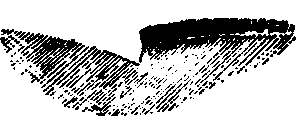
69. A common form of edge for walk or drive.
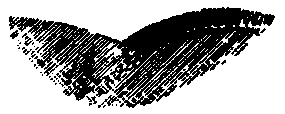
70. A better form.
"The arrangement made for the removal of surface water from the street must also take care of the surplus water from adjacent lots, so there is a practical advantage in having the level of the street lower than that of the ground adjoining. The appearance of houses and home grounds is also much better when they are higher than the street, and for this reason it is usually desirable to keep the latter as low as possible and give the underground pipes sufficient covering to protect them from frost. Where the ground is high and the sewers very deep, the grades should, of course, be determined with reference to surface conditions only. It sometimes happens that this general arrangement of the grades of home grounds, which is desirable on most accounts, causes water from melting snow to flow over the sidewalk in the winter time, where it may freeze and be dangerous to pedestrians. A slight depression of the lot away from the sidewalk and then an ascent toward the house would usually remedy this difficulty, and-also make the house appear higher. Sometimes, however, a pipe should be placed underneath the sidewalk to allow water to reach the street from inside of the lot line.
The aim in surface drainage should always be to keep the traveled portions of the street in the most perfect condition for use. The quick removal of surplus water from sidewalks, crossings, and roadways will help insure this result".
These remarks concerning the curbings and hard edges of city streets may also be applied to walks and drives in small grounds. Figure 69, for example, shows the common method of treating the edge of a walk, by making a sharp and sheer elevation. This edge needs constant trimming, else it becomes unshapely; and this trimming tends to widen the walk. For general purposes, a border, like that shown in Fig. 70, is better. The sod rolls over until it meets the walk, and the lawn-mower is able to keep it in condition. If it becomes more or less rough and irregular, it is pounded down.
If it is thought necessary to trim the edges of walks and drives, then one of the various kinds of sod-cutters that are sold by dealers may be used for the purpose, or an old hoe may have its shank straightened and the corners of the blade rounded off, as shown in Fig. 71, and this will answer all purposes of the common sod-cutter; or, a sharp, straight-edged spade may sometimes be used. The loose overhanging grass on these edges is ordinarily cut by large shears made for the purpose.
Walks and drives should be laid in such direction that they will tend to drain themselves; but if it is necessary to have gutters, these should be deep and sharp at the bottom, for the water then draws together and tends to keep the gutter clean. A shallow and rounded brick or cobble gutter does not clean itself; it is very likely to fill with weeds, and vehicles often drive in it.
The best gutters and curbs are now made of cement. Figure 72 shows a catch basin at the left of a walk or drive, and the tile laid underneath for the purpose of carrying away the surface water.
Continue to:


My Books

