


April - First And Second Weeks. April 1-15. Flowers
Description
This section is from the book "The Garden Week By Week Throughout The Year", by Walter P. Wright. Also available from Amazon: The Garden Week by Week Throughout the Year.
April - First And Second Weeks. April 1-15. Flowers
Planting And Pruning Roses
Early April is the latest period of the spring when it is safe to transplant Roses. Even now it will be well to syringe them after planting if there is no rain, in order to check evaporation from the leaves that will probably be forming. Indeed, the amateur will be wise to go further, and cut the plants back to dormant buds near the base of the stems. Some good varieties were described in Chapter III (March. The Dawn Of Spring). The pruning of established Roses ought to be completed early in April. I have already said that growers who are not familiar with the varieties will do well to prune hard, but as to this I should like to take the opportunity of speaking more fully; dealing first with dwarfs and standards. The old-time rosarian, who grew mainly for exhibition, was a notorious hard pruner. He cut his plants practically away, reducing the shoots to mere stumps of three or four inches long every spring. The modern grower has revolted against this, and the tendency nowadays is to prune lightly, especially in the case of strong-growing sorts. The hard pruning of former days was not wholly wrong, from the point of view, and with the class of variety, which prompted it. Indeed, I would recommend its imitation even now for weak Roses, especially if show flowers are wanted. Roses with twigs no thicker than macaroni may be cut back hard - every shoot to within three or four buds of its base - each spring. The modern system of light pruning would be carried to undesirable extremes if weak growths were trifled with. Perhaps some weak Roses have already been partially pruned, in pursuance of the hints given in my last chapter; let the work be completed now to the extent here indicated.
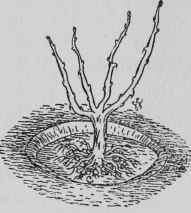
Fig. 35. -Planting Roses.
c. The roots spread out in the hole ready for planting.
The disposition to prune Roses on the whole more lightly than was formerly the case has sprung into being as a natural result of the introduction of a considerable number of Teas and Hybrid Teas. These new-comers have a much more vigorous habit than the majority of the old Hybrid Perpetuals, which once held the sway. They form long, strong shoots - approximating, in some cases, to those of recognised climbers. When these shoots get well ripened, they are quite capable of developing subsidiary shoots, on which flowers are borne. Varieties of this type do not need severe annual pruning; in fact, they are injured by it, because the wood has got so hard near the base that fresh growths do not break freely from it. Only the small shoots on the plant need be cut back; the large ones may be left unpruned, or at the most have the unripe extremities removed.

Fig. 36. - Pruning Dwarf Roses.
a. How to prune a dwarf Rose of medium strength. 6, How to prune one of strong growth for exhibition flowers. If grown for garden effect it need not be cut so low by one-half. c. A small basal shoot which must be cut away entirely. Prune to buds pointing outwards.
One sometimes reads that Hybrid Perpetual Roses should be pruned hard, but Teas and Hybrid Teas lightly. I think that this is taking an incorrect view. It is not the class to which a variety belongs, but the character of its growth, which should decide the degree of pruning. A Tea Rose should be pruned equally as hard as a Hybrid Perpetual if it is of similarly weak growth; indeed, some Teas (Cleopatra, for instance) may be pruned harder than some Hybrid Perpetuals - notably Frau Karl Druschki.
Universal hard pruning is only advisable in two cases - (1) just after planting, (2) after injury by frost. Newly-planted Roses are the better for being pruned hard. Frost-bitten Roses must be cut back, and back, and back until the primer comes to white pith.
It is not, as a rule, wise to prune either dwarf or standard Roses annually to a greater extent than removing the tips if the branches are half an inch thick. Only thin-wooded ones should be cut hard.
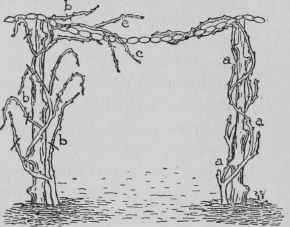
Fig. 37. - Pruning Pillar Roses.
a. Roses on one pillar properly pruned.
b. The Roses on another pillar unpruned; the dark lines show where the pruning must be done.
c. Leading shoots which must not be cut off, but tied to the chain.
With respect to climbing Roses, the common idea that pruning is inadvisable is wrong. Pruning may not be absolutely necessary, but it is certainly advantageous. One reads that Crimson Rambler, Gloire de Dijon, William Allen Richardson, Reine Marie Henriette, Dundee Rambler, Dorothy Perkins, l'ldeal, Felicite et Perpetue, Ards Rover, and the rest of the charming sisterhood of pillar, arch, and wall Roses do not need pruning. If by "need" we are to read that they are not benefited by it, the advice is entirely wrong. I do not think that any exact rule can be laid down. To say either "prune" or "do not prune," and go no further, is to follow the line of least resistance. In the former case it does not help the reader very much. In the latter it puts him on the straight and easy path that leads to Rose ruin.
One has only to study the different habits of various climbing Roses to see that the same method of pruning does not apply equally to all. I might make two broad distinctions, and class them as "rod" and "spray" Roses. The former make long canes, and bear their flowers on short shoots, which break from the rods. In the case of that Rose of miraculous vigour, Dorothy Perkins, the flowering shoots are not really short; they are often semi-rods, and droop low and gracefully under their burden of flowers. Crimson Rambler and Carmine Pillar are rod Roses, and the way to prune them is to select the old, hard, pithy rods which have flowered, are very dark in colour, and often have crinkly bark, and cut them out close to the ground. The younger, lighter-coloured rods should, of course, be retained for flowering. It sometimes happens that one of the best of the young rods is produced, not direct from the root stock, but from the lower part of an old cane, and the case creates perplexity. If there are plenty of flowering rods without the one in doubt, it may go with the old rod which bears it, but if not, the older wood may be pruned back to the point where the young one springs from it.

Single Annual Chrysanthemums from seed sown out of doors in string.
Gloire de Dijon and Reine Marie Henriette are rather "spray" than "rod" Roses. When they are established they do not throw up long canes annually, but they produce a good deal of side wood from the main branches. This wood may be pruned on somewhat the same principle as dwarfs - that is, the short, twiggy shoots cut close in, and the longer ones merely tipped. But I may modify this to the extent of saying that if there is more strong wood than can be accommodated on the wall or arch without crowding, I would cut the excess clean out. William Allen Richardson is likely to need a good deal of restriction when it is growing in congenial soil, as it generally makes more annual growth than can be accommodated. The grower should thin it vigorously. Dundee Rambler is a "rod" Rose of tremendous vigour. It has almost as much vitality as Dorothy Perkins. It is true that it does not throw up so many strong canes from the root every year as Dorothy does, but the shoots extend far and wide. It needs thinning and shortening; the older wood thinning, and the younger wood, which is often very long and slender, shortening. Dorothy Perkins may have some of the old rods cut out at the base like Crimson Rambler, but a good deal of young wood is certain to go with it, as this variety oozes shoots from every pore. The pruner sometimes gets alarmed when he observes the growing heap of prunings beside him, but he need not have any fear, as there will soon be abundance of fresh growth on his plants. Felicite et Perpdtue is only a degree less vigorous than Dorothy Perkins, but it produces fewer canes and more spray. It requires thinning and also considerable shortening, in view of the thicket of side twigs. The Penzance Briers produce rods, which should be thinned out as they get old and hard. Flowers will be produced from the younger canes, which may spring from the root stock, or as laterals from the old rods.
Continue to:


My Books

