


August - Third And Fourth Weeks. Aug. 16-31. Continued
Description
This section is from the book "The Garden Week By Week Throughout The Year", by Walter P. Wright. Also available from Amazon: The Garden Week by Week Throughout the Year.
August - Third And Fourth Weeks. Aug. 16-31. Continued
Calceolarias, Cinerarias, Cyclamens, And Primulas
Young plants raised from seed for flowering in winter and spring will be at various stages of growth. Some will be in small pots, and may be transferred from 3-inch to 5-inch when the former are full of roots. Others may be in pans or boxes, and ready for being put separately into small pots. In all cases use a sandy compost consisting mainly of loam, and pot firmly. No water will be needed for two or three days if the soil is moist at potting time, but when the plants recommence growing, which may be taken as evidence of fresh root activity, water may be given regularly in dry weather. Seed of Cyclamens may be sown in a greenhouse to give plants for flowering next summer. Any plants which are now showing bloom may be supported with top-dressings of fertiliser.
Daffodils And Narcissi
It was stated in the seventh chapter that those who have clumps of these beautiful plants in the garden might lift, divide, and replant the bulbs. Those who have to purchase need not buy before they procure their main bulb supply in October, unless they want to force for early bloom; in the latter case they may order at once, and put the bulbs close together in large pots or boxes, in a compost of loam (predominating), leaf mould, and sand. The two earliest of the Polyanthus or bunch-flowered Narcissi are Paper White and Double Roman; Golden Spur, Henry Irving, Obvallaris, and Pallidus Praecox are early Daffodils.
All may be buried in ashes or cocoa-nut fibre refuse for a few weeks.
Freesias And Roman Hyacinths
Pot more of these beautiful early flowering bulbs. The Hyacinths should be plunged like the Daffodils, but the Freesias should not.
Pruning Hedges
Those who satisfy themselves with clipping Privet and Thorn Hedges once a year had better do it soon, for the shoots will soon cease extending and begin to harden. Privet is often pruned twice - in June and in September. Young hedges are greatly strengthened at the base by being well pruned back.
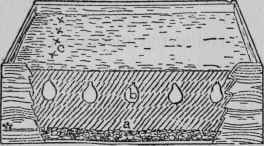
Fig. 64. - Daffodils in Boxes.
a. Drainage.
b. The bulbs buried in the compost.
C. How to dispose the bulbs in the box.
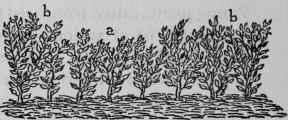
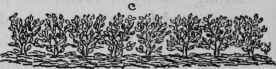
Fig. 65. - Pruning a Privet Hedge.
a. A thin part of the hedge.
b. Stronger parts.
c. How the hedge should be cut, or pruned back.

Double Trumpet Daffodils, ok Lent Lilies, in a border under a wall.
Pelargoniums In Pots
Plants that were rested and cut back after flowering may now be turned out of the pots, a good deal of the old soil crumbled away from the roots, and repotted. Later plants that have ripened up their wood may be cut back.
Zonal Geraniums For Winter
Zonals in 3-inch pots may be transferred to 6-inch, and the latter regarded as the flowering size. The best place for them until the autumn rains begin (when they should go into a frame), is an ash bed in the open garden. They will need a good deal of water when growing freely. Continue to nip off any flower stems that push.
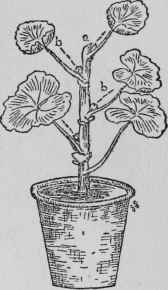
Fig. 66. - Stopping Zonal Geraniums.
a. The point of the stem pinched off.
b. The dotted lines show the resultant growth of the side shoots.
Continue to:


My Books

