


January - Third And Fourth Weeks. Flowers
Description
This section is from the book "The Garden Week By Week Throughout The Year", by Walter P. Wright. Also available from Amazon: The Garden Week by Week Throughout the Year.
January - Third And Fourth Weeks. Flowers
Roses
Those beautiful Roses, Bridesmaid, Catherine Mermet, Ulrich Brunner, Captain Hayward, Mrs. John Laing, and Niphetos will flower delightfully in the warm conservatory in spring if plants are potted now.
Rosarians have greatly extended the season of their favourite flower in the garden by raising a large number of sorts that bloom continuously. But they have not yet got to the point of having Roses in flower in March without the aid of glass. It is a moot point whether we can have Roses too long. Many people would say: "Yes, if getting them early means sticking them into men's buttonholes with a wretched bit of Asparagus or Maidenhair Fern." I suppose it does mean that, but I have not yet been able to work myself into the proper state of disgust at the practice of wearing buttonhole flowers. There must be some serious objection to it, or people would not get so angry about it. But really, when I see young Mr. Hosiery make his first task on emerging from the emporium that of buying a buttonhole flower, and reflect that a few years ago he would have gone and had a drink instead, I do not feel as strongly tempted as I ought to ask him what he means by it. Do I not know quite well what he means? And do I not sympathise? Miss Mantles (who emerges from another door) is undeniably pretty.
The nurseryman does not charge very much for pot Roses, unless the varieties are new. The first obligation which the grower is under is the unpleasant one of cutting the plants hard back. The greater part of the plants must go, nothing but stumps with a few buds on each being left. The plants will soon grow again from the dormant buds; in fact, they will be full of leaves and in bloom in a few weeks, given a temperature of 500 to 6o°.

Fig. 20. - Pruning Pot Rose.
a. Branch to be cut away altogether.
b. Branches to be cut back to good buds.
Winter-Blooming Carnations
Winter exhibitions of Carnations are now as well established an institution in London as cattle and motor shows. The winter section, which is really quite distinct from the garden Carnation of the summer, has a Society all to itself, and well deserves it. Think of having such a beautiful flower as the Carnation in mid-winter! Admirable form, brilliant colour, delicious perfume, and in every month of the year! My readers must keep up-to-date with the American type, for the flowers have long stems, and are therefore well adapted for arrangement in vases. Here are a few varieties which, at the time of writing, are among the best procurable: Britannia, red, a charming flower for the table, as the colour shows up so well under artificial light; Enchantress, blush, large, sweet, and of lovely tint; Winsor, silvery pink; May Day, pink; Mrs. Burnett, salmon pink; and White Perfection, white. It may be some time before these are superseded, but a gardening author would no more use terms of finality in connection with varieties of popular flowers than a writer on motoring would in referring to the engines of aeroplanes. Both are in a constant state of development. But the aeroplane engine will never attain the pleasing odour of the Carnation.
To get healthy plants and a nice display of winter bloom, the amateur must provide his plants with a light, airy greenhouse, and a temperature of 500 to 6o°, the former being the night heat. It may fall a little lower in very severe weather, but no real laxity in the matter of heat is permissible. It is most convenient to grow the plants in pots, but I have had very good results from making a bed for them on a raised stage in the middle of a greenhouse, and planting them in it. The flower stems were not tied to stakes, as they would be in the case of pot plants, but to thin wires stretched across the bed and attached at the sides.
A mixture of soil that suits winter-blooming Carnations is fresh loam with about a quarter of decayed manure and some sand.
Those amateurs who have plants and wish to increase the number may take cuttings of the young shoots this month, and insert several together round the side of a pot, which should be put into a bottom heat (such as that provided by a bed of moist cocoa-nut fibre refuse over hot-water pipes, or a closed tray of heated water) of about 650. They will root quickly, and when the little plants begin to grow they can be put separately into small pots, from which they can be repotted as fast as they fill their receptacles with roots until they are in 7-inch, beyond which they need not go.
A point of culture which must not be overlooked is that of stopping the plants by pinching off the tips. This may be done for the first time when they are growing freely after the first separate potting, and may be repeated in April, May, or June if any of the shoots begin to straggle. Its effect is to furnish the plants with a sufficient number of compact shoots, all of which will bloom in due course.
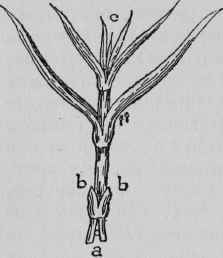
Fig. 21. - Cutting of Winter Carnation.
a. Stem cut off below a joint, slit upwards, and a small stone inserted to keep the two parts asunder.
b. Basal leaves to be removed.
c. Clean growth without a flower stem.
The plants will be quite safe in a frame, or even stood on ashes out of doors, in summer, but they should be put under glass in September.
Continue to:


My Books

