


January - Third And Fourth Weeks. Fruit
Description
This section is from the book "The Garden Week By Week Throughout The Year", by Walter P. Wright. Also available from Amazon: The Garden Week by Week Throughout the Year.
January - Third And Fourth Weeks. Fruit
Although, as mentioned in the first section of the present chapter, January is often not a good month for planting fruit trees, there is no reason why plans and preparations should not be made for making new fruit gardens, or for arranging the fruit portion of a kitchen garden.
Trained Trees
For example, it may be proposed to plant fan, cordon, or espalier trees alongside the paths in a part of the vegetable garden. How are they to be supported? Bush trees will support themselves, standards only require a stake, but flat trees must have a wall, a fence, or some sort of framework on which to lean. It may be agreed to provide an erection of poles and wire. Good; and in this case why not erect it in this, the quiet season, when labour is more readily available than in spring? Not only would I do this, but I would have the ground got ready directly the framework was complete, so that when March came there would be nothing to do but to put in the trees.
It may be urged that self-supporting bush trees are better than flat ones - that they will probably give more fruit, and are more economical to manage. They are certainly more cheaply "run," but taking the cordon as the typical trained flat tree, it has one great advantage over the bush tree for small gardens in that it takes up so much less room.
I think that every country garden, however small, should have its "Cabbage patch," only, instead of giving it up to Cabbages, if very small, I would devote it to choice early Potatoes, Asparagus, Seakale, Kidney Beans, and Marrowfat Peas, buying my Cabbages from a cottager or allotment holder who had a surplus. I can understand an allottee of the working classes growing Cabbages, but I cannot imagine an amateur giving up the precious space of a small garden to them when he can buy them for a penny each.
Well, when the Cabbage patch which is to grow no Cabbages is being planned, I think it is an excellent idea to arrange for running a wire framework round it (leaving openings at the corners to permit of free access to the vegetable part) whereon to grow fruit trees. They will not interfere with the vegetables, and their crop will be quite as much enjoyed.
Ironmongers supply metal supports suitable for straining the wires on, but those who are merely tenants on short leases may hardly think it worth while to go to more expense than is entailed by putting in a few stout poles. It is also possible to economise in wire without anything very serious happening. In the ordinary way the wires would be fixed about a foot apart, and when one glances at a typical fruit framework illustrated in an ironmonger's catalogue, one sees that ten or twelve lengths of wire are shown as close as eight inches apart. Can it be that the ironmonger wants to sell as much wire as possible that he does this thing? One does not want the wires so close even with trees trained horizontally, as a foot will do; and when it comes to cordon Apples and Pears there is no advantage whatever in having more than three wires, say one a yard from the ground, a second eighteen inches above it, and a third eighteen inches above the second. This gives a total height of six feet, but by planting the trees at an angle of 450 they have about another foot run, and seven feet will do very well, although another eighteen inches would be an advantage in rich soil.
With less wire we can do with few supports, because there is not so great a weight of metal, and so we reduce the cost in both directions.
Some readers may be glad to have an idea of the cost of metal supports. First of all, two straining posts are required for each complete length. Strainers six feet high, and galvanised, may be expected to cost from sixteen to eighteen shillings each. Intermediate galvanised standards with double pronged feet, the same height, will probably cost between three and four shillings each. Raidis-seurs for tightening up the wire will not be dear at four shillings a dozen, or the keys for winding at fourpence each. There only remains the cost of the wire, and No. 13 gauge galvanised wire will cost about two shillings per hundred yards. But 7-ply strand wire is preferable, and if only three or four lengths are being used, it will be worth while to go to the little extra cost for it. It is sold by the hundredweight, and the length varies with the gauge; No. 6 gauge, 481 yards to the hundredweight, will cost about a guinea.
If wooden supports are being used instead of metal ones, raidisseurs and key will not be needed, but merely staples, and these only cost about sevenpence per hundred. The ironmonger will perhaps lend a tool for tightening up the wire on the end posts, which should not only be deeply imbedded, but also butted, in order to stand the strain.
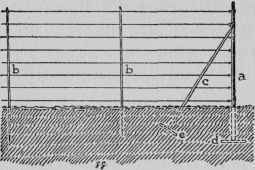
Fig. 24. - Espalier (Wire) for Training other than cordon trees. a. The end post. b. Intermediate posts.
c. Angle iron stay rod.
d. Flat iron plate at base of post.
e. A similar one at base of stay. The iron plates keep the posts firm.
The drawback to wooden supports is their comparatively short life, but this can be considerably prolonged by thoroughly charring the whole of the part which is underground, or by pickling it in creosote.
The intermediate poles may be much lighter than the end ones, but they should be well driven down, as it is desirable to have them fairly steady, especially if there is a considerable length of framework.
This matter of support can, I repeat, be attended to in January, and the soil dug and manured, so that there may be nothing in the way of speedy planting when the time for it arrives.
Continue to:


My Books

