


Chapter 16. On Wall Gardens
Description
This section is from the book "Beautiful Gardens - How To Make Them And Maintain Them", by Walter P. Wright. Also available from Amazon: Beautiful Gardens: How To Make And Maintain Them.
Chapter 16. On Wall Gardens
The suburban flower lover often makes a crude attempt at wall gardening by driving hooks into the wall of his dwelling, and dangling therefrom wire baskets filled with plants. Since sympathy must be extended to all who endeavour to beautify their homes under difficulties, it would be wrong to throw ridicule on these attempts. Even if the plants thus enthroned are nothing more than a few rather startled-looking "Geraniums," smarting with acute self-con-sciousness, the fact remains that a search for the beautiful is struggling to find expression, albeit in a somewhat flamboyant manner.
There is, however, a phase of wall gardening which is better worthy of imitation, and that is the establishment of appropriate plants in the interstices, or actually on the face, of walls. Among many beautiful examples of this pleasant art the author has seen none more successful than those in the Trinity College Botanical Gardens, Dublin, established by the late Mr. F. W. Burbidge. Many plants never look more thoroughly at home, and therefore more beautiful, than when clinging to a wall; and those in the case quoted were full of health and beauty.
The primary use for ordinary brick garden walls, such as those of kitchen gardens, is to support fruit trees, but there are often to be found in gardens rough retaining or bank-supporting walls which, now bare, could be planted with suitable flowers, and thereby rendered attractive.
There are two means by which the plants may obtain foothold. One is by forcing their roots into the joints, and the other by resting in specially made pockets. They would stand little chance of getting a firm footing on the smooth face of a well-pointed brick wall, but in the looser, less elaborately finished joints of a stone wall, such plants as Houseleeks can establish themselves quite securely. The pocket system is, of course, better, inasmuch as it permits of including plants which could not establish themselves on a wall face, and is as applicable to a brick as to a stone wall. The pockets are formed thus: first long spike nails are driven securely in between the joints. They must protrude far enough to partially support a series of selected stones. These are further secured by cementing them to the face of the wall. The combined sustaining force of the wall, spike nails, and cement, keeps the stones quite firm and secure.
A little soil may be placed in the hollow upper surface of the stones, and plants placed in position. The wall top may be covered by cementing stones along each edge, and placing soil and plants in the space thus formed.
Although a wall so treated has a somewhat "prepared" appearance at first, it is really no worse than a newly-planted rockery. The plants will spread fast, and soon completely cover it.
Among plants suitable for growing on walls, Houseleeks (Sempervivums), Sedums, and Saxifrages must rank high. They are close, clinging growers. The Sun Roses (Helianthemums) are rather straggly, but they are otherwise excellent plants. The dwarf, spring-flowering Phloxes of the subulata section should be used freely, as they do well and are remarkably pretty; among them may be mentioned frondosa, rosy red; grandiflora, pink, with crimson eye; Newry Seedling, lilac; and Vivid, rose. Erinus Alpinus is a good plant, and so is Alyssum montanum. Alyssum saxatile, the popular spring-blooming border or rockery plant, will also thrive, as well as Cheddar and other Pinks.

Fig. Dwarf Phloxes on a wall.
Several of the Campanulas come in extremely useful, notably Portenschlagiana, Garganica, and isophylla. Speaking broadly, the dwarf plants which thrive on a dry rockery will also do well on a wall, but those which like abundance of moisture cannot be expected to succeed so well.
Those who may wish to study the details of wall gardening more fully than it can be treated here would do well to refer to the illustrated article in Vol. I. of "Cassell's Popular Gardening," where a valuable series of illustrations is given.
Where plenty of stones are at command what is termed a "dry" - i.e. an unmortared - wall may be built up against a bank. It might be termed a perpendicular (or nearly perpendicular) rockery. Cornish workmen build up these dry walls with great skill and rapidity, and Nature speedily sets to work to cover them. The open spaces between the stones, which in the ordinary wall would be filled with mortar, are not capacious, but they afford room for a pinch of soil and a seed or two. Aubrietias and Arabises will cover square yards of such surfaces in a few years. Perennial Candytuft (Iberis) will also thrive. The Sandwort (Arenaria Balearica), Alpine Wallflowers, and other familiar plants will grow with freedom. There is no lack of plants; what is wanted is the stone.
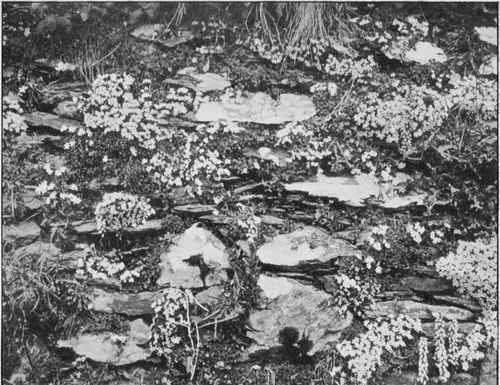
Fig. Flowers in a wall in Cornwall.

Fig. The Yellow Cinquefoil (Potentilla Ambigua) On An Open Wall.
Continue to:


My Books

