


Chapter 17. On Wild Gardens
Description
This section is from the book "Beautiful Gardens - How To Make Them And Maintain Them", by Walter P. Wright. Also available from Amazon: Beautiful Gardens: How To Make And Maintain Them.
Chapter 17. On Wild Gardens
In many gardens it happens that there is a certain area of ground which does not fall in with the general design. It is perhaps so rough, uneven, and shaded that cultivation on "full dress" lines presents serious difficulties. Of course, there is no condition which, could not be overcome by the application of sufficient labour, skill, and capital. When a railway engineer comes to an obstacle that he cannot level he either cuts through it, climbs over it, or burrows under it. The one thing that he does not do is to give up his railway because of it. A garden-maker is not bound to either give up a piece of troublesome ground or carve at it with slow and costly labour. For him there is always a way round. He can let this be his Nature Garden - his bit of wild, and it is quite likely that he will get as much pleasure out of it as he will out of the fully cultivated parts.
It is not in large gardens alone that these rough, tree-shaded areas exist; they are often found in small ones. But large or small, something has to be done with them. Here, if ever in gardening, is a case for joining hands with Nature, and, partly coaxing, partly coercing, improving on her handiwork.
The paths in the wild garden could not be, and should not be, neat, dressed paths of gravel or turf, which would entail a great deal of labour, and still be incongruous. In sandy or peaty districts the low, heathy growths will suffice for a footing, and practically all that is needed is to clear rambling branches away. The paths should be narrow and winding - losing themselves, so to say, in the tangled vegetation. In the case of wet, clayey land, some sort of made path must be provided, otherwise the garden would be impassable in wet weather. A couple of inches of unsifted ashes on a layer of broken clinkers or rubble will suffice. In wet or marshy spots a few large stones may be laid as steps.
It must not be supposed that because we are going to make a covenant with Nature in this matter we intend to tolerate a mass of weeds and ugly growths. A wild garden that is a mere waste of Cow Parsley and Crowfoot will not be satisfying. Hence it is that the first step, in the rough as in the cultivated area, may be the clearing away of noxious and objectionable growth, and some amount of shrub - thinning and tree-trimming. Then will come the introduction of fresh plants. For the most part planting must be done in scattered, informal groups. Plants must grow as if they had originated in the places they occupy, not as if they had been put there.
The Foxglove is a valuable plant for the wild garden, and comes readily from far-flung, uncovered seed. Its tall spikes have a very good effect when rising here and there without rank or order. The Honesty, Lunaria biennis, loves to naturalise itself in partly shady places. It is more than tolerable when in bloom, but its main beauty lies in the transparent seed pods which clothe it in the autumn. Violets and Primroses will be charming in the spring. The common yellow Primrose attains to a size, both of plant and bloom, in damp clays that it never reaches in impoverished woodlands. A faintly coloured bloom is sometimes found - a sort of refugee from cultivation - but it is rare, and there is no reason why some of our coloured Primroses should not be naturalised.
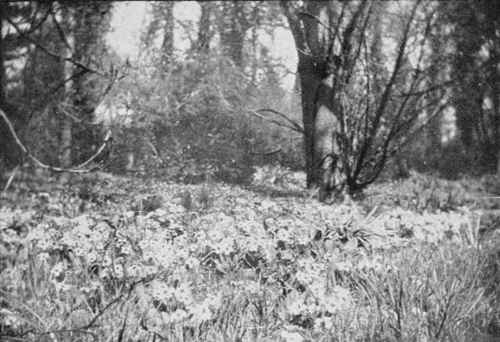
Fig. Primroses will be charming in the spring.
The little Hepatica is never so happy in a cultivated border as in a home of its own under trees, and the same may be said of Cyclamen Coum, which has a lovely effect when naturalised on a bank. Snowdrops and Daffodils love the grass. The naturalisation of Narcissi has developed apace these latter years, in spite of some failures. Thin, gravelly, and chalky soils do not offer such promise of success as deep loams and clays. Daffodils luxuriate in heavy land, where their roots can strike down and find moisture. In such places they develop immense growing force. In turfing a piece of ground where a colony of Van Sion had been established the author was interested in observing, not only that he had signally failed to extract all the bulbs, but that those which had been overlooked came through the thick turf as early as, and stronger than, plants in the bed which the turf surrounded.
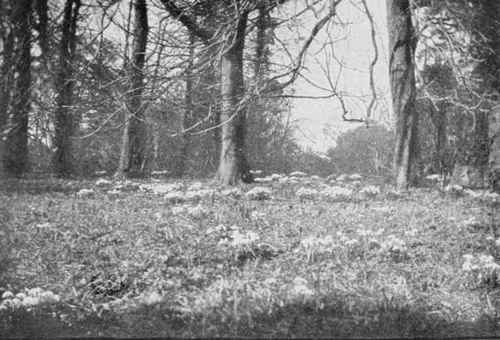
Fig. Snowdrops love the grass.
The Winter Aconite is a little early bloomer which may be established under trees, and is very cheerful in the winter. The Dog's-tooth Violet, Lily of the Valley, and Poet's Narciss, may also be named. Amongst taller plants we have the Mulleins (Verbascums), Meadow Sweet (Spiraea), Canterbury Bells, Golden Rod (Solidago), Monkshood (Aconitum), Evening Primrose (Oenothera), Snapdragon, and Solomon's Seal.
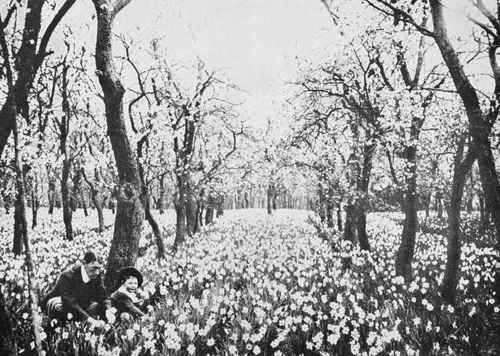
Fig. Narcissus Poeticus in an Evesham orchard.
Bold groups of good, selected plants will be better for the purpose in view than odd representatives of a great many kinds, but if more variety is wanted such things as Borage, Columbines, various hardy ferns, Heaths, Winter Heliotrope (Petasites or Tussilago), Sea Hollies (Eryngiums), Loosestrife (Lythrum), Lupins, Mallows, Meadow Saffron, Monkey Flowers (Mimuluses), Ox-eye Daisy, Plantain Lily (Funkia), Rocket, Penzance Brier Roses, St. John's Wort (Hypericum), and Wood Anemone may be employed.
Periwinkle (Vinca) will be valuable for covering bare ground spaces, and Wichuraiana Roses for rambling over banks. As creepers, Clematises, Honeysuckles, and Everlasting Peas will be as useful as any.
In such a rough, shaded spot as is indicated in the early part of this chapter the author founded a wild garden that proved very attractive. It was separated from the garden proper by a row of pole Roses, including such vigorous sorts as Crimson Rambler, Felicité Perpétue, Dundee Rambler, Ards Rover, Rampant, Euphrosyne, and Dorothy Perkins. At early morn, and in the cool of evening, the wild garden drew many wandering feet from the lawns and borders, and kept visitors lingering long in its cool paths.
Continue to:


My Books

