


62. Plants Poisonous To Eat
Description
This section is from the book "Plants And Their Uses - An Introduction To Botany", by Frederick Leroy Sargent. Also available from Amazon: Plants And Their Uses; An Introduction To Botany
62. Plants Poisonous To Eat
The number of poisonous plants which are to be found growing wild or in gardens is much larger than is generally supposed, and the cases of poisoning annually reported are more numerous than is commonly realized. While it will not be possible for us to deal with all the species that are dangerous, it will be sufficient for our purpose to select for special consideration those which have proved most likely to cause injury. A knowledge of these kinds, and of the ways in which poisoning by them has occurred, is not only highly important in itself as a means of safety, but will lead to certain rules of general application. It will be convenient for us to group the different kinds according to the parts which are most dangerous. Nevertheless it must be understood that when any part of a plant is poisonous every other part is to be regarded with suspicion.
One of the most common ways in which poisoning occurs is from the eating of underground parts of plants which resemble more or less closely species that are known to be edible. Thus it has often happened that young folks off for a ramble in the country come across some wild plant that suggests parsnip or some similar herb and has an attractive looking root which has perhaps been uncovered by recent rains. Being hungry the trampers bite off a piece of the root, and finding that it tastes good they continue to eat it. Before long distressing symptoms appear, leading within a few hours to violent convulsions and perhaps death. The plant of which they have eaten is probably the water hemlock (Fig. 179) one of our commonest swamp or brookside plants and one of the most deadly. Fatal cases like that described occur almost every year especially among children, and many cattle are poisoned by eating various parts of the plant. Sometimes poisoning results from drinking water in which the roots have been bruised by trampling. The plant should be uprooted and destroyed wherever found. Another herb closely similar to the water hemlock and too common along waysides is the poison hemlock (Fig. 180). This is most probably the plant by which Socrates was poisoned at the hands of the Athenians. Recent cases of poisoning have resulted from eating the root by mistake for parsnip, the leaves for parsley, and the seeds for anise. Children have been poisoned by blowing whistles made from the hollow stem.

Fig. 179.-Water Hemlock (Cicuta maculata, Parsley Family, Umbelliferce). Lower stem and roots, cut vertically, 1/2. Flowering and fruiting top, 1/2. Part of leaf, 1/2. Fruit entire, 5/1. Half of same, cut across. (Chesnut.)-Perennial herb 1-2 m. or more in height; roots spindle-shaped, 3-7 cm. long; stem rigid, hollow, smooth; leaves smooth, somewhat celery-like; flowers white; fruit becoming brown. Very poisonous throughout. Native home, North America, in damp soil.

Fig. 180, I.-Poison Hemlock (Conium maculatum, Parsley Family, Umbelliferoe). Flowering and fruiting top. (Baillon.)-A biennial about 1-2 m. tall; stem, smooth, purple-spotted; leaves parsley-like, of mouse-like odor when bruised; flowers white; fruit brownish. Native home, Eurasia.

Fig. 180, II.-Poison Hemlock. A, flower, cut vertically. B, fruit, entire. C, same, cut across. (Baillon.)
The common pokeweed (Fig. 181) the young shoots of which are often cooked and eaten like asparagus, is very dangerous as regards its root and fruit, and even the herbage may prove poisonous unless thoroughly boiled and the water changed. Death has resulted from eating the root by mistake for horseradish, parsnip, and artichoke. Children have died from eating the fruit, the seeds of which are especially poisonous. Household remedies prepared from the plant are widely used, but the cases of poisoning from overdoses of it ignorantly taken show it to be an especially dangerous medicine. The monkshood (Fig. 178) common in gardens is another plant the roots of which have been mistaken for horseradish, with fatal results.

Fig. 181, I.-Pokeweed (Phytolacca decandra, Pokeweed Family, Phytolaccacece). Flowering branch. (Baillon.)-Perennial herb 1-4 m. tall; leaves smooth; flowers greenish white; fruit fleshy, dark purple. Native home, United States. Root and seeds poisonous.
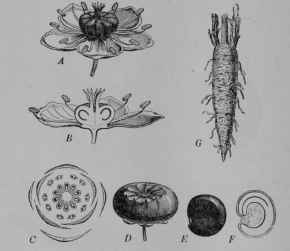
Fig. 181, II.-Pokeweed. A, flower. B, same, cut vertically. C, floral diagram. D, fruit. E, seed, entire. E, same, cut vertically. G, root. (Baillon.)
Continue to:


My Books

