


Part 47. Relation Between Culture Period And Native Home
Description
This section is from the book "Plants And Their Uses - An Introduction To Botany", by Frederick Leroy Sargent. Also available from Amazon: Plants And Their Uses; An Introduction To Botany
Part 47. Relation Between Culture Period And Native Home
Part 47. Relation between culture-period and native home. It may be laid down as a rule that, other things being equal, the nearer the native home of a cultivated species is to the region forming one of the primitive centers of agriculture, the longer has that species been under cultivation; and, conversely, the more remote its native home from an agricultural center, the more recently has it come to be cultivated. This, indeed, is what we should expect in view of the probable beginnings of agriculture already considered in our study of the grains (section 17). Reference to the foregoing tabular view will afford some interesting confirmations of this general principle, which in turn will help us to an orderly (and therefore more easily remembered) arrangement of the facts in our minds.
Let us first consider the plants which were cultivated in ancient or in prehistoric times. As used in the tabular view the term prehistoric indicates, for plants of the Old World, a cultivation of over four thousand years, or in the New World of over two thousand years: ancient, means over two thousand years for Old World plants, or for New World species, a cultivation for more than five hundred years, or in some cases for over one thousand years. That is to say, the cultivation of the plants designated as prehistoric or ancient, preceded or was associated with the earliest civilizations of the hemisphere to which they belonged. With reference to their native homes we find that these plants fall readily into the following groups: -
The Mediterranean Group of Plants
I. The Mediterranean Group: plants of which the native range fell within, or was adjacent to, the region about the eastern end of the Mediterranean sea-the region wherein were developed the great Eurasian civilizations of antiquity, from which our own is principally derived. The plants included are wheat, barley, oats, rye, chestnut, filbert, walnut, almond, pea, beet, turnip, carrot, parsnip, onion, asparagus, cabbage, spinach, lettuce, celery, cucumber, egg-plant, apple, pear, quince, plum, common cherry, European grape, musk-melon, watermelon, lemon, banana, date, fig, and olive.
The Oriental Group of Plants
II. The Oriental Group: plants having their native home extending within or adjacent to the valleys of the Yangtse-Kiang and Hoangho, the seat of the most ancient of oriental civilizations. Under this head come rice, radish (?), peach, orange, and sugar-cane.
The American Group of Plants
III. The American Group: plants indigenous to the highlands of tropical America or in lands adjacent thereto, that is, within or near the region occupied by the ancient civilizations of the Western Hemisphere. This group includes maize, peanut, coconut, kidney-bean, Lima bean, sweet potato, white potato, pumpkins and squashes, tomato, pineapple, cacao, and bitter cassava.
The plants which are indicated as of modern culture are believed not to have been cultivated by the ancients of the Old World before the beginning of the Christian Era, or in the case of New World forms, to have been in cultivation, at most only a few centuries before Columbus discovered America. By plants of recent culture are to be understood such as have been introduced into agriculture since the discovery of America. A glance at the tabular view will show that none of these "modern" or "recent" plants are native to regions within or near to the primitive centers of agriculture. Some of these plants occur wild in both the Old and the New World; namely, raspberries, the garden currant, and the field mushroom. Those confined to the Old World are buckwheat, rhubarb, and sago: those of the New World are the butternut, hickory, pecan-nut, Jerusalem artichoke, garden strawberry, and northern fox-grape.
The Brazil-nut and "carrageen" are the only other food-plants included in our list. Of these the wild product so fully satisfies the demand, that the plants have never been cultivated, and their native homes are thus without special significance in the matter under consideration. It is, however, a confirmation of the principle above stated, that no plant of any considerable agricultural importance has been derived from regions which are remote from the primitive centers of agriculture, or cut off from early communication with them, even though the climate may be highly favorable. This is true of South Africa, Australia, and New Zealand.
The facts we have stated show plainly that the native home of a cultivated food-plant stands in close relation with its importance to mankind. That is to say, just as we found that a knowledge of the chemical composition of plant-foods enabled us to understand in what manner and how much they were used, so now it appears that to know the original geographical ranges of cultivated plants helps us to explain the time and area over which their use has extended. Of course, many other considerations often need to be taken into account in order satisfactorily to explain all that is known regarding the differences in extent and duration of such usefulness. What should be insisted upon is that geographical facts are of fundamental importance in discussing the economic history of food-plants.
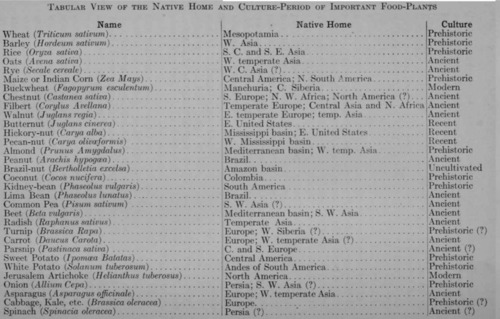
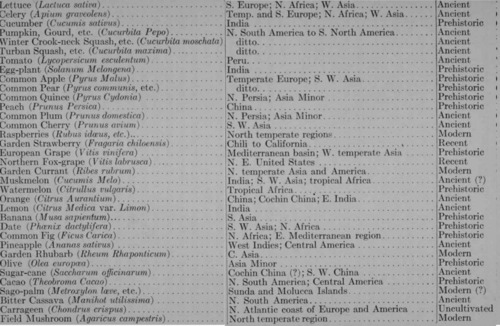
Fig. Native Home and Culture Period of Important Food Plants
Continue to:


My Books

