


Part 34. Pulse - Peas And Beans
Description
This section is from the book "Plants And Their Uses - An Introduction To Botany", by Frederick Leroy Sargent. Also available from Amazon: Plants And Their Uses; An Introduction To Botany
Part 34. Pulse - Peas And Beans
34. Pulse, under which name are included peas (Figs. 37, 38), and beans (Figs. 39, 40), 1 agree with grains and nuts in that the nutritive part is contained within the seed, but differ from them in that the seeds ripen in a rather thin-walled pod which opens at maturity by splitting in halves from end to end.
1 In the reference to the illustrations the reader will observe that the same Arabic numeral sometimes applies to more than one cut, Roman numerals being added to distinguish them. Thus in the above reference to the pictures of kidney-bean, Fig. 39 is understood as applying to Fig. 39I and Fig. 39II.
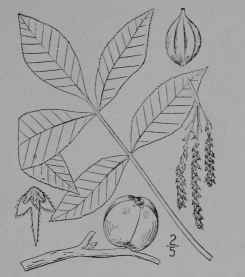
Fig. 30.-Shagbark Hickory (Carya alba, Walnut Family, Juglandaceoe). A single leaf. Staminate flower-cluster. Staminate flower, under side, enlarged. Twig bearing a single fruit. Nut. (Britton and Brown.)- A large tree becoming.36 m. tall; bark shaggy in narrow plates, gray; young twigs and leaves slightly hairy becoming smooth; flowers greenish; fruit greenish brown; nut almost white.
The very large amount of nutriment in proportion to bulk, together with the small percentage of water and oil (see chart) renders beans and peas among the very best foods for storage, and particularly adapts them for use upon long voyages. That they are highly nutritious is shown by the large amount of proteid they contain. This, however, is found to be of a sort resembling the proteid of cheese; and is not so easily digestible as that found in cereals.
Continue to:


My Books

