


Part 35. Earth Vegetables
Description
This section is from the book "Plants And Their Uses - An Introduction To Botany", by Frederick Leroy Sargent. Also available from Amazon: Plants And Their Uses; An Introduction To Botany
Part 35. Earth Vegetables
35. Earth-vegetables we shall find to be a convenient term to designate those garden esculents of which the nutritive part grows in the earth. This edible part may be either a root-tuber as in the sweet potato (Figs. 56, 57), a crown-tuber as in the beet, turnip, radish, carrot, and parsnip (Figs. 41-55), or it may be a stem-tuber as in the white potato and the Jerusalem artichoke (Figs. 59, I-IV), or a bulb as in the onion (Figs. 60, 61). A root-tuber consists entirely of a swollen root gorged with reserve food. A crown-tuber bears a crown of leaves more or less rosette-like, thus showing itself to be part stem and part root. By the term "tuber" botanists sometimes mean only a stem-tuber, but the word is more conveniently applied in a general sense to all short and much thickened roots or stems. A stem-tuber differs from a root-tuber in having "eyes" or buds regularly arranged in little pits along the sides; and from a crown-tuber in bearing no foliage-leaves, but instead minute, appendages, one below each eye. If a stem-tuber be made to sprout, the buds will grow into leafy branches. A bulb differs from a tuber in consisting chiefly of readily separable scale-like parts or layers which are mostly succulent.
As will be seen from the chemical chart the very large percentage of water in earth-vegetables presents a striking contrast to what we find in grains, nuts, and pulse. Notice also, particularly in the roots, the comparatively large amount of indigestible material (cellulose) in proportion to the proteid and other nutritive constituents. From this it follows that not only are earth-vegetables more bulky to store than grains and pulse (and, moreover, cannot ordinarily be kept longer than a few months) but in order to get as much nutriment from them as from grains or pulse, a very much larger amount must be eaten. It should not be supposed, however, that the indigestible parts of what we eat are altogether useless; for it has been observed in various experiments that digestive organs commonly work to better advantage when the nutritious materials undergoing digestion are present not in concentrated form but diluted, as it were, with a certain amount of finely divided cellulose or other harmless material which may act mechanically.
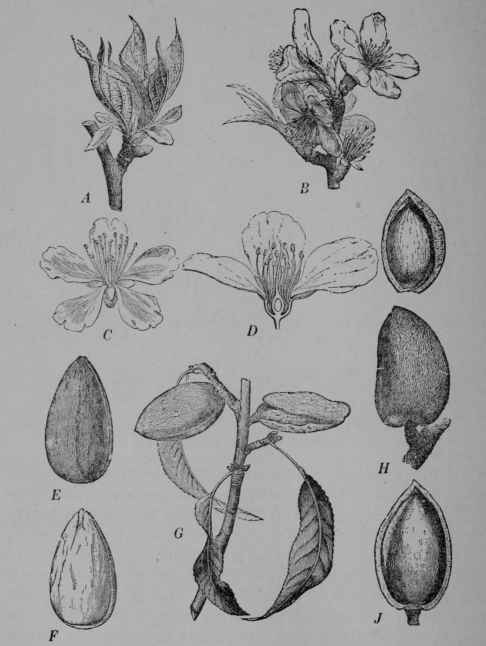
Fig. 31.-Almond (Prunus Amygdalus, Rose Family, Rosaceoe). A, twig bearing one unopened winter-bud and a cluster of young leaves expanding from another. B, a flowering branch. C, a single flower. D, the same cut vertically to show the single pistil with its small ovary at the base of an urn-like continuation of the flower-stalk at the rim of which are borne three sets of organs, namely: the stamens which are numerous and in two rows; then outside of these a single row of delicate enveloping organs, the petals,1 which in the almond flower are white or rose-colored and five in number; and finally, outside of all, a row of sepals, which are green, and five in number. G, a twig bearing three leaves and two fruits of which one is shedding its leathery husk. H, a single fruit. J, the same, with half the husk removed, to show the nut which appears above with half its shell removed to reveal the seed within. E, the seed, covered by its thin brownish coat. E, the embryo gorged with food, shown after removal of the seed-coat. All more or less reduced in size. (Baillon.) -The plant is a tree closely resembling the peach tree in general form and in every part except the fruit. The flowers, appearing in very early spring, before the leaves, are remarkably beautiful. The fruit of the almond closely resembles a green peach; it differs from the peach mainly in having in place of the hard-shelled "stone" a rather soft-shelled nut which is covered by a leathery husk that commonly splits open when ripe.
1 We have here an example of a "complete" flower or one which has all the kinds of organs which are commonly present; that is to say, besides the pistil and stamens which are known as the "essential organs," and the sepals which constitute the calyx or outer floral envelope, it has an inner envelope made up of petals distinctly different in appearance from the sepals. The petals taken together constitute what is called the corolla, or "little crown" of the flower, and form commonly the most conspicuous part. The calyx and corolla taken together are called the perianth, especially if they are closely similar in appearance.
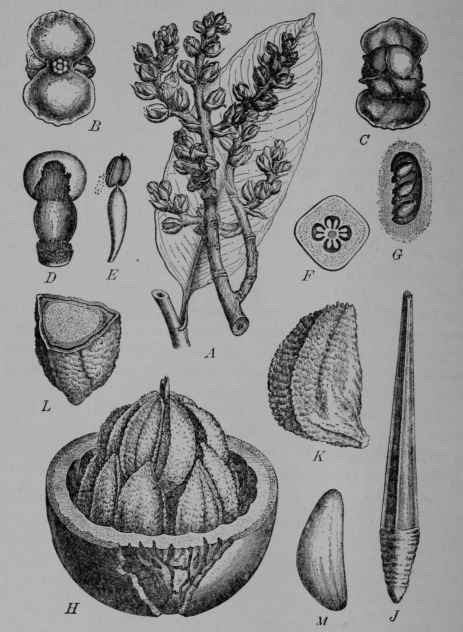
Fig. 32.-Brazil Nut (Bertholletia excelsa, Myrtle Family, Myrtaceoe). A, flower-cluster and leaf. B, expanding flower-bud viewed from below showing the under side of the two sepals. C, the same from above, showing upper side of sepals, and the six petals. D, the numerous stamens united by their filaments into a hoodlike body. E, upper part of a stamen enlarged. F, ovary cut across, to show the four cavities containing ovules. G, a single one of these cavities cut into lengthwise, giving a side view of the ovules, enlarged. H, fruit, with the upper part of its thick spherical wall removed to show the seeds within, packed about a central spindle. A part of the outer, softer layer of the wall is torn away in front, showing the channelled surface of the very hard inner layer. J, the central spindle. K, a nut in side view. L, the same cut across through the middle, to show the thick seed-coat with its thin layers, and the large germ which fills it. M, germ, removed, showing the general form and the absence of distinguishable parts. (Berg, Humbolt, and Bonpland.) The plant, which is one of the most majestic trees of the Brazilian forests, reaches a height of over 30 m.; leaves bright green; flowers with cream-colored corolla; fruits "nearly as hard and heavy as cannon-balls, fall with tremendous force from the height of 100 feet. . . . Persons are sometimes killed by them" (Wallace).
Continue to:


My Books

