


Part 35. Earth Vegetables. Continued
Description
This section is from the book "Plants And Their Uses - An Introduction To Botany", by Frederick Leroy Sargent. Also available from Amazon: Plants And Their Uses; An Introduction To Botany
Part 35. Earth Vegetables. Continued

Fig. 33.-Peanut (Ara-chis hypogoea, Pulse Family, Leguminosoe). A, lower part of a plant showing the leaves and flowers above ground, and ripening nuts and roots below; the surface of the ground being indicated at el. B, a flower cut vertically to show, at the base, the small ovary containing the ovules, and the long style extending through a slender tube which is surmounted by the calyx and corolla and is continued by a tube formed of the united filaments. C, a ripe nut cut lengthwise to show the two seeds. (Tanbert.)-The plant is an annual, i. e., it completes its life from seed to seed in one year; stems and leaves somewhat hairy; flowers orange-yellow, fruit pale. Soon after pollen has come upon the stigma, the stamens and corolla are shed and the ovary is carried out beyond the calyx by a stalk which becomes 5-8 cm. long, and, bending downwards, soon buries the little ovary in the ground. Once buried the ovary ripens into the familiar pod-like nut. If it fails to get buried the ovary withers.

Fig. 34.-Coconut (Cocos nucifera, Palm Family, Palmaceoe). Plants in fruit showing general form. (Baillon.)-The columnar trunk rises to a height of 20-30 m. and bears bright green leaves 6-7 m. long.


Fig. 35.-Coconut. A, fruit, showing husk cut vertically through the center, revealing the hard shell of the nut. B, nut viewed from below, showing the lines (a, a, a) along which the three pistils are united; and between them the three germ-pores from the lower one of which ordinarily the single germ emerges in sprouting. C, lengthwise section through the fruit sprouting; notice the thick husk into and through which the young roots grow, the hard shell of the nut (shown black) within which is the layer of solid seed food (coarsely dotted), and the liquid food or "milk" (white) into which the enlarging cotyledon or "seed-leaf" (finely dotted) pushes its way and acts as an organ of absorption. (Warming.)-The husk is smooth and grayish brown, and is largely composed of coarse, tough fibers.

Fig. 36.-Coconut. A, flower-cluster with one of the immense bracts which envelop it while young, showing staminate flowers in upper part of branches, and pistillate ones near the base, much reduced. B, staminate flower. C, pistillate flower. B and C slightly reduced. (Original drawing from photograph.)-The flowers and enclosing bracts are various shades of yellow.

Fig. 37.-Pea (Pisum sativum, Pulse Family, Leguminosce). Plant in flower and fruit, much reduced. (Nicholson.)-The plant is an annual, climbing by means of tendrils which terminate the leaves;stem and leaves pale green, smooth and covered with a delicate "bloom" which easily rubs off; flowers, white, bluish, purplish, or variegated.

Fig. 38.-Pea. A, flower. B, the same halved. B', corolla, with petals separated, showing standard (e), wings (a, a), and keel (c). C, the stamen-tube and pistil, enlarged. D, pistil. E, pod shedding seeds. E, a seed, showing stalk (f), place of minute opening, the micropyle, through which moisture penetrates (m), raphe or ridge (r) and chalaza or end of ridge (c); G, embryo, laid open, showing cotyledons or seed-leaves (c), radicle or seed-root (r), caulicle or seed-stem (t), and plumule or seed-bud (g). (Warming.)

Fig. 39 I.-Kidney Bean (Phaseolus vulgaris, Pulse Family, Leguminosoe). Plant of a twining, "running" or "pole" variety in flower and fruit X 1/12. (Vilmorin.)-The plant is a rough hairy annual vine or. in certain "dwarf" varieties, a bushy herb; flowers of various colors including white and lilac; fruit and seeds also of different colors and very variously marked.

Fig. 39 II.-Kidney Bean. A, flower, about twice natural size. B, the same with wings pressed down as if by a bee sucking nectar; showing the stigma and pollen-covered end of the style protruding from the coiled tubular keel. A bee's head or back covered with bean pollen would be in position to deposit some of the grains upon the protruding stigma and thus enable the plant to set good seeds, while an instant later it would be touched by the pollen on the style and so receive a new load to take to another bean-flower. C, a flower cut in halves vertically to show the arrangement of parts before protrusion of the stigma. Enlarged and somewhat diagrammatic. (Original.)
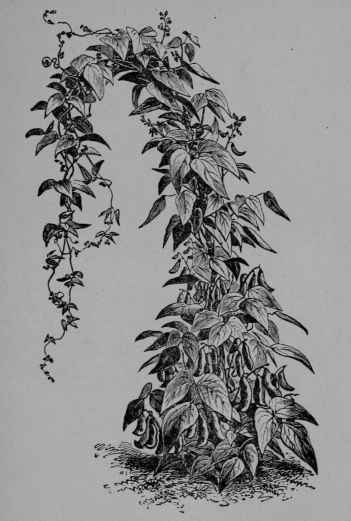
Fig. 40.-Lima Bean (Phaseolus lunatus, Pulse Family, Leguminosoe). Plant of a twining variety in flower and fruit x 1/12. (Vilmorin.)-The plant is an annual closely resembling the Kidney Bean except that the flowers are greenish white and the pods are broad, flattened, and curved like a scimitar.

Fig. 41.-Beet. (Beta vulgaris, Goose-foot Family, Chenopodiacece). Plant showing the appearance of the parts above ground at the end of its first year. X 1/5. (Original).-The leaves are smooth, green or more or less tinged with red; stem scarcely more than a "crown" covering the top of the swollen root which projects somewhat above the ground.

Fig. 42.-Beet. A plant in its second year, the underground parts cut vertically, to show the swollen root which is feeding with its store of nutriment the crown, which has given rise to several erect branches bearing leaves, flowers and fruit. (Original).-Plant, a biennial, i. e., requiring two years to complete its life, the first year storing up food which during the second year it uses to build flower-and fruit-bearing shoots; stem-branches, commonly deep red; flowers, greenish; fruit, dry, rough, and brown.

Fig. 43.-Beet. A, root. B, leaf. C, small flowering branch. D, a flower just opened. E, vertical section of a flower-bud showing a bract, (b), a layer of crystals in the ovary wall, k, and, nectar glands (d, d). E, stamen, back view. G, a flower the same as D but older. H, seed. J, the same cut in half, to show seed-coat and the germ coiled around the seed-food in the center. A-C, reduced, D-J variously enlarged. (Baillon, Volkens.)
Continue to:


My Books

