


Part 33. Nuts
Description
This section is from the book "Plants And Their Uses - An Introduction To Botany", by Frederick Leroy Sargent. Also available from Amazon: Plants And Their Uses; An Introduction To Botany
Part 33. Nuts
33. Nuts have, like grains, an edible kernel; but this is generally much larger than in any grain, and is moreover protected by a much thicker and harder shell. The chestnut (Figs. 24-26), the filbert (Fig. 23), the walnut (Fig. 27), the butternut (Fig. 28), the hickory-nut (Fig. 30), the pecan (Fig. 29), the almond (Fig. 31), the peanut (Fig. 33), the Brazil-nut (Fig. 32), and the coconut (Figs. 34-36), plainly agree in possessing the peculiarities named, although they differ considerably from one another.
In view of the fact that nuts possess such large edible kernels, and are some of them even richer than the cereals in proteid, the question naturally arises as to why, with us, nuts are so much less used for food than the grains. The many years which must often elapse between the time of planting and the fruit-yield, the much greater bulk in proportion to food-material which they occupy when stored, and the additional labor required for separating the nutritive from the inedible part, are doubtless the drawbacks which very largely account for the inferior rank of nuts in our market. With the exception of the chestnut, all we have mentioned contain an enormous proportion of oil. This, although of use as food, renders nuts more difficult of digestion than grains, and causes them to spoil with keeping after a comparatively short time.
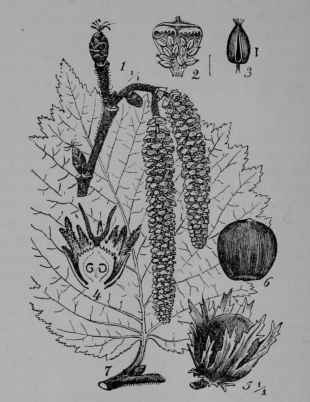
Fig. 23.-Filbert or Hazelnut (Corylus Avellana, Birch Family, Betulaceoe). 1, a twig bearing on the right two loose, hanging, yellowish flower-clusters consisting entirely of staminate flowers and their scale-like bracts, and on the left and at the tip, two pistillate flower-clusters enclosed by bracts and bud-scales which permit only the crimson stigmas to protrude (natural size). 2, a single staminate flower, viewed from below, showing the numerous stamens and the scale to which they are attached (enlarged, the vertical line at the right showing the natural size). 3, a single stamen (enlarged). a pistillate flower, cut vertically through the ovary, showing the two ovules (only one of which commonly ripens into a seed), the short style, and two stigmas which protrude beyond the bract-cup (enlarged). 5, the fruit, partially enclosed by the now leafy bract-cup. 6, the nut removed, showing the scar where it was attached at the base. (5 and 6, natural size.) (Wossidlo.)-The plant is a shrub or small tree1 3-10 m. tall, much branched; twigs ash-colored, sticky-hairy; bark on older stems mottled bright brown and gray; leaves downy below; nuts brown.
1 Shrubs and trees are distinguished from herbs by having woody stems above ground which live from year to year. A tree is a self-supporting woody plant which becomes several times taller than a man, and forms a single main trunk. A shrub differs from a tree in being usually of less height and having many well-developed branches starting from near the ground in place of a main trunk.

Fig. 24.-Chestnut (Castanea sativa, Beech Family, Fagaceoe). A leafy twig, bearing flower-clusters composed mostly of yellowish, staminate flowers with a few greenish pistillate flowers near the base. About one-quarter natural size. (Baillon.)-The plant is one of the largest forest trees of the north temperate zone, sometimes in forests attaining a height of 30 m. Bark, on the trunk and older branches, dark, very hard, and with long deep clefts; when younger smooth and lighter colored; young twigs deep green, bronzed or purplish brown, covered with whitish dots. Leaves, polished, bright green above, smooth and paler below.
In spite of their disadvantages, however, chestnuts, walnuts, and peanuts form a very important part of the food of many Europeans, largely taking the place of cereals. In many tropical regions where cereals do not grow, immense quantities of peanuts and Brazil-nuts are eaten, while in some places the coconut constitutes the chief, sometimes almost the only, food. The importance of nuts, to mankind, therefore, is much greater than we commonly suppose, considering that with us they are used scarcely more than as luxuries.
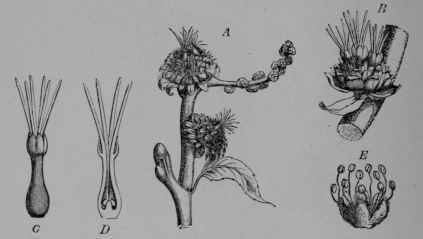
Fig. 25.-Chestnut. A, twig bearing two clusters of pistillate flowers, and a small immature cluster of staminate flowers. B, a single cluster of three pistillate flowers protruding from among the bracts which form a cup around them. C, a single pistillate flower, showing six elongated stigmas and a bell-shaped calyx of six sepals formed above the ovary. D, the same, cut vertically to show the ovules at the base of the flask-shaped ovary. E, a single staminate flower, showing the numerous stamens surrounded by the calyx of six sepals joined at the base. The figures all somewhat enlarged. (Baillon.)
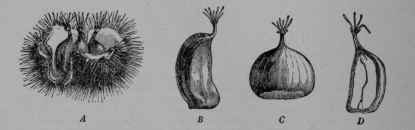
Fig. 26.-Chestnut. A, ripe fruit, showing the now spiny bract-cup or "burr" split open and exposing three nuts within. Reduced. B, one of the side nuts, showing at the tip the stigmas and calyx. About two-thirds natural size. C, the middle nut, showing the scar of attachment at base. D, a side nut, cut vertically to show the seed within containing a large embryo gorged with starchy food. (Baillon.)
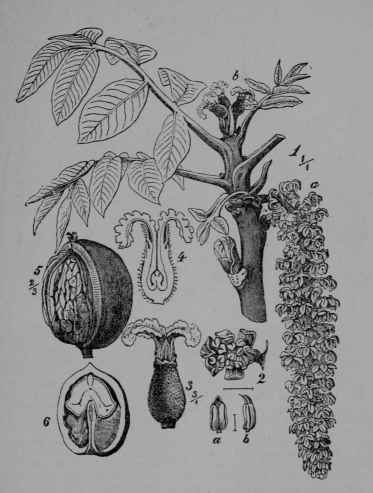
Fig. 27.-Walnut (Juglans regia, Walnut Family, Juglandaceoe). 1, a spring shoot bearing young leaves; at a, a staminate flower-cluster, and at b, a cluster of three pistillate flowers. 2, a single staminate flower viewed from below, showing the numerous stamens, and three sepals and three bracts which cover them above; a, inner view of a single stamen; b, the same in side view. 3, a single pistillate flower, showing the two spreading stigmas protruding beyond the small calyx, which crowns the ovary. 4, the same cut vertically, showing the single ovule at the base. J, a fruit with part of the husk removed, showing the rough-shelled nut within. 6, nut cut in half vertically, showing half of the four-lobed seed or "meat," within. (Wossidlo.)-The plant is a handsome, widely spreading tree attaining a height of 20 m. Bark soon becoming thick and much cracked. Leaves smooth, dull green, bronzy to yellowish. Flowers greenish. Fruit-hull, green turning black. Wind carries the pollen from tree to tree.
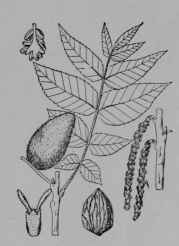
Fig. 28.-Butternut (Juglans cinerea, Walnut Family, Juylandaceoe). A twig in autumn bearing a single leaf and a ripe fruit. Twig, in spring bearing two staminate flower-clusters. A single staminate flower viewed from above. A pistillate flower showing the two protruding stigmas. A nut removed from its husk, showing the deeply sculptured shell. The flowers, enlarged; the other parts reduced. (Britton and Brown.)- The plant is a forest tree becoming sometimes 30 m. tall; old bark roughish, gray; young twigs and leaves sticky-hairy; flowers brownish green; stigmas red; fruit green turning to brown, covered thickly with very sticky hairs, nut blackish.
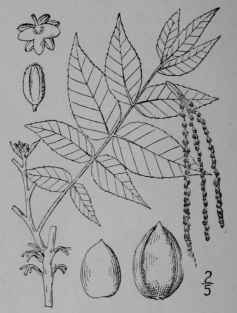
Fig. 29.-Pecan (Carya olivoeformis, Walnut Family, Juglandaceoe). Twig in spring after removal of all the leaves but one and all the staminate flower-clusters below it except the lower part of their stalks. At the tip of the twig is the small cluster of pistillate flowers. Three-branched staminate flower-cluster. Staminate flower, top view. Stamen. Fruit. Nut, after removal of the husk. Flower and stamen, enlarged. (Britton and Brown.)-The plant is a large slender tree, becoming 50 m. tall; bark somewhat rough; young twigs and leaves hairy; mature foliage nearly smooth; flowers greenish; fruit brownish green; nut light brown.
The native home of the various nuts and of other food-plants, the length of time they have been cultivated, and certain other matters of related interest, will be discussed at the end of this chapter.
Continue to:


My Books

